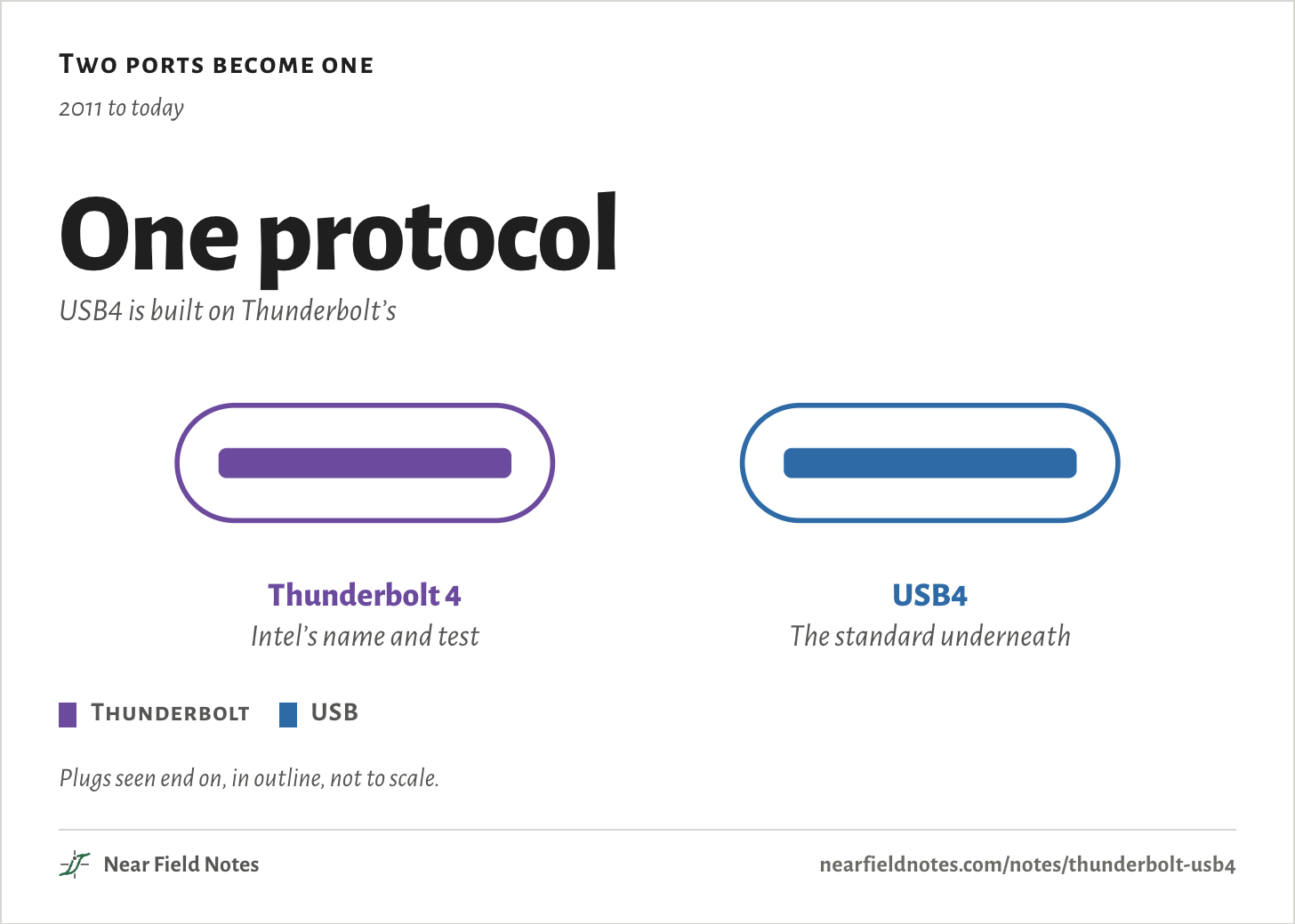
Because USB4 is built on Thunderbolt. In 2011 they were two different ports with two different plugs. On 4 March 2019 Intel gave the Thunderbolt protocol to the USB group, royalty-free, and the group announced USB4 the same day. Today Thunderbolt is a name and a test that Intel owns. The standard underneath is USB4.
Two ports become one
2011 to today
Thunderbolt
USB
Plugs seen end on, in outline, not to scale.
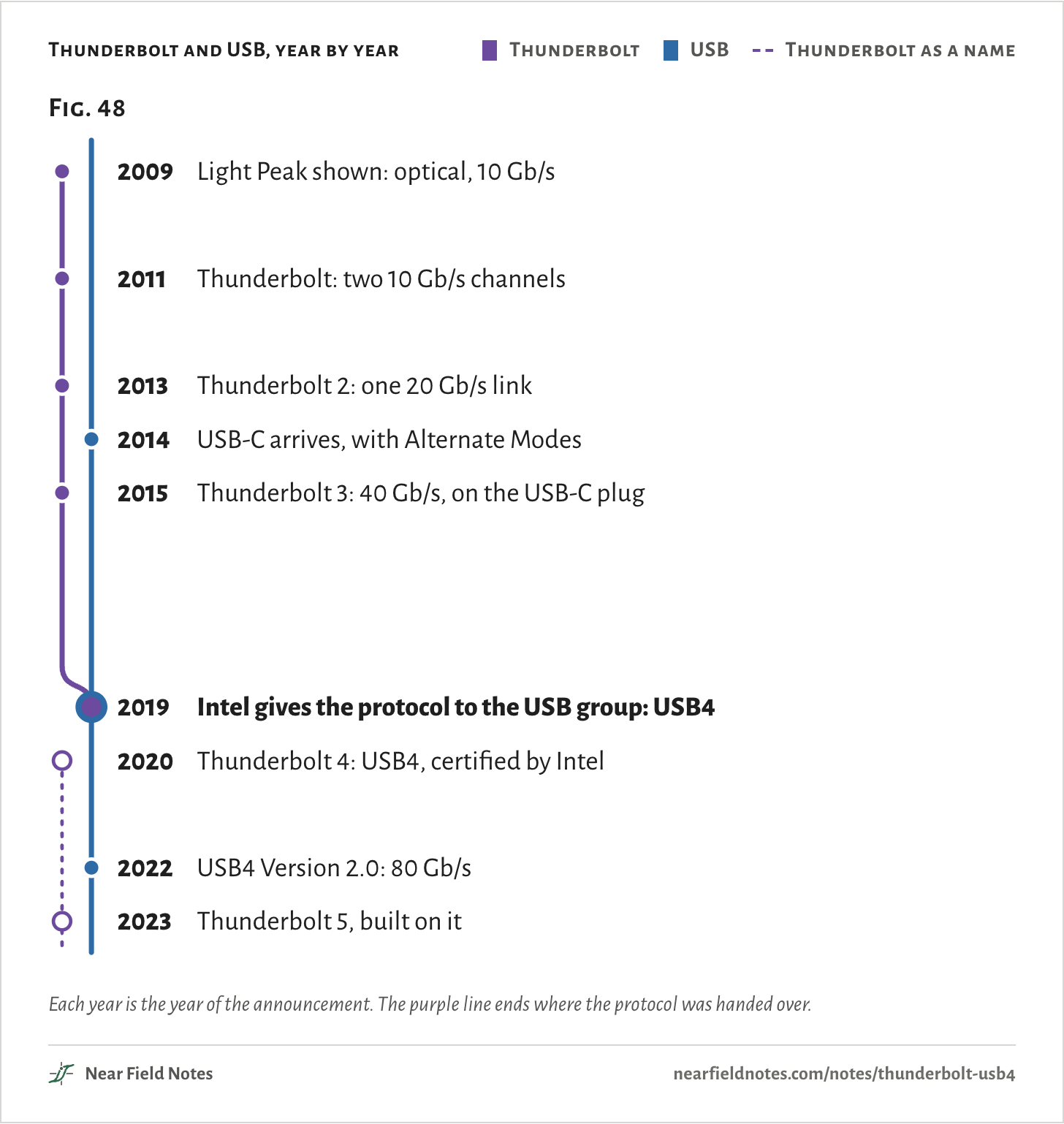
Two lines that became one
2009 to 2023
Thunderbolt began as Intel’s own fast port. USB was the free port that every computer had. For ten years they were separate, and then one was built on the other.
Each year is the year of the announcement. The purple line ends where the protocol was handed over.
Thunderbolt on its own
2009 to 2013
Intel first showed it on 23 September 2009 as Light Peak, an optical cable at 10 Gb/s. It shipped on 24 February 2011 as Thunderbolt, on copper, using the Mini DisplayPort plug.
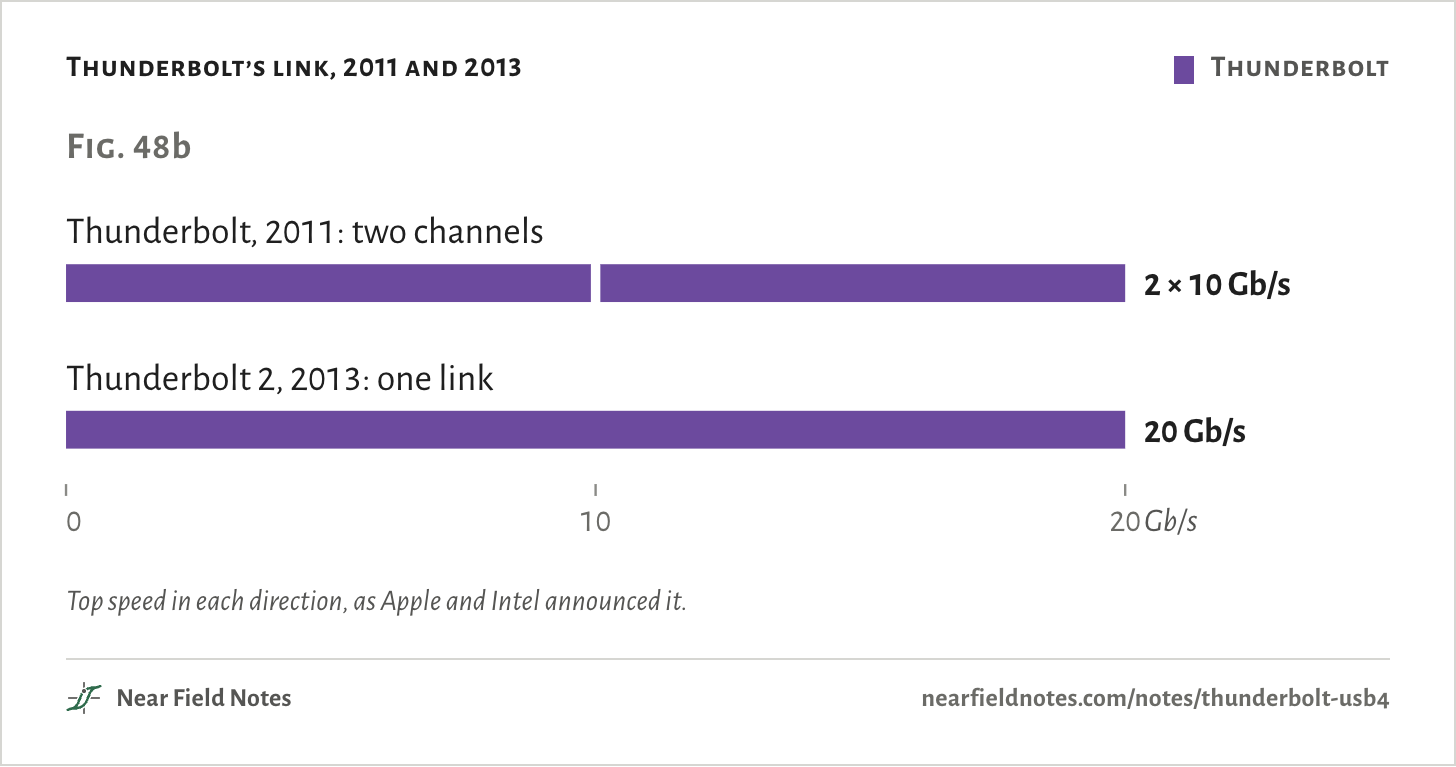
Thunderbolt’s link, 2011 and 2013
Thunderbolt
Top speed in each direction, as Apple and Intel announced it.
480
Thunderbolt and Thunderbolt 2
Two channels, then one link
Field marks. Thunderbolt carried PCI Express for data and DisplayPort for screens, on two channels of up to 10 Gb/s each.
Look-alike. The port had the shape of a Mini DisplayPort socket, because it used that plug.
Range. Thunderbolt 2, named on 4 June 2013, joined the two channels into one 20 Gb/s link. It kept the same cables and the same plug.
Habitat. The 2011 port and its cables were copper. Intel’s own description allowed optical cables as well.
481
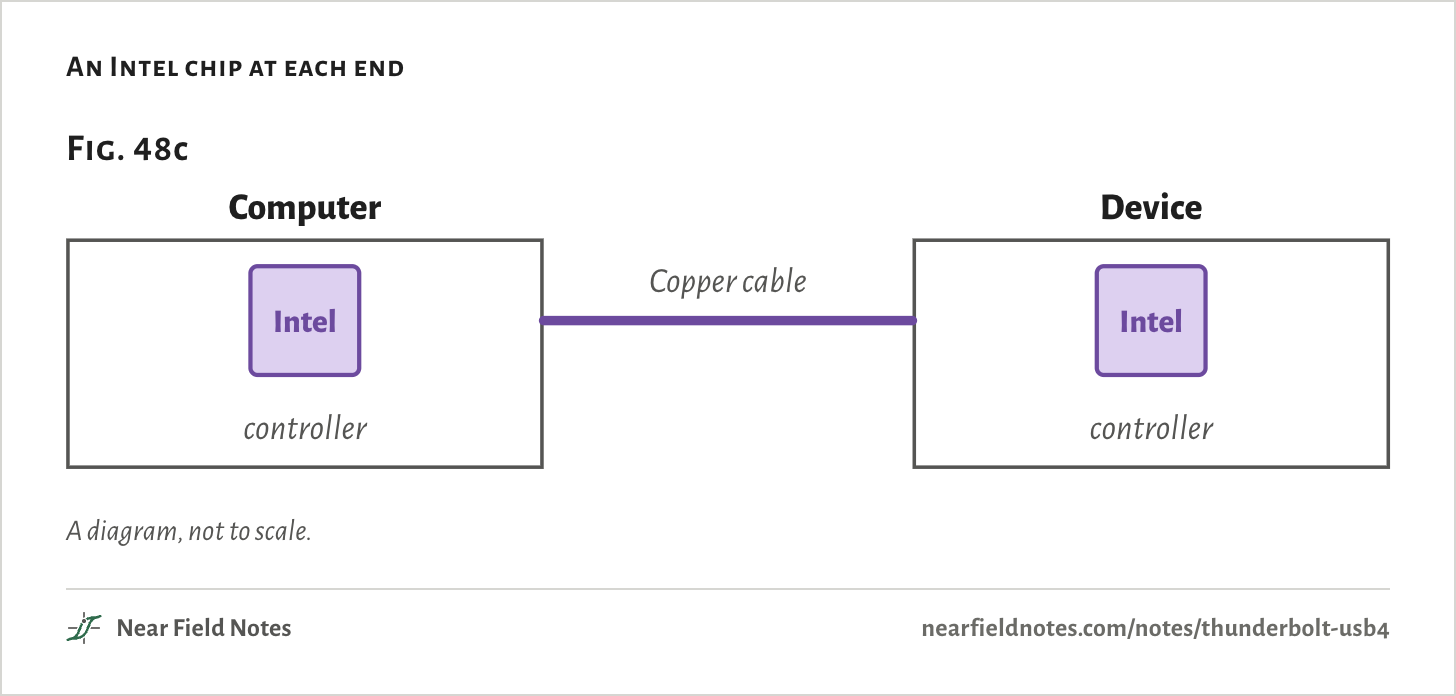
One thing stayed the same through both versions. Thunderbolt needed an Intel controller chip at both ends of the cable: one in the computer and one in the device.
An Intel chip at each end
A diagram, not to scale.
Onto the USB-C plug
2014 and 2015
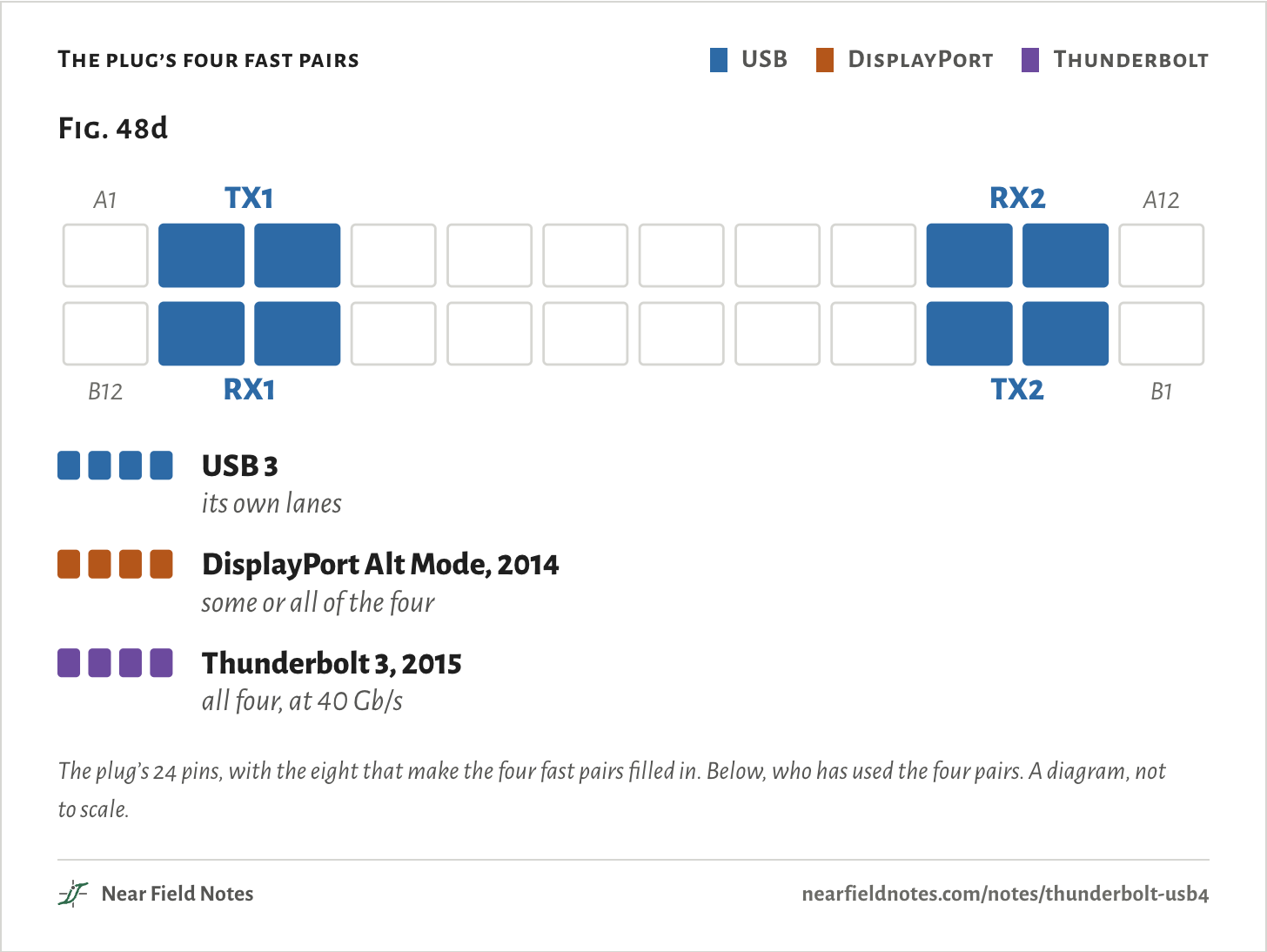
Then USB-C arrived. Its specification of August 2014 had a feature called Alternate Mode: another standard could take over the fast wires in the cable.
The plug’s four fast pairs
USB
DisplayPort
Thunderbolt
The plug’s 24 pins, with the eight that make the four fast pairs filled in. Below, who has used the four pairs. A diagram, not to scale.
482
Alternate Mode
Four fast pairs that another standard can use
Field marks. The plug has 24 pins. Eight of them make four fast pairs: TX1, TX2, RX1 and RX2.
Look-alike. A port that offers an Alternate Mode is still a USB port. The specification says every USB-C host and device has to offer USB as well. Chargers are the one exception.
Range. DisplayPort went first. VESA announced its Alternate Mode on 22 September 2014, using some or all of the four pairs. On 2 June 2015 Intel announced Thunderbolt 3: Thunderbolt on the USB-C plug, at 40 Gb/s.
Habitat. The two ends agree on a mode with USB Power Delivery messages before the pairs change hands. Every mode the plug can enter is in the note on USB-C alt modes.
483
One plug, very different ports
2015 and 2016
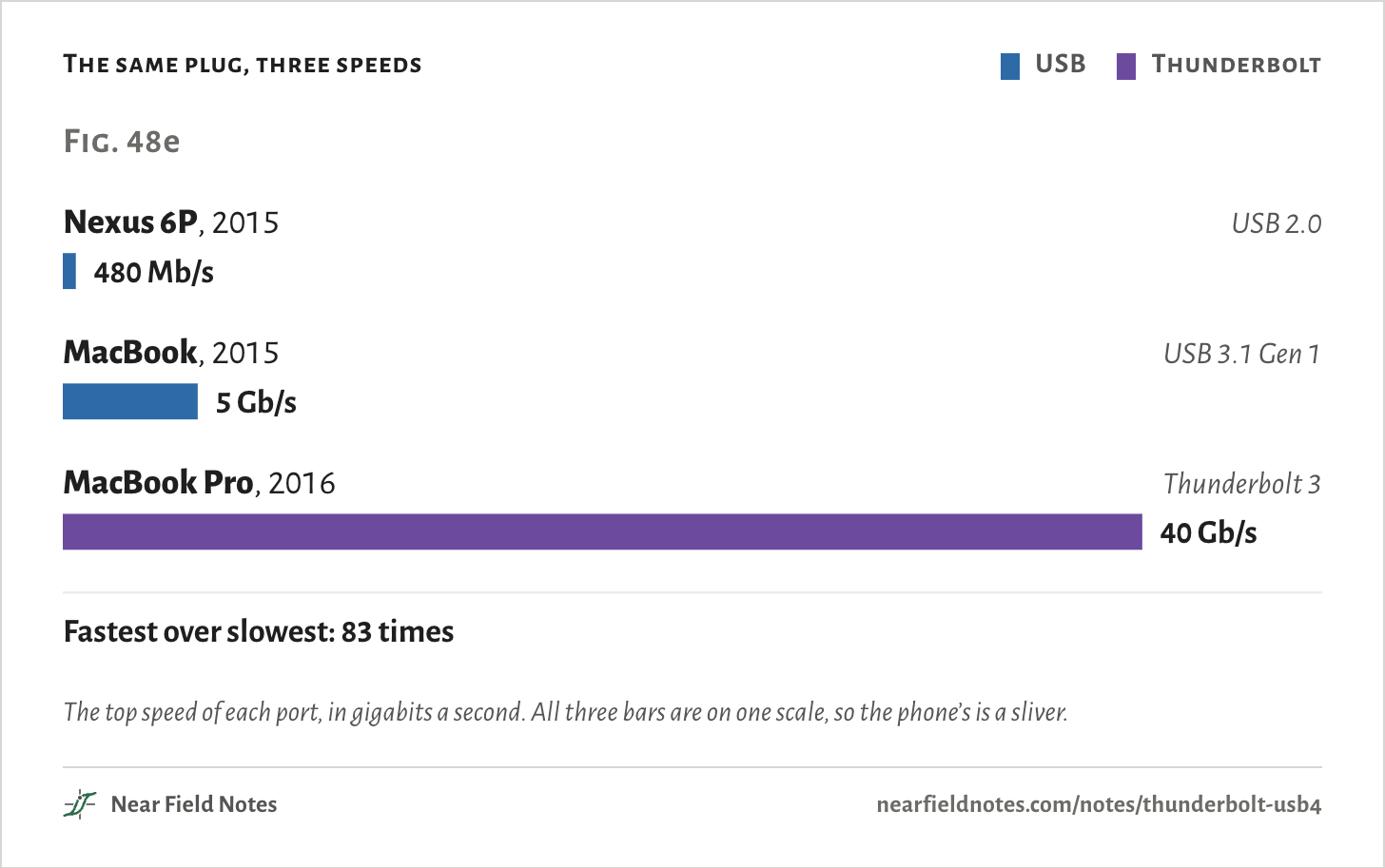
So one plug now meant very different ports. Three devices from those two years show how far apart they were.
On Google’s Nexus 6P phone the plug was USB 2.0. That is 480 Mb/s, the speed USB reached in the year 2000.
On Apple’s 2015 MacBook it was 5 Gb/s, with no Thunderbolt. On the 2016 MacBook Pro it was Thunderbolt 3, at 40 Gb/s.
Same shape, and 83 times apart in speed.
The same plug, three speeds
USB
Thunderbolt
The top speed of each port, in gigabits a second. All three bars are on one scale, so the phone’s is a sliver.
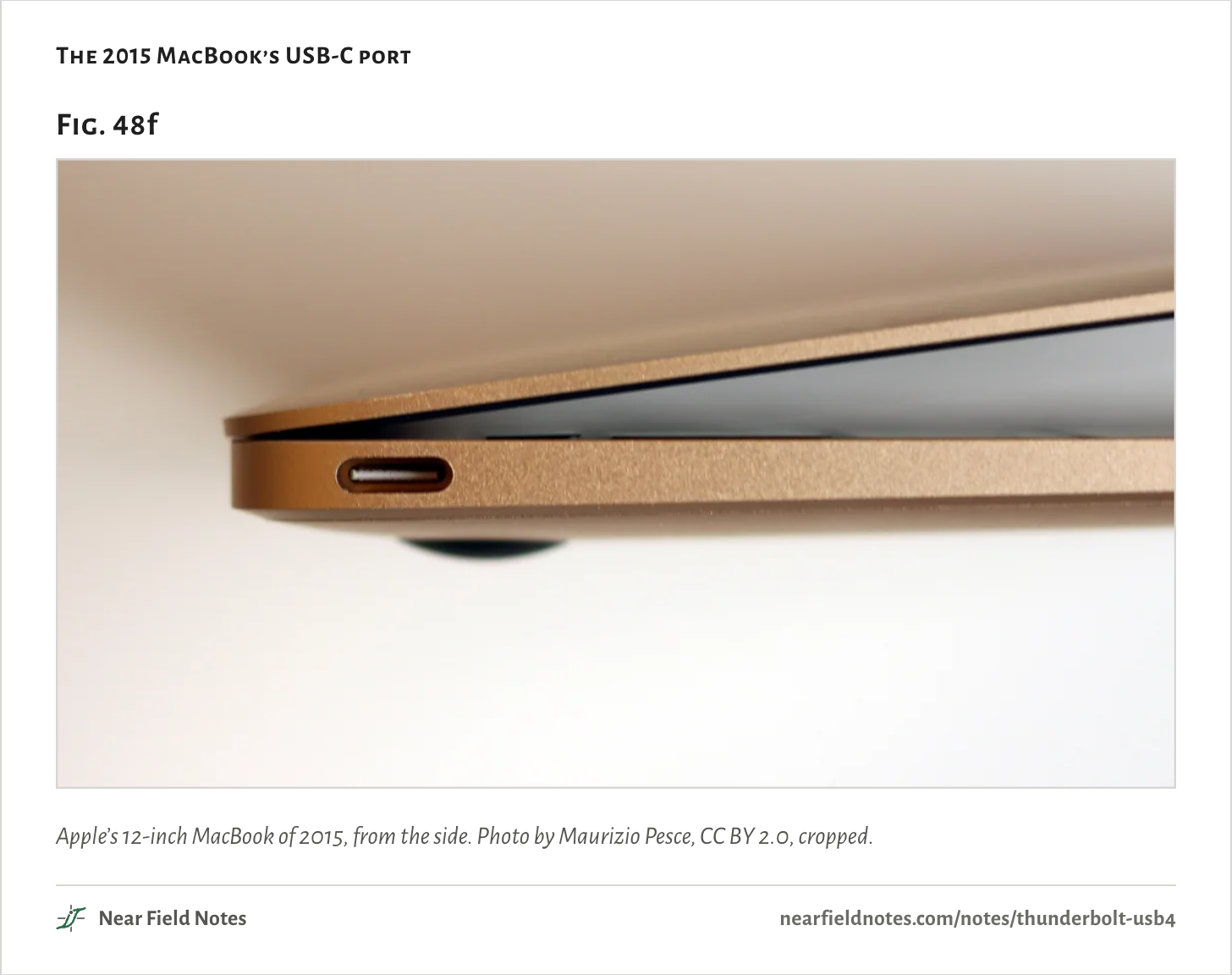
This is the 2015 MacBook’s one port. The oval is the same on all three devices, and nothing about its shape says which speed is behind it.
At 40 Gb/s the board behind the port has work to do as well. The note on retimers and redrivers covers that.
The 2015 MacBook’s USB-C port
Apple’s 12-inch MacBook of 2015, from the side. Photo by Maurizio Pesce, CC BY 2.0, cropped.
Intel opens it up
2017 to 2019
On 24 May 2017 Intel announced two plans. It would build Thunderbolt 3 into its own processors. And it would release the protocol to the industry, royalty-free, so other chip makers could build it.
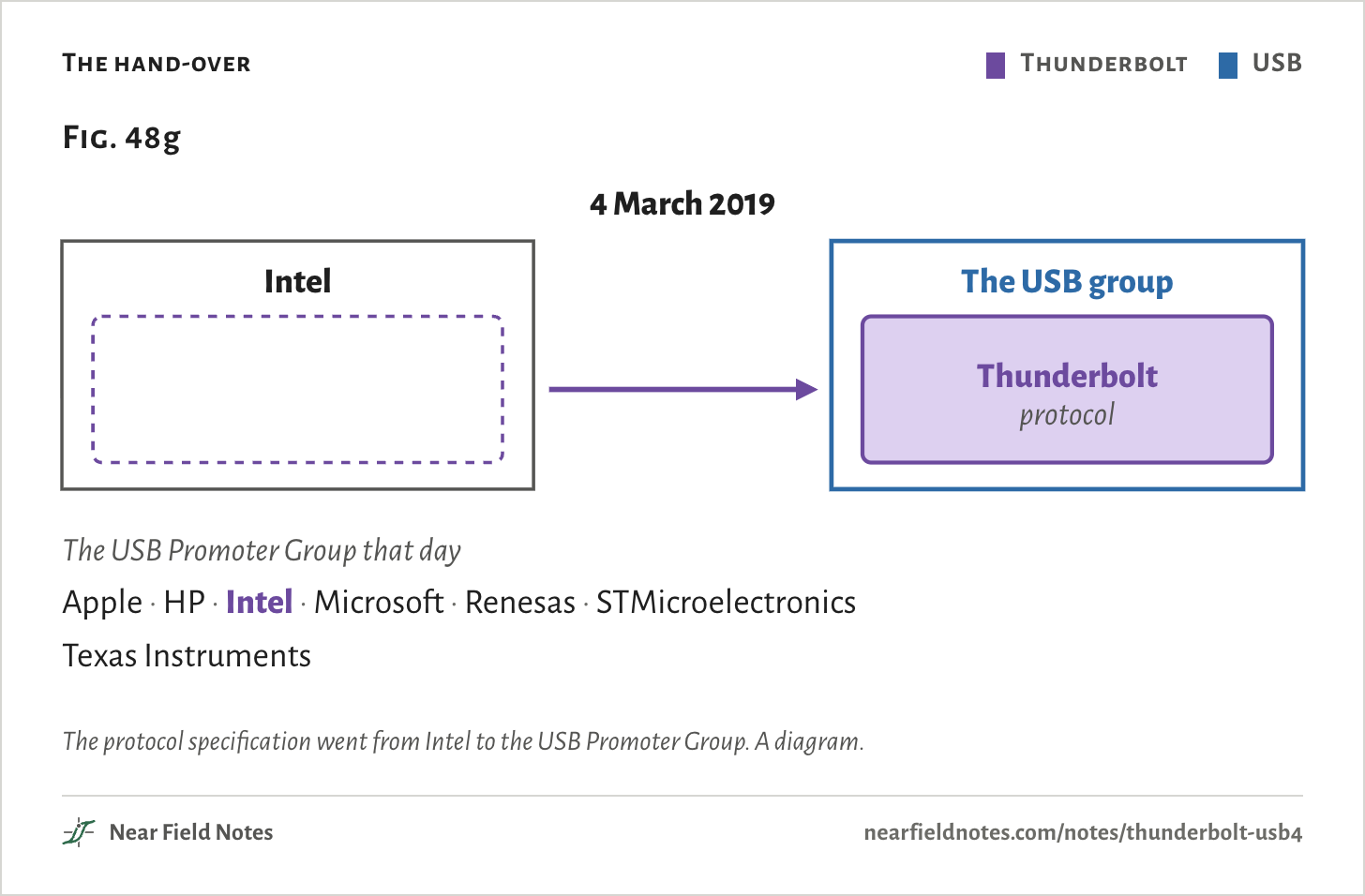
The hand-over
Thunderbolt
USB
The protocol specification went from Intel to the USB Promoter Group. A diagram.
484
The hand-over
The protocol goes to the USB group
Field marks. On 4 March 2019 Intel said it had contributed the Thunderbolt protocol specification to the USB Promoter Group, royalty-free.
Look-alike. The same day the group announced USB4, and said it was based on the Thunderbolt protocol specification that Intel had just contributed.
Range. The group had seven companies by then, and Apple was one of them.
Habitat. USB4 Version 1.0 was published on 3 September 2019. Its cover says August 2019.
485
USB4 and Thunderbolt 4
2019 and 2020
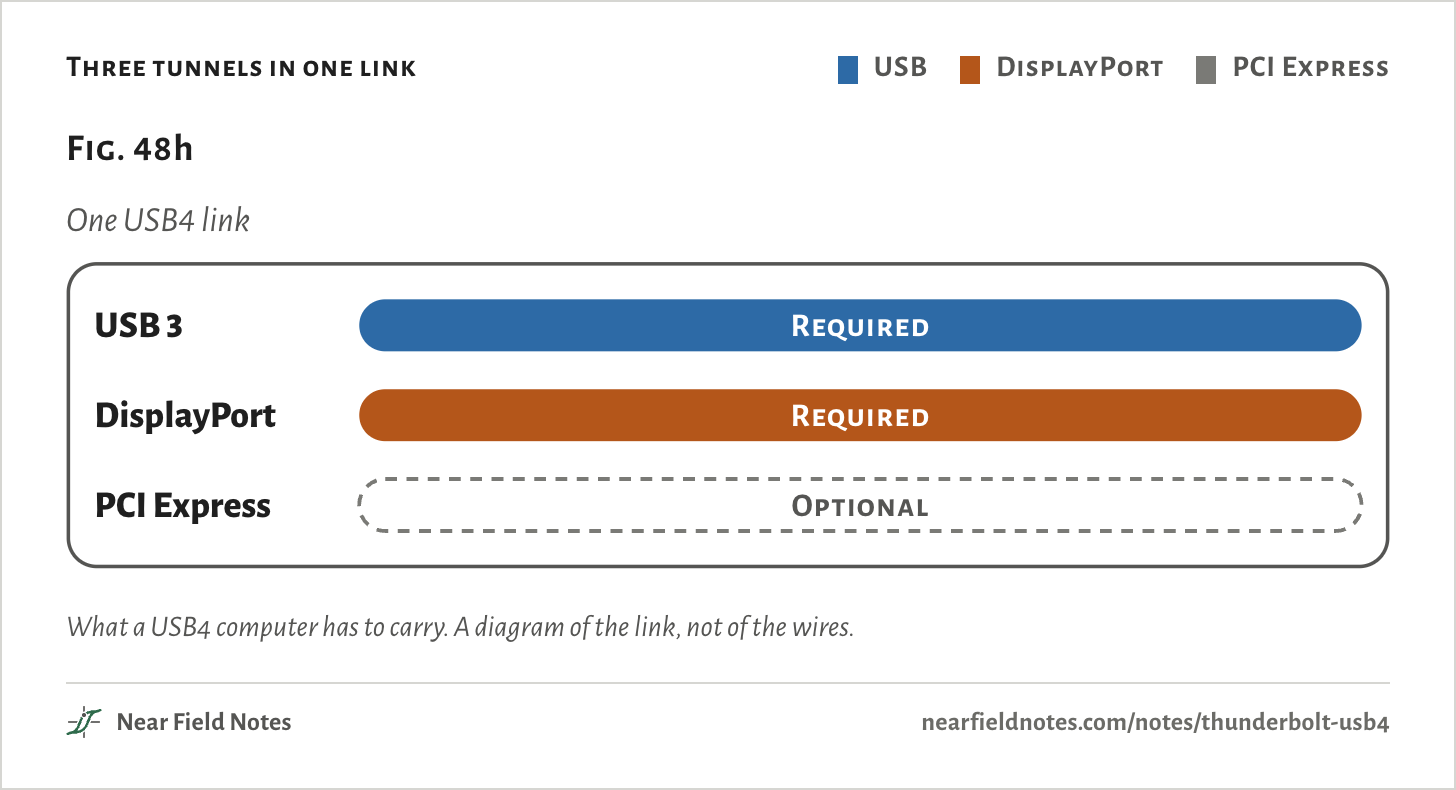
USB4 works the way Thunderbolt does. It tunnels USB 3, DisplayPort and PCI Express through one link. But a USB4 computer only has to do the first two.
PCI Express, the full 40 Gb/s, and working with Thunderbolt 3 devices are all optional for a USB4 computer. A USB4 hub or dock has to do all of them.
So two computers can both say USB4 and differ. One may run at 20 Gb/s with no PCI Express. The other may do everything.
Three tunnels in one link
USB
DisplayPort
PCI Express
What a USB4 computer has to carry. A diagram of the link, not of the wires.
Required or optional
Fig. 48i
What the port does
USB4 computer
USB4 hub or dock
Thunderbolt 4 computer
USB 3 tunneling
Required
Required
Required
DisplayPort tunneling
Required
Required
Required
PCI Express tunneling
Optional
Required
Required
40 Gb/s
Optional
Required
Required
Works with Thunderbolt 3 devices
Optional
Required
Required
From USB4 Version 1.0 and Intel’s Thunderbolt 4 announcement of 8 July 2020.
486
Thunderbolt 4
USB4 with the bar raised
Field marks. Thunderbolt 4, announced on 8 July 2020, makes those three options required. Its lowest speed is 40 Gb/s, where USB4’s is 20. Its PCI Express runs at 32 Gb/s, twice Thunderbolt 3’s minimum of 16.
Look-alike. A USB4 port and a Thunderbolt 4 port use the same plug and the same protocol. Intel says Thunderbolt 4 complies with the USB4 specification.
Range. Intel adds rules of its own: two 4K displays, charging on at least one port of a thin laptop, and waking the computer from a dock. Every product has to pass Intel’s certification.
Habitat. Thunderbolt is Intel’s trademark. The USB4 specification says a product may carry it only after certification and a license.
487
So today Thunderbolt is a name and a test that Intel owns. The standard underneath is USB4.
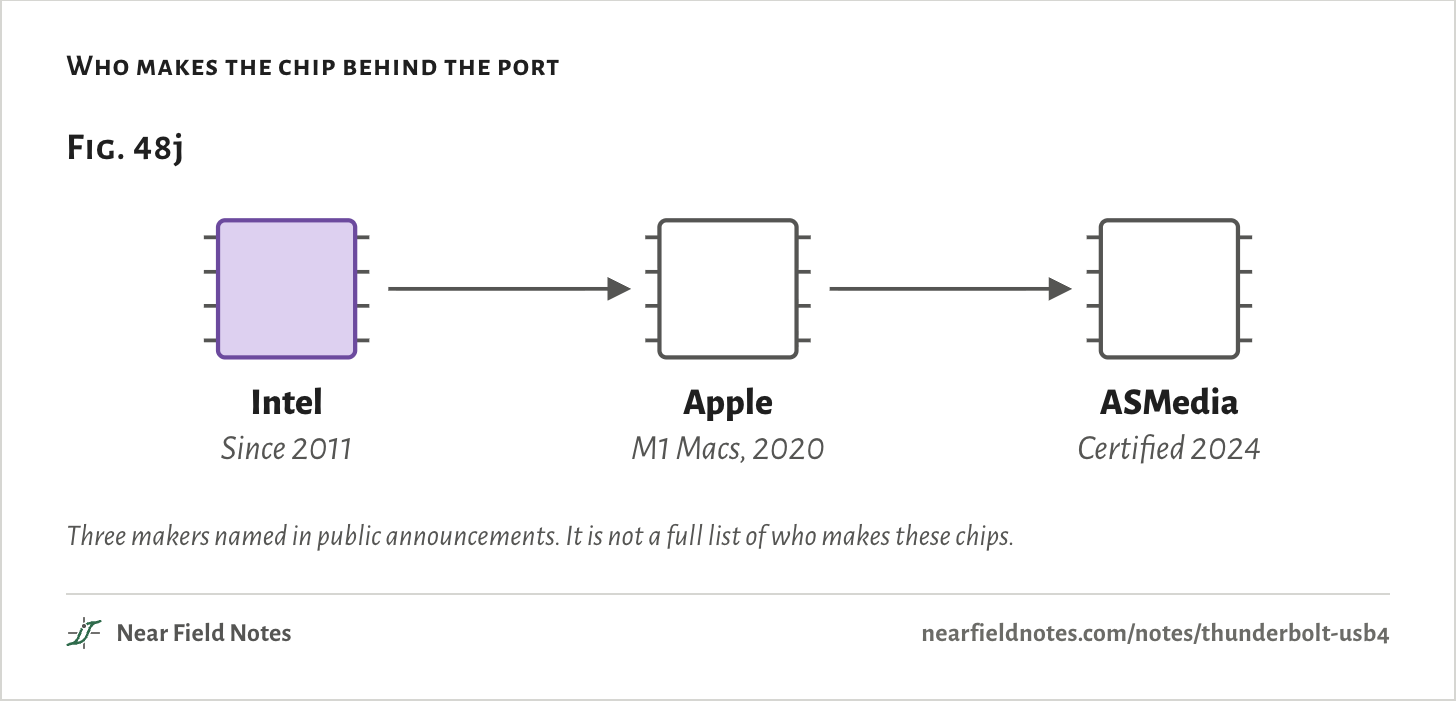
The chip behind the port can now come from someone else. Apple designed its own controller for the M1 Macs, announced on 10 November 2020. ASMedia said on 29 August 2024 that its ASM4242 had passed Thunderbolt 4 certification.
Who makes the chip behind the port
Three makers named in public announcements. It is not a full list of who makes these chips.
The fast port, made free
1999 and 2019
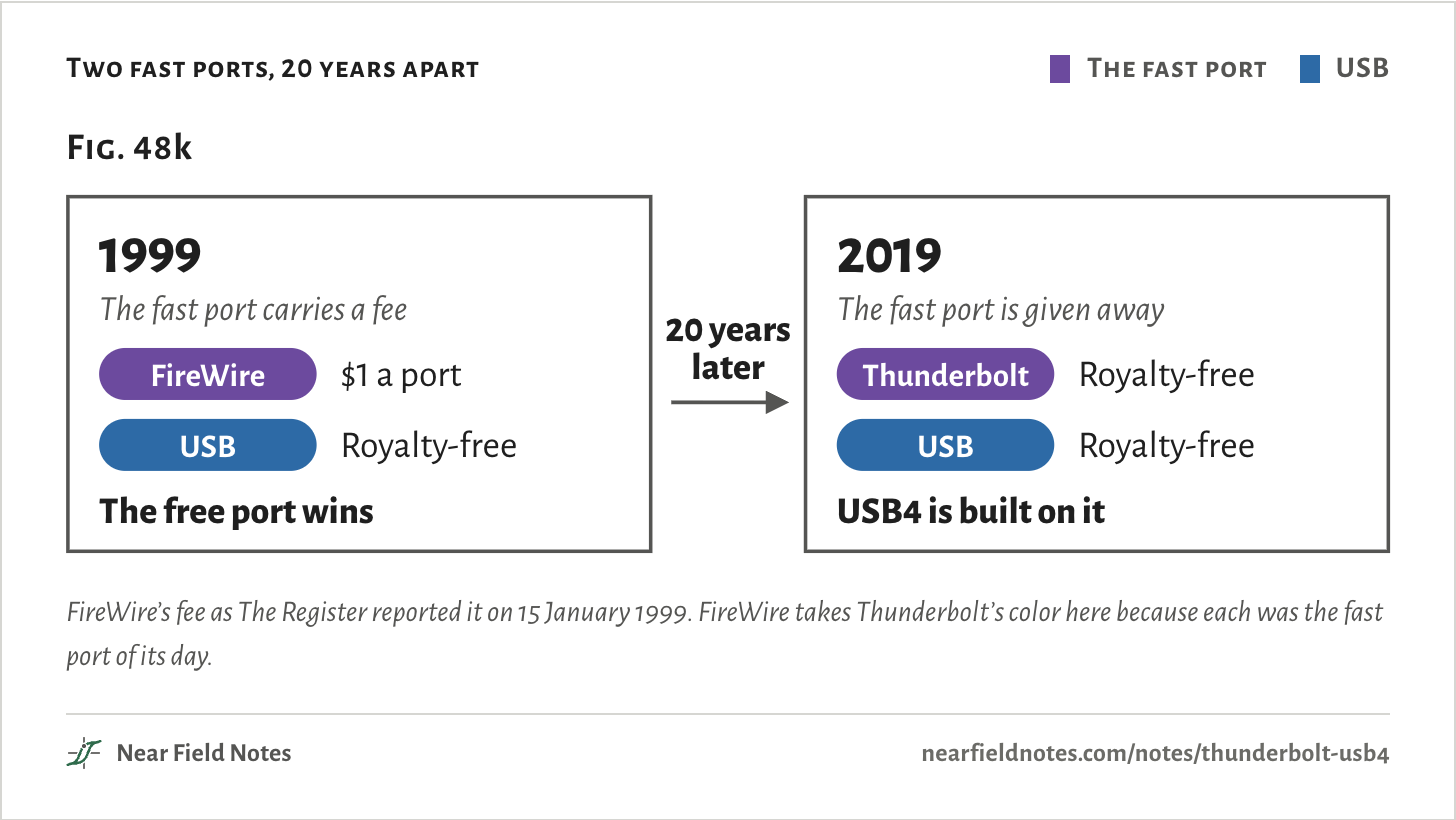
This series began with another fast port. In 1999 FireWire was the fast one, it carried a fee, and the free port beat it.
The fee was reported at $1 a port. USB had none. That story is the first note of this series, on FireWire and USB.
20 years later Intel made its fast port free, and the next USB was built on it.
Two fast ports, 20 years apart
The fast port
USB
FireWire’s fee as The Register reported it on 15 January 1999. FireWire takes Thunderbolt’s color here because each was the fast port of its day.
The plug keeps growing
2021 to 2024
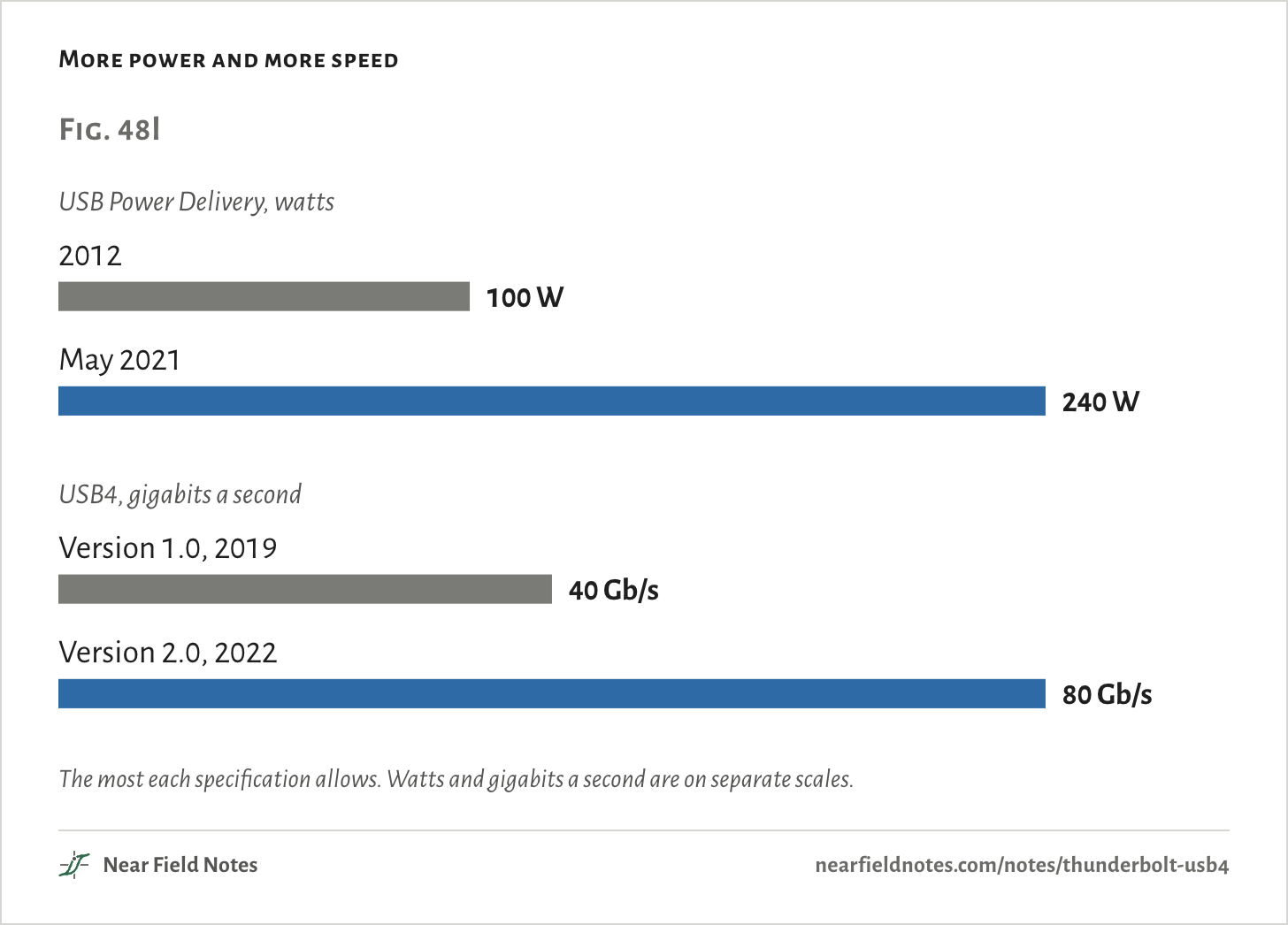
The plug stayed the same and what it carries kept growing. The USB group raised Power Delivery from 100 W to 240 W on 26 May 2021. USB4 Version 2.0, published on 18 October 2022, reached 80 Gb/s.
More power and more speed
The most each specification allows. Watts and gigabits a second are on separate scales.
488
USB-C by law
The required charging port in the European Union
Field marks. Directive (EU) 2022/2380, dated 23 November 2022, makes USB-C the required charging port. It has applied to phones, tablets, cameras, headphones and similar devices since 28 December 2024, and to laptops since 28 April 2026.
Look-alike. Thunderbolt 5, announced on 12 September 2023, is built on USB4 Version 2.0.
Range. On 12 September 2023, eleven years to the day after it announced Lightning, Apple announced the first iPhones with USB-C.
Habitat. The iPhone 15’s port runs at USB 2 speed. That is 480 Mb/s again, the same as the Nexus 6P eight years before. The iPhone 15 Pro reaches 10 Gb/s with a USB 3 cable.
489
The story in dates
1987 to 2024
So that is why they are the same thing. Intel gave Thunderbolt’s protocol away, and USB4 was built on it.
This note in dates
2009Intel shows Light Peak, an optical cable at 10 Gb/s
2011Thunderbolt ships, on copper, with the Mini DisplayPort plug
2013Thunderbolt 2: one 20 Gb/s link
2014USB-C arrives, and DisplayPort is its first Alternate Mode
2015Thunderbolt 3 moves onto the USB-C plug, at 40 Gb/s
2017Intel says it will release the protocol, royalty-free
2019Intel gives the protocol to the USB group, and USB4 is announced
2020Thunderbolt 4, and Apple’s own controller in the M1 Macs
2021USB Power Delivery reaches 240 W
2022USB4 Version 2.0 at 80 Gb/s, and the European Union’s directive
2023Thunderbolt 5, and the first iPhones with USB-C
2024USB-C is the required charging port for phones in the European Union
490
The series
From one fast bus to one plug, 37 years
Field marks. Work on what became FireWire began in 1987. In 2024 one plug became the required charging port for phones across the European Union. That is 37 years.
Look-alike. The fast port and the free port were rivals for most of that time. They are now one protocol under two names.
A specification is written by people. USB4 Version 1.0 credits 513 engineers from 81 companies.
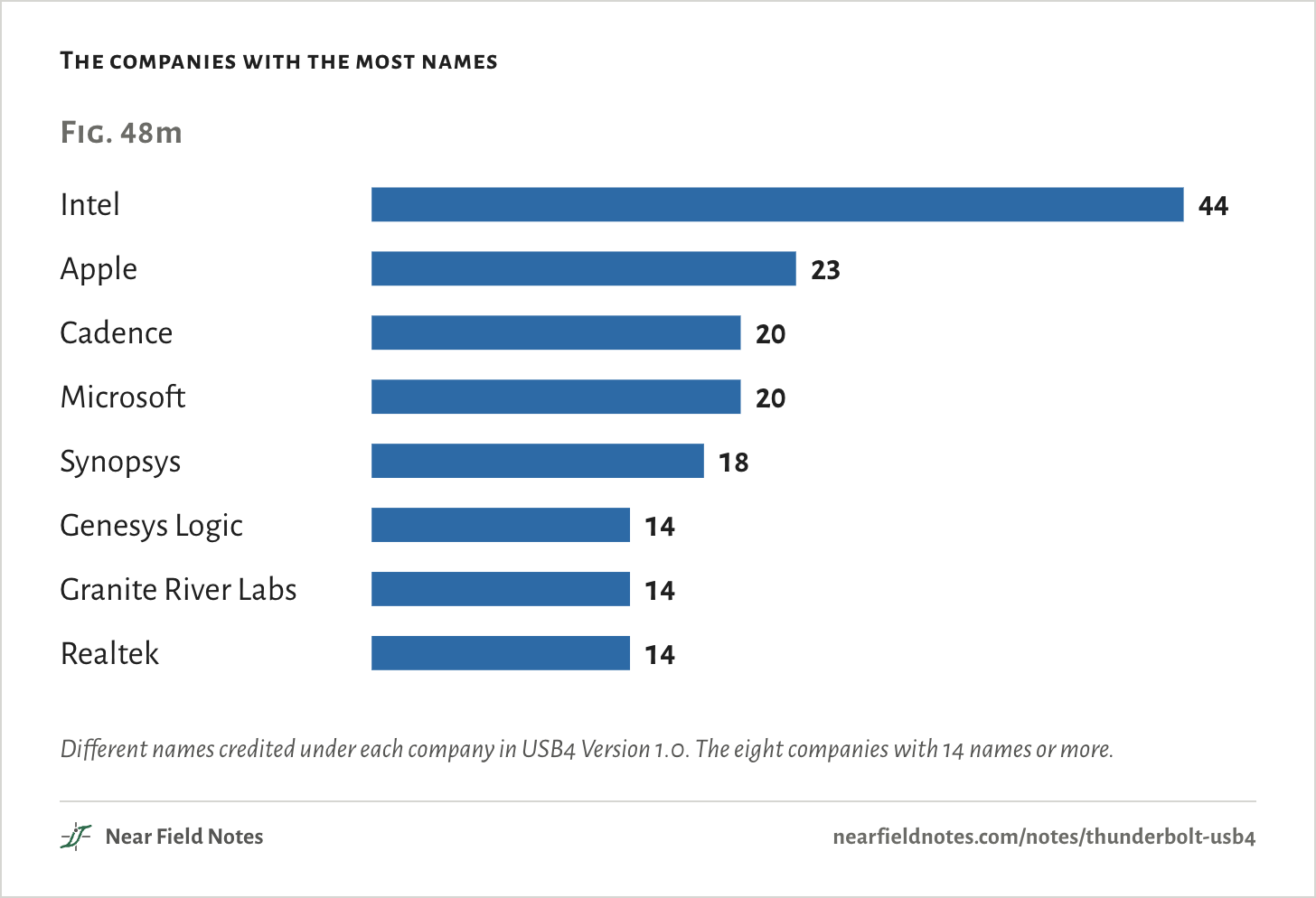
Intel has the most names, with 44. Apple has 23. Half of the 81 companies have four names or fewer.
The whole list is below, as the specification prints it: the promoter companies first, then the contributor companies from A to Z. Roles are left off.
The companies with the most names
Different names credited under each company in USB4 Version 1.0. The eight companies with 14 names or more.
All 513 names, by company
The engineers credited in the USB4 Specification, Version 1.0, August 2019, as printed.
Promoter companies
Apple Inc.
Nimrod Agmon
Lior Aloni
Brian Baek
Omer Bar-Lev
Moshe Benyamini
Gopu Bhaskar
Carlos Calderon
David Conroy
Bill Cornelius
Scott Deandrea
William Ferry
Itay Franko
Mark Goikhman
Scott Jackson
Alan Kobayashi
Alexei Kosut
Christine Krause
Collin Pieper
Reese Schreiber
Etan Shirron
Jose Tierno
Jeff Wilcox
Dan Wilson
Hewlett-Packard Inc.
Roger Benson
Marcus Benzel
Alan Berkema
Kenneth Chan
Frank Chen
Phil Chen
Hosup Chung
Glen Dower
Mark Lessman
Nam Nguyen
Roger Pearson
Kenneth Smith
Chris Tabarez
Intel Corporation
Ansari Nausheen
Alexandre Audier
Binata Bhattacharyya
Huimin Chen
Hengju Cheng
Salauddin Choudhury
John Crouter
Jhuda Dayan
Saranya Gopal
Venkataramani Gopalakrishnan
Raul Gutierrez
Michael Gouzenfeld
Mickey Gutman
Benjamin Hacker
Yaniv Hayat
Uri Hermoni
Abdul Ismail
Abhilash K V
Ziv Kabiry
Vijaykumar Kadgi
Vijay Kasturi
Lev Kolomiets
Edmond Lau
Yun Ling
Guibin Liu
Balaji Manoharan
Uma Medepalli
Assaf Mevorach
Naod Negussie
CheeLim Nge
Duane Quiet
Rajaram Regupathy
Reuven Rozic
Oren Salomon
Zeeshan Sarwar
Brad Saunders
Ehud Shoor
Einat Surijan
Karthi Vadivelu
Chen Vrubel
Stephanie Wallick
Tzewen Wang
Gal Yedidia
Vladimir Yudovich
Microsoft Corporation
Randy Aull
Jim Belesiu
Martin Borve
Anthony Chen
Jesse Chen
Matt Chung
Aacer Daken
Rajib Dutta
Mark Friend
Philip Froese
David Hargrove
Robbie Harris
Kit Hui
Toby Nixon
Rahul Ramadas
Andrea Severson
Kiran Shastry
Nathan Sherman
Ji Sun
Shyamal Varma
Renesas Corporation
Tam Do
Robert Dunstan
Philip Leung
Kiichi Muto
Ziba Nami
Hajime Nozaki
Raman Sargis
Yoshiyuki Tomoda
Starry Tsai
Jia Wei
Toshifumi Yamaoka
STMicroelectronics
Nathalie Ballot
Joel Huloux
Gerard Mas
Texas Instruments
Mike Campbell
Anant Gole
Craig Greenburg
Michael Koltun IV
Sai Karthik Rajaraman
Anwar Sadat
Cory Stewart
Sue Vining
Deric Waters
Gregory Watkins
Contributor companies
ACON, Advanced-Connectek, Inc.
Victory Chen
Conrad Choy
Vicky Chuang
Jessica Feng
Sharon Hsiao
Wayne Wang
Advanced Micro Devices
Dennis Au
Nat Barbiero
Jason Chang
Michael Comai
Walter Fry
Will Harris
Jason Hawken
Jim Hunkins
Ling Kong
Scott Ogle
Victor Salim
Joseph Scanlon
Peter Teng
Allion Labs, Inc.
Howard Chang
Casper Lee
Brian Shih
Analogix Semiconductor, Inc.
Greg Stewart
Haijian Sui
Yueke Tang
Ning Zhu
Anritsu Corporation
Wataru Aoba
John Jerico Custodio
Kazuhiro Fujinuma
Hiroshi Goto
Alessandro Messina
Tadanori Nishikobara
Ryo Sunayama
Toshihiro Suzuki
Mitsuhiro Usuba
Takeshi Wada
ASMedia Technology Inc.
Chang Chinyu
Chang Weiyun
Chen Chiahsin
Chen Chunhung
Chuang Weber
Kuo Han Sung
Lin Curtis
Lin ShuYu
Tseng PS
Tseng YD
Wei Daniel
Wu ShengChung
Avery Design Systems, Inc.
Chris Browy
Chilai Huang
Zhihong Zeng
BitifEye Digital Test Solutions GmbH
Sebastian Muschala
Hermann Stehling
Bizlink Technology, Inc.
Alex Chou
Morphy Hsei
Kevin Tsai
Cadence Design Systems, Inc.
Marcin Behrendt
Jacek Duda
Shikha Gupta
Gaurav Jain
Poonam Khatri
Yash Kothari
Vinod Lakshman
Shivaji Magadum
Andy Mauffet-Smith
Rohit Mishra
Uyen Nguyen
Raja Pounraj
Thirumal Reddy
Anand RK
Anshul Shah
Neelabh Singh
Ofer Steinberg
Mark Summers
Claire Ying
Wasiq Zia
Corigine, Inc.
Kevin Fan
Ali Khan
Xiao Xiao
Corning Optical Communications LLC
Mark Bradley
Wojciech Giziewicz
Ian McKay
Jamie Silva
Cypress Semiconductor
Mark Fu
Naman Jain
Savan Javia
Palani Subbiah
Dell Inc.
Mohammed Hijazi
Tom Lanzoni
Ken Nicholas
Marcin Nowak
Scott Ogle
Adie Tan
Lee Zaretsky
Diodes Incorporated
Qun Song
DisplayLink (UK) Ltd.
Pete Burgers
Dan Ellis
DJI Technology Co., Ltd.
Steve Huang
Electronics Testing Center, Taiwan
Sophia Liu
Elka International Ltd.
Alvin Cheng
Chloe Hsieh
Roy Ting
Jui-Ming Yang
Ellisys
Abel Astley
Mario Pasquali
Chuck Trefts
Tim Wei
Etron Technology, Inc.
Andy Chen
Shihmin Hsu
Bryan Huang
Chien-Cheng Kuo
Jen Hong Larn
Foxconn / Hon Hai
Patrick Casher
Joe Chen
Jason Chou
Fred Fons
Bob Hall
Terry Little
Christine Tran
A.J. Yang
Jie Zheng
Fresco Logic Inc.
Tim Barilovits
Bob McVay
Christopher Meyers
Jie Ni
Jeffrey Yang
Genesys Logic, Inc.
Sean Chen
Gerry Chou
Thomas Hsieh
Jerry Hu
Perlman Hu
Roy Huang
ChunYen Kuo
Weddell Lee
Jimmy Lin
Miller Lin
D.C. Lu
Greg Tu
Han Wu
Yihsun Wu
Google Inc.
Mark Hayter
Benson Leung
Raj Mojumder
David Schneider
Granite River Labs
Nikhil Acharya
Yun Han Ang
Sandy Chang
Allen Chen
Cyan Chen
Swee Guan Chua
Alan Chuang
Steven Lee
Caspar Lin
Tim Lin
Krishna Murthy
Johnson Tan
Rajaraman V
Chin Hun Yaep
Hotron Precision Electronic Ind. Corp.
Rosa Chen
Patrick Yeh
YF Zhang
I-PEX (Dai-ichi Seiko)
Alan Kinningham
Ro Richard
Japan Aviation Electronics Industry Ltd.
Mark Saubert
Junichi Takeuchi
JMicron Technology Corp.
Charon Chen
Mika Cheng
Kevin Liu
Kandou Bus SA
Brian Holden
Hitaish Sharma
David Stauffer
Andrew Stewart
Mark Vennebarger
Keysight Technologies Inc.
Atsushi Imaoka
Biing Lin Lem
Jit Lim
Francis Liu
Roland Scherzinger
L&T Technology Services
Binu Chinna Thankam
Sunil Kumar
Siddharth Pethe
Badrinath Ramachandra
Arunkumar Selvam
Gayathri SN
LeCroy Corporation
Alan Blankman
Patrick Connally
Carl Damn
David Fraticelli
Daniel H Jacobs
Farnoosh Jafary
Tyler Joe
Carlo Mazzetti
Mike Micheletti
Kathryn Morales
Jeff Sabuda
Joseph Schachner
Chris Webb
Lenovo
Toshikazu Horino
Shinji Matsushima
Yuuki Matsuura
Nozomu Nagata
Munefumi Nakata
Kazuya Shibayama
Shunki Sugai
Chikara Takahashi
Masahiro Tokuno
Kayanagi Tsuneo
LG Electronics Inc.
Do Kyun Kim
Yoon Jong Lee
Seung Yoo
Lintes Technology Co., Ltd.
Tammy Huang
Charles Kaun
RD Lintes
Max Lo
CT Pien
Jin Yi Tu
Jason Yang
Lotes Co., Ltd.
Regina Liu-Hwang
John Lynch
Luxshare-ICT
Josue Casillo
CY Hsu
Antony Lin
John Lin
Stone Lin
Scott Shuey
Eric Wen
Pat Young
Maxio Technology (Hangzhou) Ltd.
George Fang
MediaTek Inc.
Henry Chen
Alexyc Lin
Pochou Lin
Chiachun Wang
MegaChips Corporation
Rahul Agarwal
Ramesh Dandapani
Satoru Kumashiro
Ryuichi Mariizumi
Sireesha Vemulapalli
Nobu Yanagisawa
Mercedes-Benz Research & Development, North America, Inc.
Hans Wickler
Microchip Technology Inc.
Mark Bohm
Atish Ghosh
Fernando Gonzalez
Mark Gordon
Richard Petrie
Brigham Steele
Anthony Tarascio
Robert Zakowicz
Molex LLC
Alan MacDougall
MQP Electronics Ltd.
Sten Carlsen
Pat Crowe
Newnex Technology Corp.
Sam Liu
NVIDIA
Jamie Aitken
Mark Overby
NXP Semiconductors
Mahmoud El Sabbagh
Ken Jaramillo
Abhijeet Kulkarni
Vijendra Kuroodi
Krishnan TN
Oculus VR LLC
Marty Evans
Joaquin Fierro
Chao Hu
ON Semiconductor
Eduardo De Reza
Oscar Freitas
Christian Klein
Amir Lahooti
Parade Technologies, Inc.
Jian Chen
Jimmy Chiu
Mark Qu
Craig Wiley
Paul Xu
Kevin Yuan
Alan Yuen
Phison Electronics Corp.
Jimmy Chen
Ko Hong Lipp
Sebastien Jean
Stark Kuan
Thomas Lee
Anton Lin
Winnie Lu
Wei Sui-Ning
James Tsai
Michael Wu
Fu-Hua Yang
Chang Yuan-Cheng
Qualcomm, Inc
Tomer Ben Chen
Yiftach Benjamini
Richard Burrows
Amit Gil
James Goel
Philip Hardy
Raja Jagadeesan
Lalan Mishra
Dmitrii Vasilchenko
Chris Wiesner
Realtek Semiconductor Corp.
Chung-Chun Chen
Jen Wen Chen
Shen Chen
Jonathan Chou
Chang Ding
Yao Feng
Bokai Huang
An-Ming Lee
Ray Lee
Ryan Lin
Terry Lin
Luobin Wang
Kay Yin
Chris Zeng
Rohde & Schwarz GmbH & Co. KG
Johannes Ganzert
Randy White
Samsung Electronics Co., Ltd.
Jaedeok Cha
KangSeok Cho
Cheoloon Chung
Sangju Kim
Termi Kwon
Cheolho Lee
Edward Lee
Jun Bum Lee
Chahoon Park
Sunggeun Yoon
Seagate Technology LLC
Alvin Cox
Paul McParland
Michael Morgan
Cuong Tran
Silicon Line GmbH
Ian Jackson
SiliConch Systems Private Limited
Kaustubh Kumar
Rakesh Polasa
Satish Anand Verkila
Spectra7 Microsystems Corp.
Alex Chow
James McGrath
Specwerkz
Sydney Fernandes
Amanda Hosler
Diane Lenox
Soren Petersen
Sumitomo Electric Ind., Ltd., Optical Comm. R&D Lab
Sainer Siagian
Mitsuaki Tamura
Synaptics Inc.
Jeff Lukanc
Mark Miller
Prashant Shamarao
Synopsys, Inc.
Prishkrit Abrol
Subramaniam Aravindhan
Jeanne Cai
Jun Cao
Morten Christiansen
Scott Guo
Eric Huang
Joseph Juan
Venkataraghavan Krishnan
Jitendra Kushwaha
Behram Minwalla
Saleem Mohammad
Rick Schmidt
Jasjeet Singh
Mahendra Singh
John Stonick
Zongyao Wen
Fred Yu
Tektronix, Inc.
Madhusudan Acharya
Sourabh Das
Keyur Diwan
Mark Guenther
Abhijeet Shinde
Gary Simontom
Thine Electronics, Inc.
Shuhei Yamamoto
Tyco Electronics Corp., a TE Connectivity Ltd. company
Simon Li
Jeff Mason
Jacky Mo
Tommy Yu
Yuanbo Zhang
Tony Zhu
Varjo Technologies
Kai Inha
VIA Labs, Inc.
Wayne Tseng
VIA Technologies, Inc.
Benjamin Pan
Terrance Shih
Jay Tseng
Fong-Jim Wang
Weltrend Semiconductor
Chao-Chee Ku
Jeng Cheng Liu
Wayne Lo
Ho Wen Tsai
Eric Wu
Randolph Wu
Simon Yeh
Western Digital
David Landsman
Larry McMillan
Rob Ryan
Wilder Technologies
Steve Bright
Zach Moore
Joe O’Brien
Majid Shayegh
Conditions
Dates
The day of each company’s or group’s own announcement. Light Peak’s day is from press reports of Intel’s developer forum.
Speeds
The top speed each maker or specification states. The Nexus 6P’s 480 Mb/s is USB 2.0’s top speed, set in April 2000. The review of the phone says USB 2.0 and does not give the number.
83 times
40 Gb/s divided by 0.48 Gb/s
Required or optional
USB4 Version 1.0, for a host: sections 2.1.5 and 2.2.10 and chapters 3, 9 to 11 and 13. Thunderbolt 4 from Intel’s announcement and press deck of 8 July 2020.
The names
The contributor list printed in USB4 Version 1.0. It has 517 entries. Three names are printed twice under one company and one name is printed under two companies, which leaves 513 different names. The 81 companies were counted by hand on the printed list.
Years
20 years is from the fee report of January 1999 to the hand-over of March 2019. 37 years is from 1987 to 2024.
Drawings
The plugs, boxes, chips and tunnels are diagrams and are not to scale. Fig. 48f is a photograph under CC BY 2.0, cropped.
Sourced, not measured. Every number here comes from a public record, and nothing was simulated.
Limits
Intel’s 2017 post said the protocol would be released the next year. The hand-over on record is 4 March 2019, and no document found puts it in 2018.
The 2011 release names two channels and two protocols. It does not say which protocol ran on which channel, and neither does this note.
Reaching 40 Gb/s on USB4 takes a cable certified for 40 Gb/s. Not every USB-C cable is.
The M1 Macs were not the first Thunderbolt computers without an Intel processor. A motherboard for AMD processors was certified in February 2020. The M1’s place here is that Apple designed the controller chip.
USB4 Version 2.0 can also send 120 Gb/s in one direction with 40 Gb/s in the other. The 80 Gb/s here is the speed in both directions.
Thunderbolt 4 has more requirements than the ones listed here. The note gives the ones that separate it from a plain USB4 computer.
The FireWire fee of $1 a port is a press report of 1999, not a published price list.
The iPhone 15 did not end Lightning on that day. It was the first iPhone with USB-C.
The contributor list is one version of one specification. People who worked on Thunderbolt before 2019, or on later versions of USB4, are not in it unless their names are printed there.
Files
from_sim.pyCopies the dates, speeds and names into the note
sim/usb4.jsonEvery date, speed and count, each with its source
sim/names.jsonThe USB4 Version 1.0 names, by company
figures.pyDraws the figures and checks the numbers in the text against the data