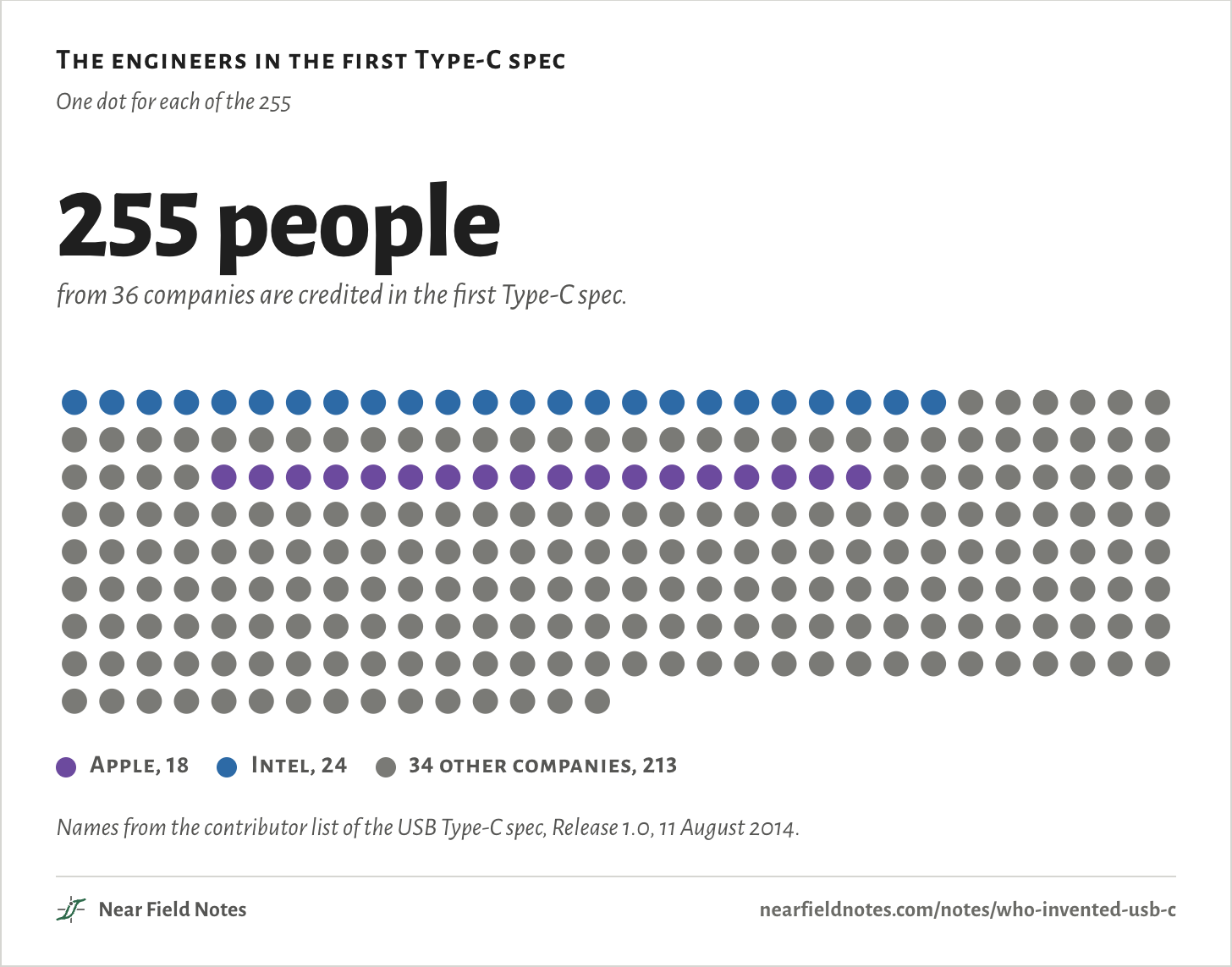
No one company did. The first USB Type-C spec, released on 11 August 2014, credits 255 engineers from 36 companies, and 18 of them were Apple’s. Intel filed patent applications on the outline in November 2012, nine months before Apple’s first filing like it. Apple’s Lightning plug went in either way up before any of that, and it shaped what the group built. Who drew the final shape of the plug is not public.
The engineers in the first Type-C spec
One dot for each of the 255
Apple, 18
Intel, 24
34 other companies, 213
Names from the contributor list of the USB Type-C spec, Release 1.0, 11 August 2014.
The plug and its spec
USB Type-C, Release 1.0
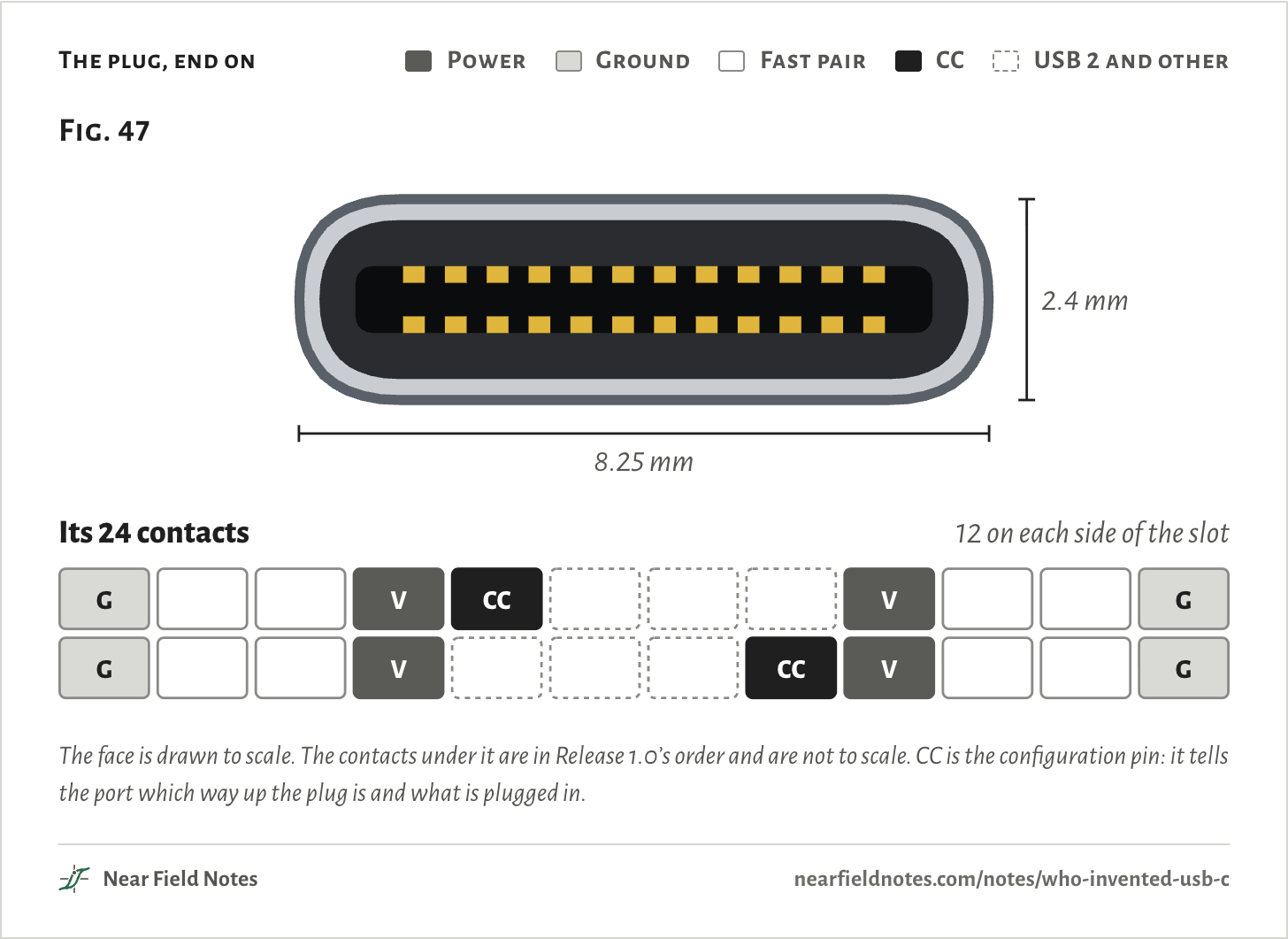
USB-C is the everyday name for USB Type-C: one small plug for data, video and power that goes in either way up. It has 24 contacts, 12 on each side of a slot. The bottom row is the top row turned half a turn, so the plug works both ways.
A spec defines it. That is the document every maker builds the plug, the port and the cable to. It comes from the USB 3.0 Promoter Group, a small group of companies. A working group with engineers from many more did the work.
The ports that came before this one are in Note 46.
The plug, end on
Power
Ground
Fast pair
CC
USB 2 and other
The face is drawn to scale. The contacts under it are in Release 1.0’s order and are not to scale. CC is the configuration pin: it tells the port which way up the plug is and what is plugged in.
Four tries at one port
2009 to 2012
Where did the idea of one port for everything come from? By 2009 everyone wanted it. Four efforts each solved a piece of it before Type-C began.
Intel built Thunderbolt. AMD showed Lightning Bolt. The USB group added Power Delivery to the plugs it already had. And in September 2012 Apple shipped Lightning.
Four tries, 2011 to 2012
Fig. 47b
Port
When
What it did
ThunderboltIntel
February 2011
Reached the MacBook Pro in 2011. It needed an Intel chip in the computer and in every device.
Lightning BoltAMD
January 2012
Sent USB 3.0 down a DisplayPort cable. It was later called DockPort.
USB Power DeliveryThe USB group
July 2012
Up to 100 W, on the same old plug shapes
LightningApple
September 2012
Small, and it went in either way up
Dates from each announcement. DockPort became a VESA standard in January 2014. The 100 W level needed plugs and cables rated for it.
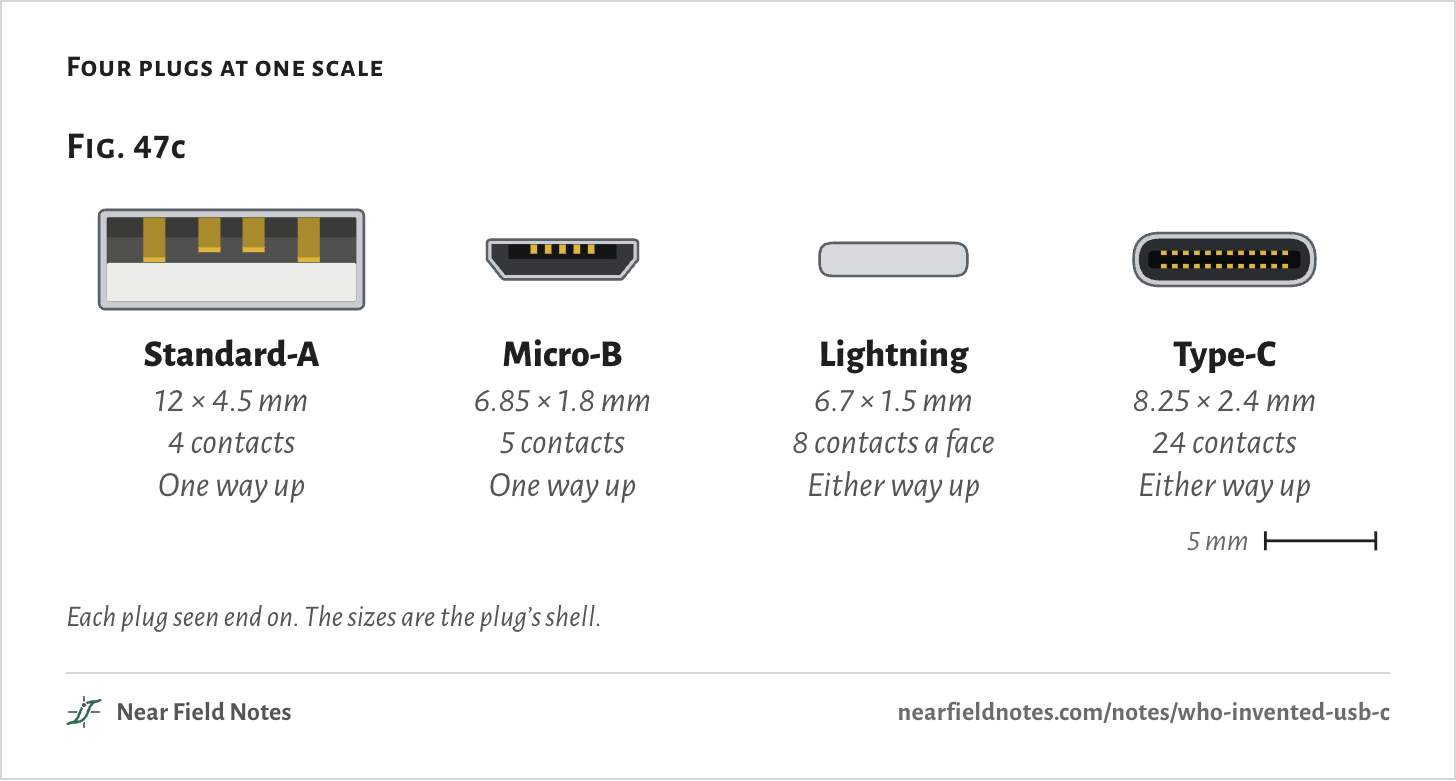
Four plugs at one scale
Each plug seen end on. The sizes are the plug’s shell.
470
Lightning
It went in either way up, and USB’s plugs did not
Field marks. Lightning is a solid tab 6.7 mm wide and 1.5 mm thick, with 8 contacts on each face. Apple’s announcement said: “it’s reversible.”
Look-alike. Micro-B, the phone plug of the day, is about as wide at 6.85 mm. It has 5 contacts and goes in one way up.
Range. Power Delivery put up to 100 W through the USB plugs that already existed. It did not change their shapes.
Habitat. Lightning was Apple’s, and Thunderbolt needed Intel’s chip at both ends. Most of the four belonged to somebody.
471
Each one solved a piece. None of them was a plug every maker could build that did all of it.
Who filed first
September 2012 to August 2014
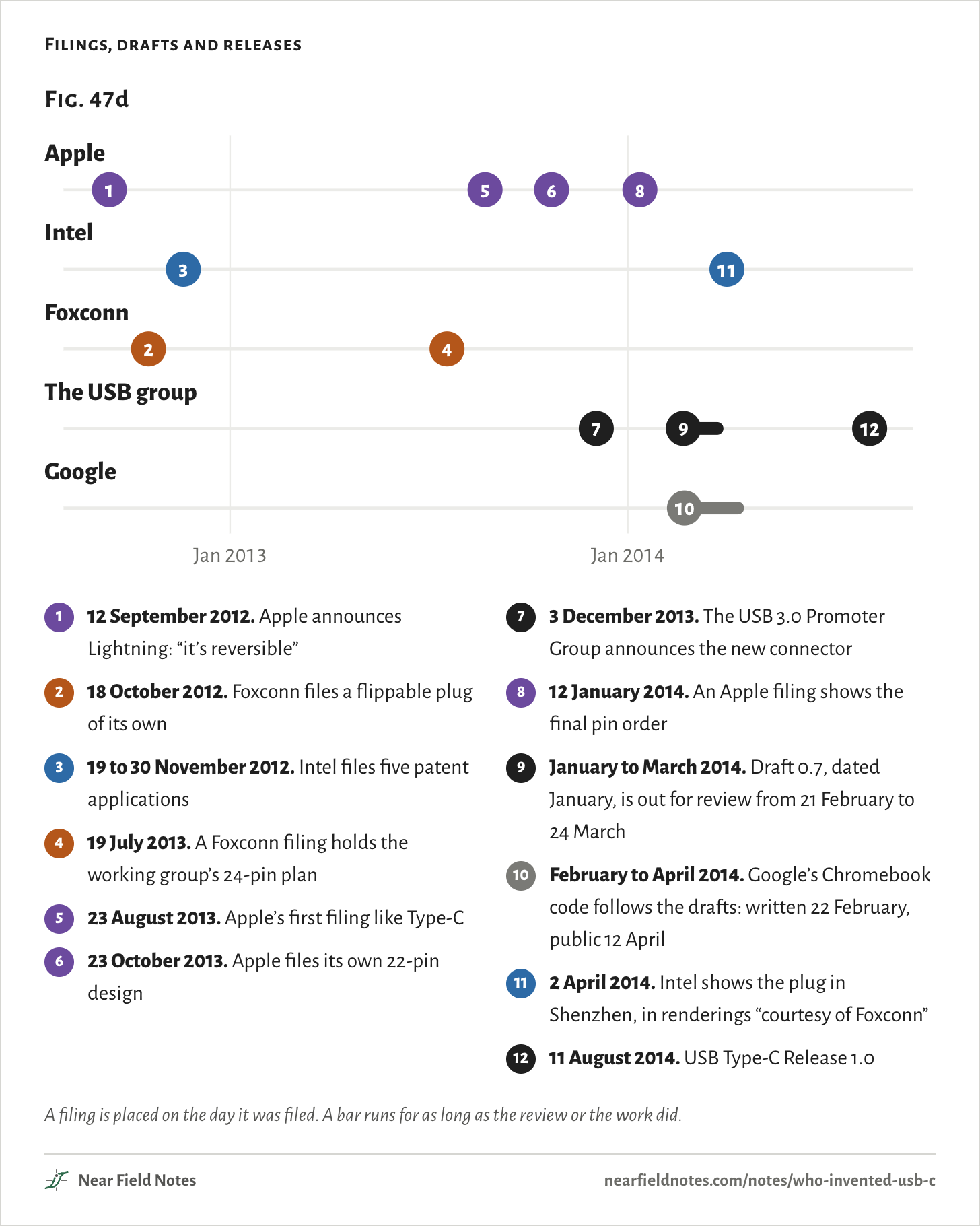
Who thought of that plug first? Patent filings carry dates, so they show who had written down which idea by when. Five weeks after Lightning, Foxconn filed a flippable plug of its own. In November 2012 Intel filed five patent applications. Apple’s first filing like Type-C came nine months after Intel’s.
Filings, drafts and releases
112 September 2012. Apple announces Lightning: “it’s reversible”
218 October 2012. Foxconn files a flippable plug of its own
319 to 30 November 2012. Intel files five patent applications
419 July 2013. A Foxconn filing holds the working group’s 24-pin plan
523 August 2013. Apple’s first filing like Type-C
623 October 2013. Apple files its own 22-pin design
73 December 2013. The USB 3.0 Promoter Group announces the new connector
812 January 2014. An Apple filing shows the final pin order
9January to March 2014. Draft 0.7, dated January, is out for review from 21 February to 24 March
10February to April 2014. Google’s Chromebook code follows the drafts: written 22 February, public 12 April
112 April 2014. Intel shows the plug in Shenzhen, in renderings “courtesy of Foxconn”
1211 August 2014. USB Type-C Release 1.0
A filing is placed on the day it was filed. A bar runs for as long as the review or the work did.
472
Intel’s filings of November 2012
The outline, nine months before Apple
Field marks. Five applications: two on 19 November, two on 20 November and one on 30 November. They became US patents 9,590,373, 8,936,483, 9,285,853, 8,990,442 and 9,229,836.
Look-alike. Foxconn’s filing of 18 October is a flippable plug too. It came five weeks after Lightning and a month before Intel’s.
Range. Intel’s five describe a plug that works either way up, a way to sense which way it went in, power for chips inside the cable, and one wire that tells the port what is plugged in.
Habitat. Apple’s first filing like Type-C is dated 23 August 2013.
473
An outline is not a connector. The spec’s chair has said that the iPhone’s flippable plug influenced the group, and that it looked at a Lightning-style plug with more pins. “That turned out to not be technically feasible,” the chair said on the Unsung Science podcast in 2023.
So a separate group drew a new connector. Connector makers, chip makers, PC makers and phone makers were in it.
Three pin plans
July 2013 to August 2014
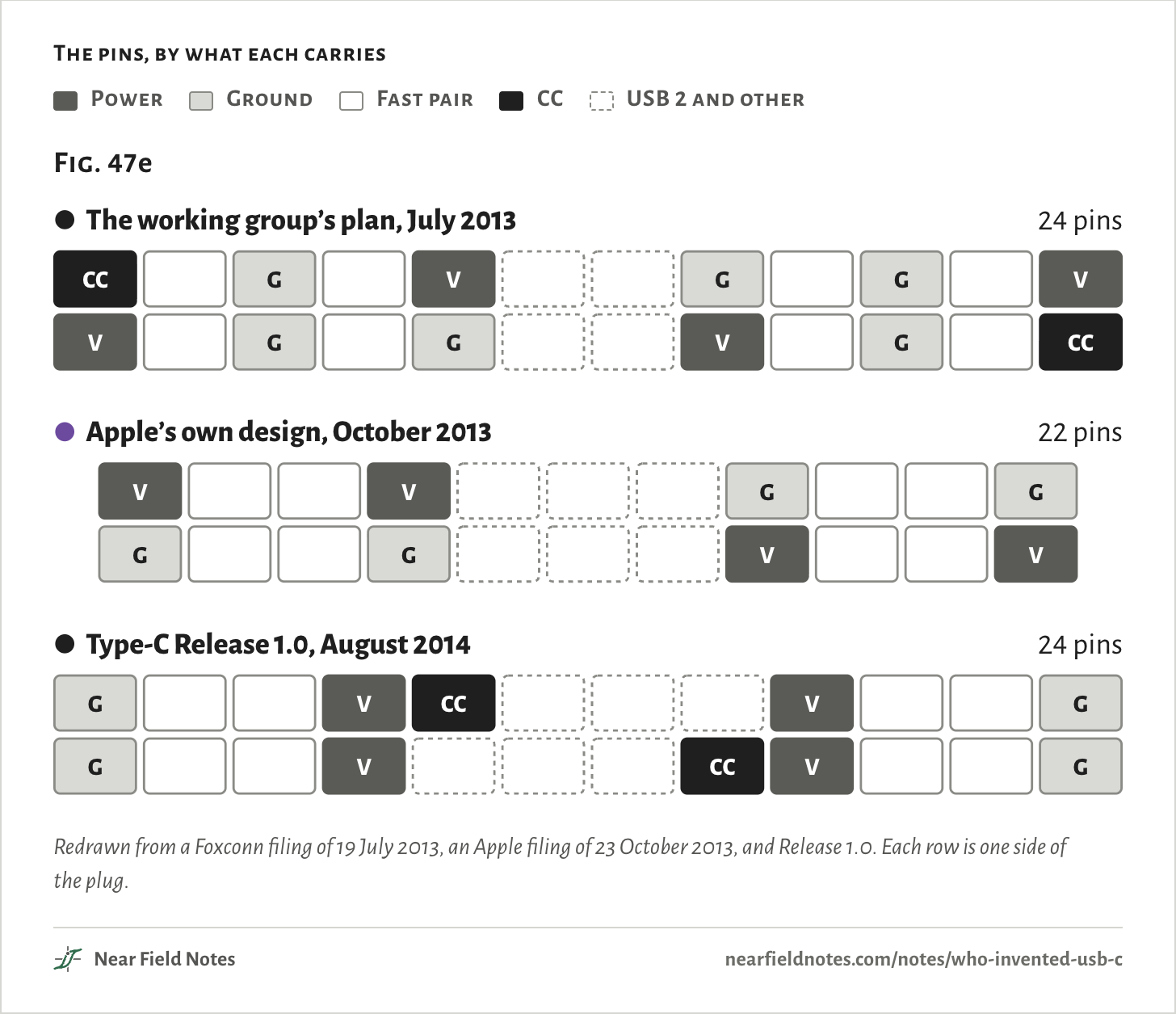
What did that group draw? By July 2013 it had a plan of record: 24 pins, with two new ones called CC. The pin table sits in a Foxconn patent filing from that month, labeled as the USB working group’s plan.
Apple’s connector team began filing in August. Its own design that fall had 22 pins.
On 3 December 2013 the USB 3.0 Promoter Group announced the new connector. The group was HP, Intel, Microsoft, Renesas and Texas Instruments. Apple was not among them.
The order that shipped is not the July plan. Ground took both ends of each row, and CC moved from the ends to the middle. The earliest public document with that order is an Apple filing of 12 January 2014.
The pins, by what each carries
Power
Ground
Fast pair
CC
USB 2 and other
Redrawn from a Foxconn filing of 19 July 2013, an Apple filing of 23 October 2013, and Release 1.0. Each row is one side of the plug.
From draft to Release 1.0
January to August 2014
Who turned the plan into the plug that shipped? The public record thins out here. Draft 0.7 is dated January 2014. It went out for review on 21 February, only to companies that had signed an agreement. No draft has been made public.
The work still left traces. Google’s Chromebook team wrote open code against the drafts: code for power messages on the CC wire, written on 22 February and public on 12 April. On 2 April Intel showed the plug at its developer forum in Shenzhen, in renderings marked “courtesy of Foxconn.” Release 1.0 came out on 11 August 2014.
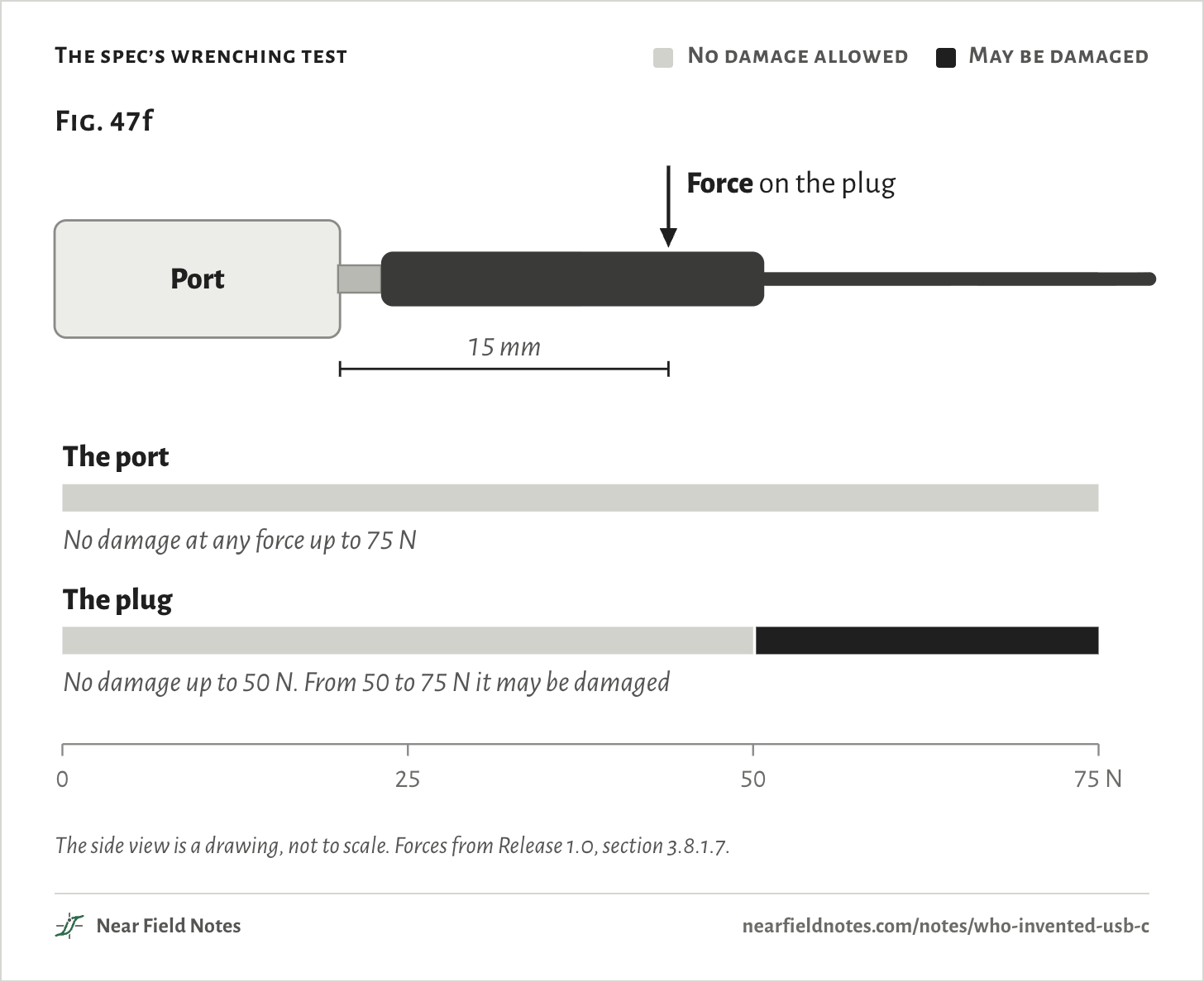
The spec’s wrenching test
No damage allowed
May be damaged
The side view is a drawing, not to scale. Forces from Release 1.0, section 3.8.1.7.
474
Wrenching strength
The plug is made to give before the port
Field marks. The test pushes sideways on a plug that is in its port, 15 mm from the port’s edge, in four directions.
Look-alike. 50 N is the weight of about 5 kg, or 11 lb.
Range. Up to 50 N neither part may be damaged. From 50 to 75 N the plug may be damaged and the port must not be. The spec sets no rule above 75 N.
Habitat. The port is part of a phone or a laptop. The plug is on a cable, which is the cheaper one to replace.
475
“An Apple invention”
January to March 2015
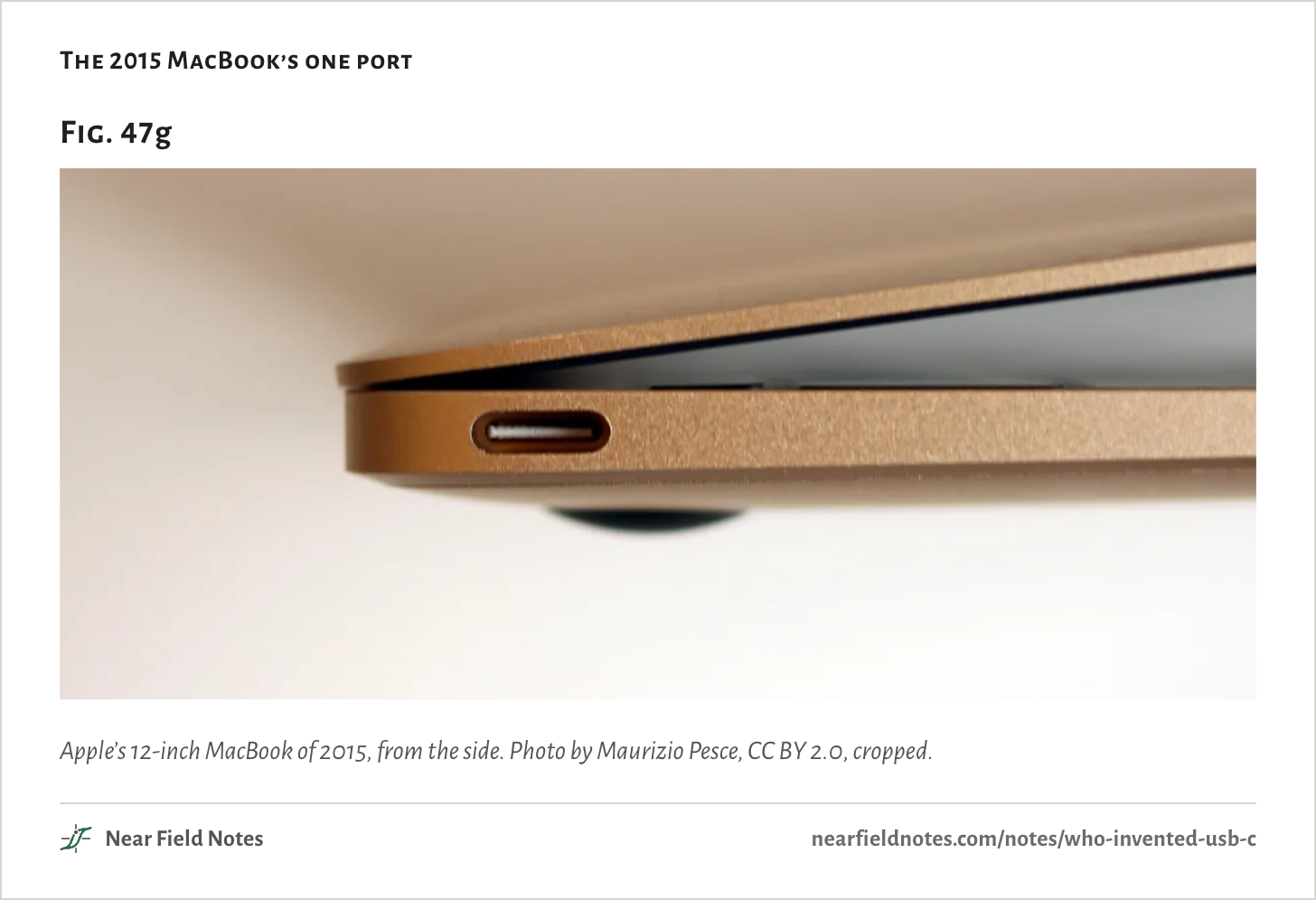
So where did the Apple story start? With the first products. Nokia’s N1 tablet went on sale in China on 8 January 2015. Apple announced its MacBook on 9 March, with a single port, and shipped it on 10 April. Google’s Chromebook Pixel went on sale on 11 March with two.
The week the MacBook was announced, an Apple blogger said on a podcast that USB-C was “an Apple invention.” Two days later a post on the same blogger’s site made it “basically invented.”
A USB-IF spokesperson answered in BetaNews that the spec “was developed by the USB 3.0 Promoter Group.” Apple was not in that group yet.
The 2015 MacBook’s one port
Apple’s 12-inch MacBook of 2015, from the side. Photo by Maurizio Pesce, CC BY 2.0, cropped.
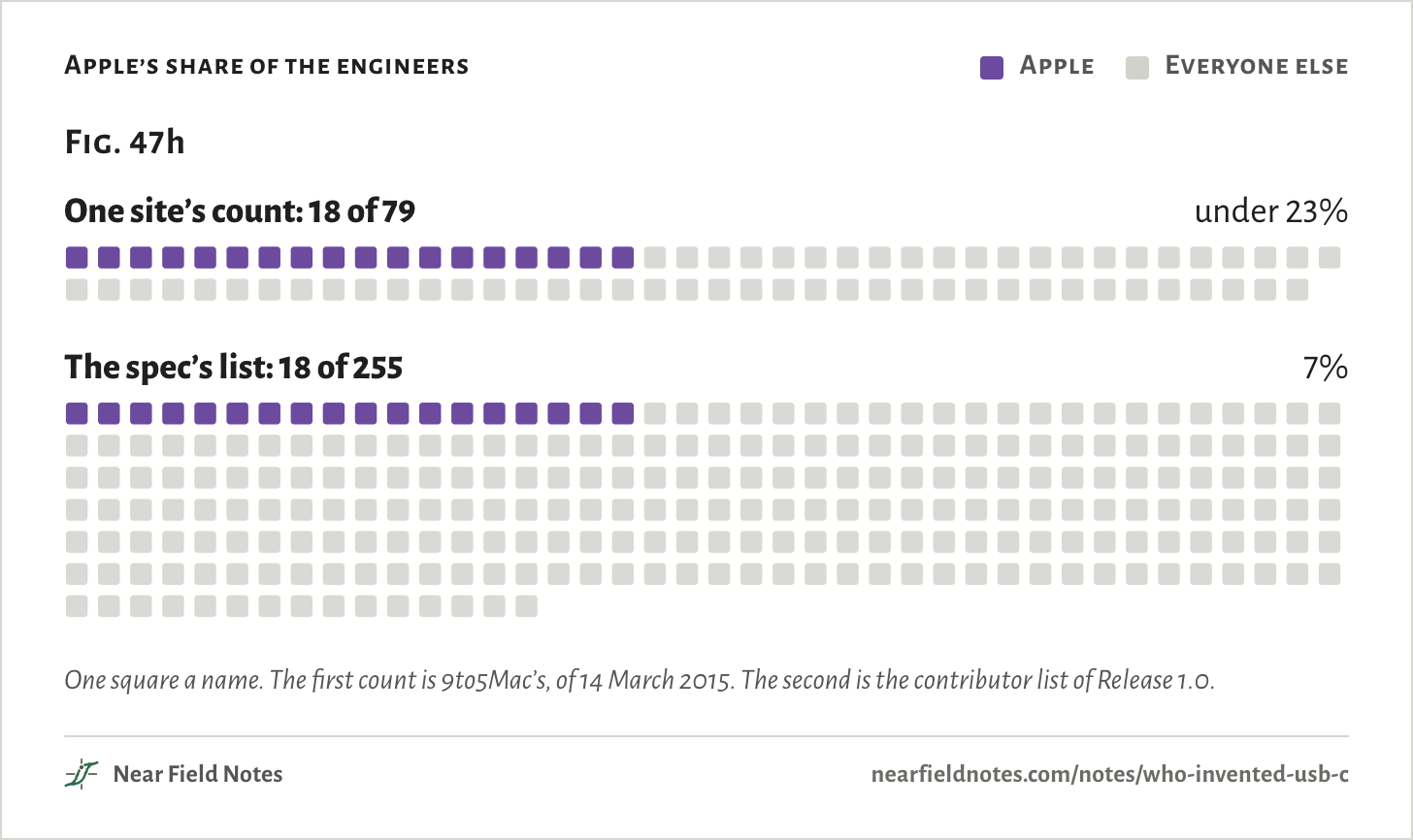
Apple’s share of the engineers
Apple
Everyone else
One square a name. The first count is 9to5Mac’s, of 14 March 2015. The second is the contributor list of Release 1.0.
476
Apple’s share
18 of 255 is 7%
Field marks. One site counted 18 Apple engineers among 79 named, and called it under 23%.
Look-alike. The spec’s own list has 18 Apple names among 255. That is 7%.
Range. Apple had no names among the 167 in the USB 3.0 spec of 2008.
Habitat. The Promoter Group on the cover of Release 1.0 is six companies: HP, Intel, Microsoft, Renesas, STMicroelectronics and Texas Instruments. Apple is on the group’s list by January 2017.
477
Where Apple fits
USB Type-C, Release 1.0
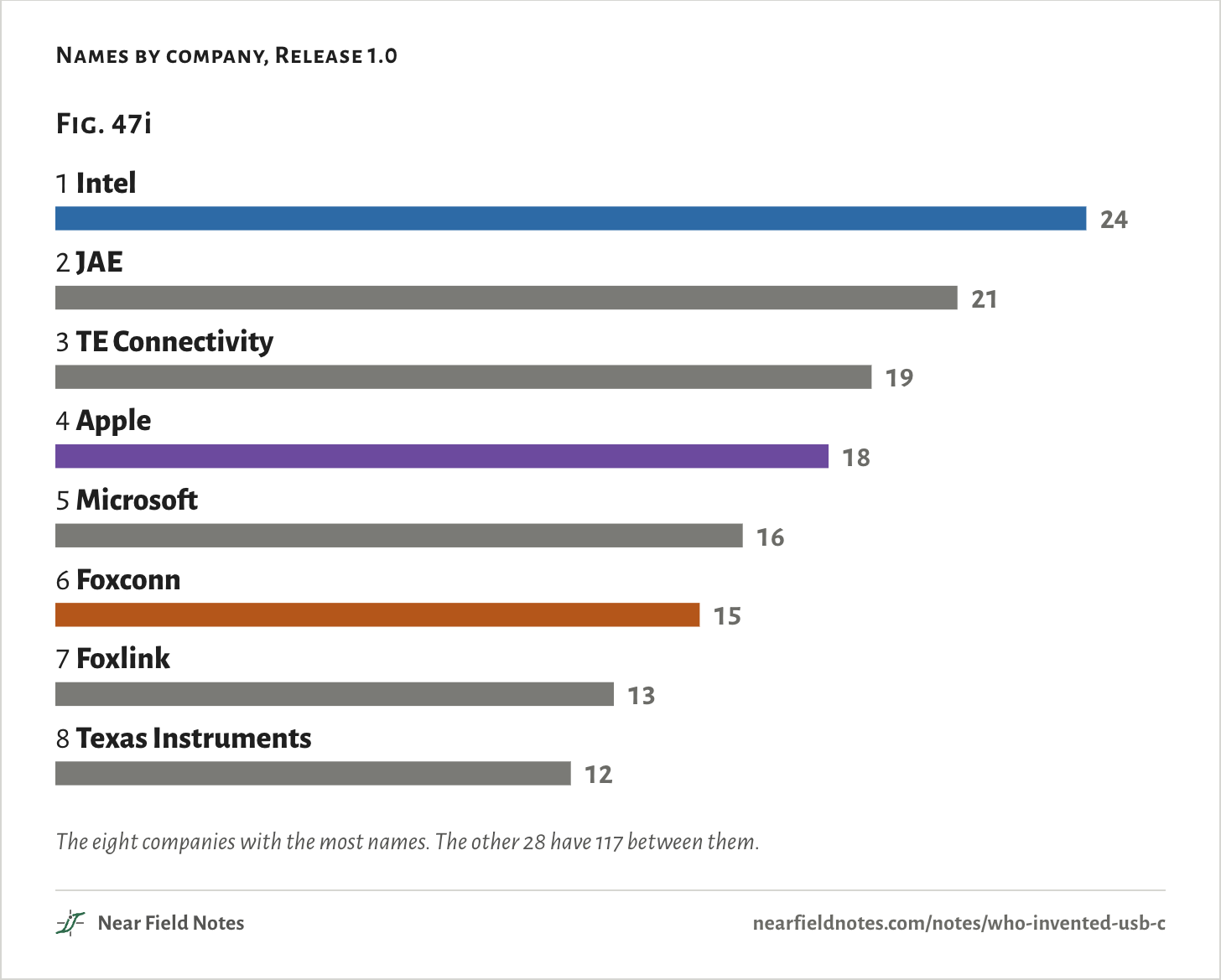
If not 7% of an invention, what was Apple’s part? Its flippable plug came first, and it shaped the group. It went from no names on USB 3.0 to 18 on Type-C, the fourth most of any company. Apple played a big part. It did not start the work, and it did not do it alone.
Names by company, Release 1.0
The eight companies with the most names. The other 28 have 117 between them.
478
Who ran the spec
Fig. 47j
Seat
Company
Plenary and functional group chair, co-author
Intel
Functional group co-chair, co-author
Intel
Mechanical group co-chair, chapter co-editor
Intel
Mechanical group co-chair, chapter co-editor
Seagate
The chairs, co-authors and chapter editors that Release 1.0 names, by company.
479
The chairs and editors came from Intel and Seagate. Who drew the final shape of the plug is not public.
The names
2014 to 2024
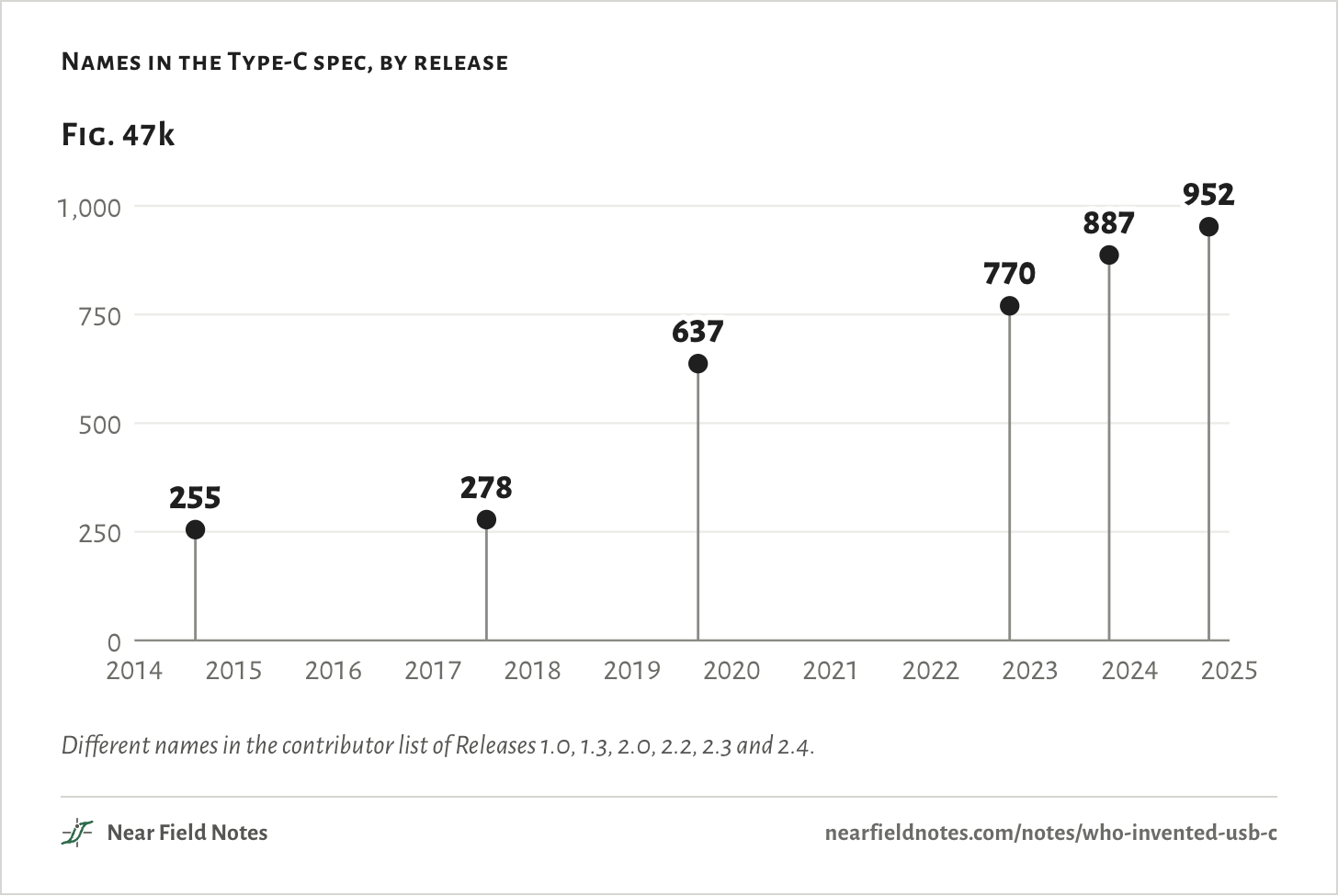
So who gets the credit? The only credit the spec gives is a list of names. There were 255 on the first release, and Release 2.4 of 2024 prints 952. Most of them never got a keynote.
Here they are, as the specs print them, by company from A to Z. Power Delivery 2.0 came out the same day as Type-C 1.0 and has a list of its own.
Names in the Type-C spec, by release
Different names in the contributor list of Releases 1.0, 1.3, 2.0, 2.2, 2.3 and 2.4.
USB Type-C, Release 1.0August 2014 · 255 names, 36 companies
Advanced Micro Devices
Steve Capezza
Walter Fry
Will Harris
Advanced-Connectek, Inc. (ACON)
Glen Chandler
Vicky Chuang
Alan Tsai
Jeff Chien
Aven Kao
Stephen Yang
Lee (Dick Lee) Ching
Danny Liao
Conrad Choy
Alan MacDougall
Agilent Technologies, Inc.
James Choate
Apple
Mahmoud Amini
William Ferry
Nathan Ng
Sree Anantharaman
Zheng Gao
James Orr
Paul Baker
Girault Jones
Keith Porthouse
Jason Chung
Keong Kam
Sascha Tietz
David Conroy
Min Kim
Colin Whitby-Strevens
Bill Cornelius
Chris Ligtenberg
Dennis Yarak
Cypress Semiconductor
Mark Fu
Anup Nayak
Sanjay Sancheti
Rushil Kadakia
Jagadeesan Raj
Subu Sankaran
Dell
Mohammed Hijazi
Sean O’Neal
Thomas Voor
David Meyers
Ernesto Ramirez
DisplayLink (UK) Ltd.
Pete Burgers
Richard Petrie
Electronics Testing Center, Taiwan
Sophia Liu
Foxconn
Asroc Chen
Chien-Ping Kao
Pei Tsao
Allen Cheng
Ji Li
AJ Yang
Jason Chou
Ann Liu
Yuan Zhang
Edmond Choy
Terry Little
Jessica Zheng
Bob Hall
Steve Sedio
Andy Yao
Foxlink/Cheng Uei Precision Industry Co., Ltd.
Robert Chen
Armando Lee
Steve Tsai
Sunny Chou
Dennis Lee
Wen Yang
Carrie Chuang
Justin Lin
Wiley Yang
Wen-Chuan Hsu
Tse Wu Ting
Junjie Yu
Alex Hsue
Google
Joshua Boilard
Nithya Jagannathan
David Schneider
Jim Guerin
Lawrence Lam
Ken Wu
Jeffrey Hayashida
Ingrid Lin
Mark Hayter
Adam Rodriguez
Granite River Labs
Mike Engbretson
Johnson Tan
Hewlett Packard
Alan Berkema
Michael Krause
Linden McClure
Robin Castell
Jim Mann
Mike Pescetto
Hirose Electric Co., Ltd.
Jeremy Buan
Gourgen Oganessyan
Sid Tono
William MacKillop
Intel Corporation
Dave Ackelson
James Jaussi
Chee Lim Nge
Mike Bell
Luke Johnson
Sridharan Ranganathan
Kuan-Yu Chen
Jerzy Kolinski
Hengju Cheng
Christine Krause
Brad Saunders
Bob Dunstan
Yun Ling
Amit Srivastava
Paul Durley
Xiang Li
Ron Swartz
Howard Heck
Guobin Liu
Karthi Vadivelu
Hao-Han Hsu
Steve McGowan
Rafal Wielicki
Abdul (Rahman) Ismail
Japan Aviation Electronics Industry Ltd. (JAE)
Kenji Hagiwara
Kimiaki Saito
Jussi Takaneva
Masaki Kimura
Yuichi Saito
Tomohiko Tamada
Toshio Masumoto
Mark Saubert
Kentaro Toda
Joe Motojima
Toshio Shimoyama
Kouhei Ueda
Ron Muir
Tatsuya Shioda
Takakazu Usami
Tadashi Okubo
Atsuo Tago
Masahide Watanabe
Kazuhiro Saito
Masaaki Takaku
Youhei Yokoyama
JPC/Main Super Inc.
Sam Tseng
Ray Yang
LeCroy Corporation
Daniel H. Jacobs
Lenovo
Rob Bowser
Wei Lie
Howard Locker
Tomoki Harada
Lotes Co., Ltd.
Ariel Delos Reyes
Regina Liu-Hwang
JinYi Tu
Ernest Han
Max Lo
Jason Yang
Mark Ho
Charles Kaun
LSI Corporation
Dave Thompson
Luxshare-ICT
Josue Castillo
CY Hsu
Stone Lin
Daniel Chen
Alan Kinningham
Pat Young
Lisen Chen
John Lin
MegaChips Corporation
Alan Kobayashi
Microchip (SMSC)
Josh Averyt
Donald Perkins
Mohammed Rahman
Mark Bohm
Microsoft Corporation
Randy Aull
Robert Hollyer
Ivan McCracken
Fred Bhesania
Kai Inha
Toby Nixon
Anthony Chen
Jayson Kastens
Gene Obie
Marty Evans
Andrea Keating
Srivatsan Ravindran
Vivek Gupta
Eric Lee
David Voth
Robbie Harris
MQP Electronics Ltd.
Sten Carlsen
Pat Crowe
Nokia Corporation
Daniel Gratiot
Samuli Makinen
Timo Toivola
Pekka Leinonen
Pekka Talmola
Panu Ylihaavisto
Renesas Electronics Corp.
Nobuo Furuya
Philip Leung
Kiichi Muto
Rohm Co., Ltd.
Mark Aaldering
Arun Kumar
Takashi Sato
Kris Bahar
Vijendra Kuroodi
Hiroshi Yoshimura
Yusuke Kondo
Chris Lin
Samsung Electronics Co., Ltd.
Soondo Kim
Jagoun Koo
Jun Bum Lee
Woonki Kim
Cheolho Lee
Seagate
Alvin Cox
Tom Skaar
Dan Smith
Tony Priborsky
STMicroelectronics
Nicolas Florenchie
Christophe Lorin
Federico Musarra
Joel Huloux
Patrizia Milazzo
Pascal Legrand
Tektronics, Inc.
Randy White
Texas Instruments
Jawaid Ahmad
Grant Ley
Brian Quach
Richard Hubbard
Win Maung
Wes Ray
Scott Jackson
Lauren Moore
Anwar Sadat
Yoon Lee
Martin Patoka
Deric Waters
Tyco Electronics Corp. (TE Connectivity Ltd.)
Max Chao
Jim McGrath
Scott Shuey
Robert E. Cid
Takeshi Nakashima
Hidenori Taguchi
Kengo Ijiro
Luis A. Navarro
Bernard Vetten
Eiji Ikematsu
Masako Saito
Ryan Yu
Joan Leu
Yoshiaki Sakuma
Sjoerd Zwartkruis
Clark Li
Gavin Shih
Mike Lockyer
Hiroshi Shirai
VIA Technologies Inc.
Terrance Shih
Jay Tseng
Fong-Jim Wang
Names and companies as printed in the USB Type-C Specification, Release 1.0.
USB Power Delivery, Revision 2.0August 2014 · 157 names, 35 companies
Apple
Bill Cornelius
Colin Whitby-Strevens
James Orr
Jason Chung
Keith Porthouse
Paul Baker
Sasha Tietz
Sree Raman
William Ferry
Canova Tech
Alessandro Ingrassia
Andrea Colognese
Matteo Casalin
Nicola Scantamburlo
Cypress Semiconductor
Anup Nayak
Rushil Kadakia
Dell Inc.
Bruce Montag
Gary Verdun
DisplayLink
Dan Ellis
Peter Burgers
Richard Petrie
Ellisys
Chuck Trefts
Etron Technology, Inc.
Chien-Cheng Kuo
Jack Yang
Richard Crisp
Fairchild Semiconductor
Oscar Freitas
Foxconn / Hon Hai
AJ Yang
Steve Sedio
Terry Little
Google Inc.
Adam Rodriguez
David Schneider
Jim Guerin
Ken Wu
Mark Hayter
Vincent Palatin
Granite River Labs
Mike Engbretson
Hewlett Packard
Alan Berkema
Lee Atkinson
Rahul Lakdawala
Robin Castell
Ron Schooley
Vaibhav Malik
Walter Fry
Intel Corporation
Bob Dunstan
Brad Saunders
Chee Lim Nge
Dan Froelich
David Harriman
Guobin Liu
Harry Skinner
Jervis Lin
John Howard
Karthi Vadivelu
Christine Krause
Leo Heiland
Maarit Harkonen
Nge Chee Lim
Paul Durley
Rahman Ismail
Ronald Swartz
Sarah Sharp
Scott Brenden
Steve McGowan
Tim McKee
Toby Opferman
Japan Aviation Electronics Industry Ltd. (JAE)
Kenta Minejima
Mark Saubert
Toshio Shimoyama
LeCroy Corporation
Daniel H Jacobs
Jake Jacobs
Kimberley McKay
Mike Micheletti
Roy Chestnut
LSI Corporation
Dave Thompson
Luxshare-ICT
Alan Kinningham
MCCI Corporation
Chris Yokum
Geert Knapen
Microchip Technology Inc.
Don Perkins
John Sisto
Josh Averyt
Mark Bohm
Mick Davis
Rich Wahler
Shannon Cash
Microsoft Corporation
David Voth
Jayson Kastens
Kai Inha
Marwan Kadado
Randy Aull
Shiu Ng
Toby Nixon
Vivek Gupta
Yang You
MQP Electronics Ltd.
Pat Crowe
Sten Carlsen
Nokia Corporation
Frank Borngräber
Kai Inha
Pekka Leinonen
Richard Petrie
Sten Carlsen
NXP Semiconductors
Abhijeet Kulkarni
Ahmad Yazdi
Bart Vertenten
Ken Jaramillo
Krishnan TN
Robert de Nie
Obsidian Technology
Robert Heaton
ON Semiconductor
Bryan McCoy
Cor Voorwinden
Edward Berrios
Tom Duffy
Qualcomm, Inc.
Narendra Mehta
Terry Remple
Yoram Rimoni
Renesas Electronics Corp.
Atsushi Mitamura
Kiichi Muto
Masami Katagiri
Patrick Yu
Peter Teng
Philip Leung
Steve Roux
Tetsu Sato
Rohm Co., Ltd.
Akihiro Ono
Chris Lin
Manabu Miyata
Takashi Sato
Vijendra Kuroodi
Yusuke Kondo
Seagate Technology LLC
Alvin Cox
John Hein
Marc Noblitt
Ronald Rueckert
Tony Priborsky
SMSC
John Sisto
Ken Gay
Mark Bohm
Richard Wahler
Shannon Cash
Tim Knowlton
William Chiechi
ST-Ericsson
Fabien Friess
Giuseppe Platania
Jean-Francois Gatto
Milan Stamenkovic
Nicolas Florenchie
Patrizia Milazzo
ST-Microelectronics
Pascal Legrand
Meriem Mersel
Patrizia Milazzo
Texas Instruments
Anand Dabak
Deric Waters
Grant Ley
Ingolf Frank
Ivo Huber
Javed Ahmad
Jean Picard
Martin Patoka
Scott Jackson
Srinath Hosur
Steven Tom
VIA Technologies, Inc.
Jay Tseng
Terrance Shih
Western Digital Technologies, Inc.
Charles Neumann
Curtis Stevens
John Maroney
Names and companies as printed in the USB Power Delivery Specification, Revision 2.0, released the same day. Seven names are printed under two company headings, and the list keeps both.
Added to the Type-C list, 2015 to 2019Releases 1.1 to 2.0 · 383 names, 81 companies
Advanced Micro Devices
Jason Hawken
Joseph Scanlon
Tim Perley
Peter Teng
Advanced-Connectek, Inc. (ACON)
Victory Chen
Wayne Wang
Dennis Cheung
Jessica Feng
Sunney Yang
Allion Labs, Inc.
Howard Chang
Brian Shih
Chester Tsai
Minoru Ohara
Amphenol AssembleTech (Xiamen) Co., Ltd.
Louis Chan
Martin Li
Alan Yang
Jesse Jaramillo
Lino Liu
Terry Ke
Shawn Wei
Amphenol Corporation
Zhinenng Fan
Analogix Semiconductor, Inc.
Mehran Badii
Greg Stewart
Haijian Sui
Yueke Tang
Apple Inc.
Jennifer Tsai
Colin Abraham
Derek Iwamoto
Breton Saunders
Brian Baek
Reese Schreiber
Michael Bonham
Kevin Keeler
Carlos Calderon
Woopoung Kim
Jeff Wilcox
Alexei Kosut
Eric Wiles
Dan Wilson
Christophe Daniel
Matthew Mora
Brian Follis
Bizlink Technology, Inc.
Alex Chou
Morphy Hsieh
Cadence Design Systems, Inc.
Marcin Behrendt
Dariusz Kaczmarczyk
Neelabh Singh
Huzaifa Dalal
Tomasz Klimek
Michal Staworko
Pawel Eichler
Jie Min
Fred Stivers
Sathish Kumar Ganesan
Asila Nahas
Mark Summers
Uyen Nguyen
Claire Ying
Canova Tech
Piergiorgio Beruto
Michael Marioli
Paola Pilla
Andrea Maniero
Antonio Orzelli
Nicola Scantamburlo
Cirrus Logic Inc.
Sean Davis
Darren Holding
Brad Lambert
Corning Optical Communication LLC
Wojciech Giziewicz
Ian McKay
Jamie Silva
Cosemi Technologies Inc.
Samir Desai
Devang Parekh
Cypress Semiconductor
Benjamin Kropf
Naman Jain
Venkat Mandagulathur
Dell
Siddhartha Reddy
Merle Wood
Dialog Semiconductor (UK) Ltd.
Yimin Chen
Diodes Incorporated
Kay Annamalai
Bob Lo
Qun Song
Justin Lee
Jaya Shukla
Ada Yip
Paul Li
DJI Technology Co., Ltd.
Steve Huang
Elka International Ltd.
Roy Ting
Ellisys
Abel Astley
Mario Pasquali
Tim Wei
Rick Bogart
Chuck Trefts
Etron Technology, Inc.
Chien-Cheng Kuo
Feature Integration Technologies Inc.
Jacky Chan
KungAn Lin
Paul Yang
Chen Kris
Yuchi Tsao
Amanda Ying
Yulin Lan
Foxconn / Hon Hai
Fred Fons
Patrick Casher
Joe Chen
Jie Zheng
Christine Tran
Foxlink/Cheng Uei Precision Industry Co., Ltd.
Robert Lu
Fresco Logic Inc.
Bob McVay
Christopher Meyers
Google
Alec Berg
Todd Broch
Richard Palatin
Adam Langley
Stephan Schooley
Toshak Singhal
Vincent Palatin
Dylan Reid
Granite River Labs
Yung Han Ang
Alan Chuang
Krishna Murthy
Sandy Chang
Allen Chen
Caspar Lin
Chin Hun Yaep
Swee Guan Chua
Hewlett Packard Inc.
Lee Atkinson
Srinath Balaraman
Steve Chen
Roger Benson
Rahul Lakdawala
Asjad Shamim
Hirose Electric Co., Ltd.
Eungsoo Shin
William Kysiak
Sang-Muk Lim
Hosiden Corporation
Takahisa Otsuji
Fumitake Tamaki
I-PEX (Dai-ichi Seiko)
Ro Richard
Tetsuya Tagawa
Infineon Technologies
Tue Fatt David Wee
Intel Corporation
Rolf Kuhnis
Henrik Leegaard
Sankaran Menon
Ziv Kabiry
Vijaykumar Kadgi
Brad Berlin
Rajaram Regupathy
Pierre Bossart
Ehud Shoor
Jhuda Dayan
Edmond Lau
Einat Surijan
Saranya Gopal
Tsion Vidal
Seppo Ingalsuo
Stephanie Wallick
Sagar Pawar
Devon Worrell
Li Yuan
Japan Aviation Electronics Industry Ltd. (JAE)
Hiroaki Ikeda
Kenta Minejima
Toshiyuki Moritake
LeCroy Corporation
Tyler Joe
Lenovo
Wei Liu
Jianye Li
LG Electronics Inc.
Do Kyun Kim
Lintes Technology Co., Ltd.
Tammy Huang
CT Pien
RD Lintes
Lotes Co., Ltd.
John Lynch
Chi-Chang Lin
Luxshare-ICT
Gorden Lin
James Stevens
Sally Chiu
Alan Liu
Maxim Integrated Products
Forrest Christo
Sang Kim
Michael Miskho
Ken Helfrich
Jeff Lo
Jacob Scott
MCCI Corporation
Terry Moore
MediaTek Inc.
Alex YC Lin
MegaChips Corporation
Satoru Kumashiro
Microchip (SMSC)
Matthew Kalibat
John Sisto
Anthony Tarascio
Shannon Cash
Kiet Tran
Thomas Farkas
Christopher Twigg
Fernando Gonzalez
Andrew Rogers
Prasanna Vengateshan
Microsoft Corporation
Teemu Helenius
Jim Belesiu
Dan Iatco
Rahul Ramadas
Michelle Bergeron
Nathan Sherman
Bala Sivakumar
Philip Froese
Shoaib Khan
David Hargrove
Andrew Yang
Arvind Murching
Molex LLC
Adib Al Abaji
Monolithic Power Systems
Chris Sporck
Di Han
NEC Corporation
Kenji Oguma
Newnex Technology Corp.
Sam Liu
Nimrod Peled
NXP Semiconductors
Guru Prasad
Mahmoud EL Sabbagh
Ken Jaramillo
Dennis Ha
Krishnan TN
Oculus VR LLC
Amish Babu
Joaquin Fierro
ON Semiconductor
Eduardo De Reza
Christian Klein
Michael Smith
Oscar Freitas
Amir Lahooti
Parade Technologies, Inc.
Jian Chen
Paul Xu
Alan Yuen
Craig Wiley
Power Integrations
Shruti Anand
Aditya Kulkarni
Amruta Patra
Rahul Joshi
Akshay Nayaknur
Qualcomm, Inc.
Lior Amarilio
Philip Hardy
Jack Pham
Aris Balatsos
Will Kun
Vamsi Samavedam
Tomer Ben Chen
Jonathan Luty
Matthew Sienko
Richard Burrows
Lalan Mishra
Dmitrii Vasilchenko
Amit Gil
George Paparrizos
Joshua Warner
James Goel
Vatsal Patel
Chris Wiesner
Amit Gupta
Realtek Semiconductor Corp.
Marco Chiu
Ty Kingsmore
Terry Lin
Tsung-Peng Chuang
Ray Lee
Chuting Su
Charlie Hsu
Jay Lin
Changhung Wu
Fan-Hau Hsu
Ryan Lin
Renesas Electronics Corp.
Kai Bao
Hajime Nozaki
Yosuke Sasaki
Ziba Nami
Toshifumi Yamaoka
Richtek Technology Corp.
Roger Lo
Rohm Co., Ltd.
Yoshinori Ohwaki
Ruben Balbuena
Nobutaka Itakura
Kazuomi Nagai
Samsung Electronics Co., Ltd.
Cheolyoon Chung
Jaedeok Cha
Sangju Kim
KangSeok Cho
Jinyoung Oh
Wooin Choi
Chahoon Park
Yeongbok Choi
Chulwoo Park
Termi Kwon
Youngjin Park
JaeRyong Han
Jung Waneui
Jaehyeok Jang
Edward Lee
Sunggeun Yoon
Wonseok Jang
Seagate
Emmanuel Lemay
Shenzhen Deren Electronic Co., Ltd.
Smark (Zhudong) Huo
Yang Lirong
Lucy Zhang
Wen Fa Lei
Silicon Line Gmbh
Ian Jackson
SiliConch Systems Private Limited
Jaswanth Ammineni
Aniket Mathad
Rakesh Polasa
Pavitra Balasubramanian
Shubham Paliwal
Abhishek Sardeshpande
Kaustubh K
Vishnu Pusuluri
Jinisha Patel
Vinay Patel
Kaustubh Kumar
Satish Anand Verkila
Simula Technology Inc.
John Chang
Jung Lin
CK Wang
Voss Cheng
Jyunming Lin
Alice Yu
Thomas Li
Doris Liu
Softnautics LLP
Bhavesh Desai
Dipakkumar Modi
Ujjwal Talati
Hetal Jariwala
Ishita Shah
Sony Corporation
Shinichi Hirata
Shigenori Tagami
Spectra7 Microsystems Corp.
Andrew Kim
John Mitchell
Specwerkz
Amanda Hosler
Diane Lenox
STMicroelectronics
Nathalie Ballot
Jerome Bach
Gregory Cosciniak
Chekib Hammami
Richard O’Connor
Filippo Bonaccorso
Massimo Panzica
Christophe Cochard
Legrand Pascal
Nicolas Perrin
Cedric Force
Sumitomo Electric Ind., Ltd.
Takeshi Inoue
Wataru Sakurai
Masaki Suzuki
Yasuhiro Maeda
Sainer Siagian
Mitsuaki Tamura
Synaptics Inc.
Daniel Bogard
Jeff Lukanc
Prashant Shamarao
Synopsys, Inc.
Subramaniam Aravindhan
Morten Christiansen
Satya Patnala
Nivin George
Texas Instruments
Sue Vining
Sai Karthik Rajaraman
Mike Campbell
Shafiuddin Mohammed
Greg Collins
Dafydd Roche
Gary Cooper
GP Gopalakrishnan
Brian Parten
Cory Stewart
Craig Greenberg
Jason Peck
Bill Waters
Nate Johnson
John Perry
Michael Koltun IV
Louis Peryea
Gregory Watkins
Roy Wojciechowski
Total Phase
Chris Yokum
Tyco Electronics Corp. (TE Connectivity Ltd.)
Jeff Mason
Calvin Feng
Nathan Tracy
Noah Zhang
UL LLC
Michael Hu
Ventev Mobile
Brad Cox
Colin Vose
Weltrend Semiconductor
Hung Chiang
Wayne Lo
Eric Wu
Jeng Cheng
Ho Wen Tsai
Xiaomi Communications Co., Ltd.
Xiaoxing Yang
Juejia Zhou
Names new to the Type-C list in Releases 1.3 and 2.0, with the company printed there.
Added in 2021, with 240 W chargingRelease 2.1 · 134 names, 50 companies
Advanced Micro Devices
Gerald Merits
Sujan Thomas
Allion Labs, Inc.
Yan Ken
Alex Chuang
Stan Lin
Chou Tsungbo
Maroco Fan
Terry Kao
Apple Inc.
Raju Desai
ASMedia Technology Inc.
Kuo Lung Li
Bizlink Technology, Inc.
Kevin Tsai
Cypress Semiconductor
Chia Hua Chang
Savan Javia
Anita Thimma Govarthanarajan
Dell
Ken Nicholas
Diodes Incorporated
Jin-sheng Wang
Foxconn / Hon Hai
Chris Goralka
Brandon Chen
Fresco Logic Inc.
Brian Collins
Google
Naga Viswanadha
Eric Herrmann
Udaya Kiran Ammu
Nathan Kolluru
Benson Leung
Chao Fei
Abraham Levkoy
Songping Wu
Granite River Labs
Prasannakumar Marikunte Nagaraju
Velmurugan Ayyakkannu
Vishal Kakade
Hariprasad Bhat
Jesson Li
Amy Peng
Bala M
Annie Tao
Honor Device Co., Ltd.
Wang Feng
HP Inc.
Rami Bathaniah
Indie Semiconductor
Ian Board
Jim Wilshire
Intel Corporation
Oren Salomon
Dmitriy Berchanskiy
Tomer Savariego
Oded David
Venkataramani Gopalakrishnan
Yaniv Hayat
Udaya Natarajan
Aruni Nelson
Duane Quiet
Kannappan Rajaraman
Reza M. Zamani
Vitaly Zhivov
Japan Aviation Electronics Industry Ltd. (JAE)
Junichi Takeuchi
Kandou Bus SA
Hitaish Sharma
David Stauffer
Paul Wilson
Keysight Technologies Inc.
Pedro Merlo
Kinetic Technologies, Inc.
Ramesh Dandapani
Jay Slivkoff
Sireesha Vemulapalli
Leadtrend
Yao-Wei Hsieh
LeCroy Corporation
Giuseppe Leccia
Lotes Co., Ltd.
James Lin
Luxshare-ICT
Antony Lin
Kenny Chen
Carr Wang
Yangli Wang
Eric Wen
Blue Ho
Mercedes-Benz Research & Development, North America, Inc.
Hans Wickler
Microsoft Corporation
Praveen Kumar Palacharla
Patrick Law
Vahid Vassey
Lily Huang
Arjun Padmanabhan
Monolithic Power Systems
Junyong Gong
Istvan Nagy
Ao Sun
Vincent Wu
Yuncong Jiang
Multilane Inc.
Fadi Daou
Rita Khawaja
Elias Khoury
NVIDIA
Jamie Aitken
ON Semiconductor
Edward Berrios
Eric Maier
Rod Comer
Rick Pierce
Parade Technologies, Inc.
Jingfan Zhang
Qualcomm, Inc.
Vara Prasad Arikatla
Nicholas Cadieux
David Chang
Renesas Electronics Corp.
Yen-Mo Chen
Richtek Technology Corp.
Ben Chiang
Leo Kang
Ken Shih
Max Huang
Alex Yang
Rohde & Schwarz GmbH & Co. KG
Kai Uwe Schmidt
Martin Stumpf
Samsung Electronics Co., Ltd.
Sung Geun Joo
Koyoungwon Kim
Junhwa Choi
Ilhyung Chung
SB C&S Corp.
Toshinari Nakamura
Eiji Sakai
Kenji Watanabe
Morito Ogikubo
Silicon Line Gmbh
Boleslaw Wojtowicz
Zhiying Zhang
SiliConch Systems Private Limited
Ranjith S
Simula Technology Inc.
Richard Liu
STMicroelectronics
Gregory Gosciniak
Guenael Cadier
Dominique Chaillot
Yohann Martiniault
Synaptics Inc.
Dan Ellis
Synopsys, Inc.
John Stonick
Tektronix, Inc.
Sourabh Das
Abhijeet Shinde
Mark Guenther
Texas Instruments
Anant Gole
Jacob Ontiveros
Thine Electronica, Inc.
Yuseke Fujita
Shuhei Yamamoto
UL LLC
Leo Chung
Henry Tsou
Lance Yang
Paul Vanderlaan
Chien-Wei Yeh
Dylan Su
Eric Wall
Unigraf OY
Sergey Grushin
Weltrend Semiconductor
Jeng Cheng Liu
Western Digital, HGST
Larry McMillan
Names new with Release 2.1, with the company printed in Release 2.2.
Added from 2022 to 2024Releases 2.2 to 2.4 · 183 names, 65 companies
Acroname Inc.
Grant Fritz
Connor Goss
Matt Krugman
Advanced Micro Devices
Michael Comai
Juan Martinez
Advanced-Connectek, Inc. (ACON)
Bobo Chen
Same Dai
Kevin Yao
Allion Labs, Inc.
Lexus Lee
Jesse Jiang
Denver Mishima
Liam Wu
Apple Inc.
Jay Sha
Jonathan Brown
Aptiv Consumer Connectivity
Andrew Burchett
Moe Elghrawi
Bizlink Technology, Inc.
CY Tsai
Giovanni Wang
Cadence Design Systems, Inc.
Sanjeet Kumar
Sanjai Gandhi
China Telecommunications Technology Labs
Ming Wei
Credo Semiconductor, Inc.
Jim Bartenslager
Yasuo Hidaka
Ping Xiong
Yifei Dai
Kevin Gao
Phil Sun
Dell
Rose Hou
Marcin Nowak
Ellisys
Wenhui Luo
EverPro Technologies Company, Ltd.
Hui Jiang
Silane Zhou
Eva Chen
Foxconn / Hon Hai
Shruti Deore
Foxlink/Cheng Uei Precision Industry Co., Ltd.
Patrick Yeh
Google
Jameson Thies
Prashant Malani
Diana Zigterman
Mehdi Abrishamchian
Lucasz Bartosik
Ketan Shringarpure
Bartosz Szpila
Charlie Costakis
Nehemiah Dureus
Radu Vele
George-Daniel Matei
Granite River Labs
Kristof Mommen
Mark Jiang
Rajesh B
Pascal Berten
Olivia Lu
Vasudev Uttharahalli
Mike Yang
Yun Yang
Winson Mok
GuangDong OPPO Mobile Telecommunications Corp, Ltd.
Jerry Qin
Hirose Electric Co., Ltd.
Hyejun Lee
Kohei Hida
Zhili Liang
Youngbon Park
Kazunori Ichikawa
Sukkyu Jang
Huawei Technology Co., Ltd.
Jianhong He
Gang Liang
Liansheng Zheng
Zhengbing Li
Ruinan Sun
Lauri Soderbacka
Hynetek Semiconductor Co., Ltd.
Yingyang Ou
James Xie
I-PEX (Dai-ichi Seiko)
Jack Ozeki
Infineon Technologies
Godwin Gerald Arulappan
Shopitham Ram
Behzad Jamasbi
Gayathri Vasudevan
Pradeep Baipai
Dominic Gutierrez
Geona Mary Pullankannappally Devasia
Anton Gutsul
Intel Corporation
Nirmala Bailur
Huimin Chen
Eliahu Suued
Chuen Ming Tan
Pranav Tipnis
Hem Doshi
Asutosh Pathak
Amardeep Rai
Gal Yedidia
Venkataramana Kotakonda
Japan Aviation Electronics Industry Ltd. (JAE)
Norihiko Nakamura
Kandou Bus SA
Amanda Dong
Majid Foodeei
Keysight Technologies Inc.
Jit Lim
Xiao Zhang
Soon Tatt Beh
Fang Huey Lim
Kinetic Technologies, Inc.
Kei Yasuno
Akihiro Moto
LeCroy Corporation
Chetan Kopalle
Lenovo
Munefumi Nakata
LG Electronics Inc.
Seung Hyun Yoo
Won-Jong Choi
Jeeyoung Kim
Minji Kim
Logitech Inc.
Niclas Granqvist
Luxshare-ICT
Peter Jhou
Wayne Yeh
MediaTek Inc.
Henry Chen
Jing-Hao Huang
Yishu Hsieh
Shih Jyun-Yang
Tung-Sheng Lin
Jason Hsu
Akan Lin
Chasel Wang
Liang-Yu Hsu
Yu-Yi Chu
Colin Tsai
Microsoft Corporation
Kiran Shastry
Ugan Sivagnanenthirarajah
Monolithic Power Systems
Greg Virnig
NVIDIA
Jason Tsai
NXP Semiconductors
Wouter Sijm
Jia Guo
ON Semiconductor
Alan Finkel
Alex Cornwall
Parade Technologies, Inc.
Tom Burton
Reginald Conley
Phison Electronics Corp.
Wilson Wen
Power Integrations
Daryll Bonavente
Kaushik Raam
Qualcomm, Inc.
Adi Menachem
Realtek Semiconductor Corp.
Jason Wang
Kyle Tsai
Renesas Electronics Corp.
Mengfei Liu
Fengshuan Zhou
Yuhuan Zhou
Tony Lai
Resillion (Belgium NV)
Bart Grispen
Richtek Technology Corp.
Tzuhsien Chuang
Bryan Huang
Rohde & Schwarz GmbH & Co. KG
Curtis Donahue
Patrick McKenzie
Samsung Electronics Co., Ltd.
Sangwoo Kang
Wonseok Kang
Kyunghwan Lee
Kyungwoo Lee
Scosche Industries
Josh Aguilera
Kevin Trejo
Perry DeGuzman
Seagate
Curtis Stevens
Shenzhen Deren Electronic Co., Ltd.
Valerie Yang
STMicroelectronics
Mathieu Rouviere
Synopsys, Inc.
Prishkrit Abrol
Jaspreet Gambhir
Taiwan Testing and Certification Center
Dennis Chang
Tektronix, Inc.
Nitin Jhanwar
Texas Instruments
Kasthuri Annamalai
Kevin Kosta
Prajith Cheerakkoda
Biju Erayamkot Panayamthatta
Neeta Thawani
Katherine Huckabay
The Silanna Group Pty. Ltd.
Tod Wolf
Trinity Co., Ltd.
Tetsushi Hoshikawa
Kinya Kishita
Unigraf OY
Alexander Gushchin
Topi Lampiranta
VIA Technologies Inc.
Rex Hsu
Einsent Huang
Vivo Mobile Communications Co. Ltd.
Benny Dong
Junchen Wei
Ziji Zhou
Fangding Luo
Western Digital
Dave Landsman
Rotem Sela
Prithviraj Sengupta
Xiaomi Communications Co., Ltd.
Qi Zhu
Canfeng Chen
Zhe Wang
Zhuhai iSmartWare Technology Co., Ltd.
Yuanchao Liang
Liu Qiong
Long Zhang
Names new to the Type-C list in Releases 2.2 to 2.4, with the company printed there.
The three later lists hold only the names new to the list: 383, 134 and 183. With the first 255 that is 955 entries, and Release 2.4’s own list has 952 different names.
The story in dates
2011 to 2015
Filings, drafts and products
Feb 2011Thunderbolt reaches the MacBook Pro
Jan 2012AMD shows Lightning Bolt, later called DockPort
Jul 2012USB Power Delivery 1.0, up to 100 W
12 Sep 2012Apple announces Lightning
18 Oct 2012Foxconn files a flippable plug
19 Nov 2012Intel files the first of five applications
19 Jul 2013A Foxconn filing holds the working group’s 24-pin plan
23 Aug 2013Apple’s first filing like Type-C
23 Oct 2013Apple files a 22-pin design
3 Dec 2013The USB 3.0 Promoter Group announces the connector
12 Jan 2014An Apple filing shows the final pin order
21 Feb 2014Draft 0.7 goes out for review
2 Apr 2014Intel shows the plug in Shenzhen
11 Aug 2014Type-C Release 1.0 and Power Delivery 2.0
8 Jan 2015Nokia’s N1 tablet goes on sale in China
11 Mar 2015Google’s Chromebook Pixel goes on sale
10 Apr 2015Apple’s MacBook ships
480
Key to the question
Who invented USB-C?
1aWhose plug went in either way up first?Apple, September 2012
1bWho filed the outline first?Intel, November 2012
1cWho drew the final shape?Not public
1dWhom does the spec credit?255 engineers, 36 companies
USB-C was not invented by one company.
481
How Thunderbolt ended up inside this plug is in Note 48.
Conditions
The count
Names in the contributor list of the USB Type-C Cable and Connector Specification, Release 1.0, 11 August 2014. A name counts once, under the company the spec prints it with.
Later releases
Different names in the lists of Releases 1.3, 2.0, 2.2, 2.3 and 2.4
Filing dates
The day each application was filed, or its priority date, from the patent or the provisional application itself
Pin plans
Redrawn by what each pin carries from FIG. 10 of Foxconn’s provisional 61/856,077, FIG. 16 of Apple’s provisional 61/894,895, and Release 1.0. FIG. 27 of Apple’s provisional 61/926,376 has Release 1.0’s order.
Drafts
Draft 0.7’s date from a Foxconn filing that cites it. The review dates from the USB-IF’s notes of 3 December 2013 and 20 February 2014.
Forces
Release 1.0, section 3.8.1.7, wrenching strength
Quotes
The spec’s chair to Yahoo Tech, 16 December 2015, and on the Unsung Science podcast, 18 August 2023. The 2015 podcast’s words are as MacRumors and BetaNews wrote them down.
Names
As printed, with each company’s name as the spec gives it. Seats such as chair or editor are left off the lists.
Sourced, not measured. Every number here comes from a public record, and nothing was simulated.
Limits
No draft of the spec has been made public. The months between the July 2013 plan and Release 1.0 are known only from filings, code and slides.
Who drew the final shape of the plug is not public.
The Apple filing of 12 January 2014 is the earliest public document with the final pin order. The record does not show who set that order, and an earlier document may exist that is not public.
A filing date shows when an idea was written down. It does not show who had it first.
A contributor list says who took part. It does not say what each person did.
The day Apple joined the Promoter Group is not on record. It is not on the group’s list in April 2016 and is on it in January 2017.
Nokia’s N1 went on sale on 8 January 2015. The day the first one reached a buyer is not confirmed.
Files
sim/facts.jsonEach date and count the figures draw, with its source
sim/names.jsonThe five lists of names
Sources
USB Type-C Cable and Connector Specification, Releases 1.0 to 2.4; USB Power Delivery Specification, Revisions 1.0 and 2.0; Universal Serial Bus 3.0 Specification
US patents 9,590,373, 8,936,483, 9,285,853, 8,990,442 and 9,229,836 (Intel), 9,287,668 (Hon Hai) and 9,992,863 (Apple)
US provisional applications 61/856,077 (Foxconn), 61/869,585, 61/894,895 and 61/926,376 (Apple)