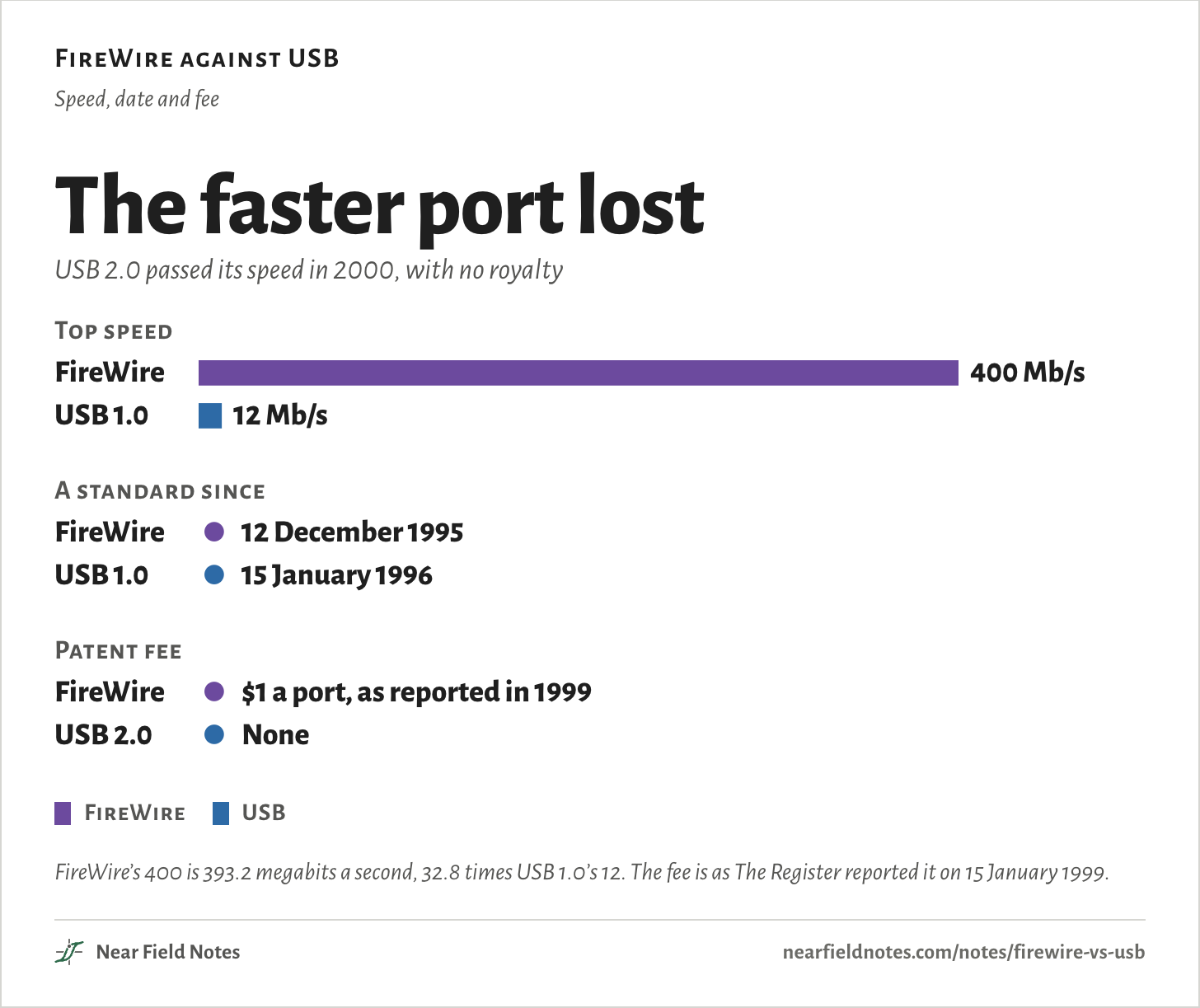
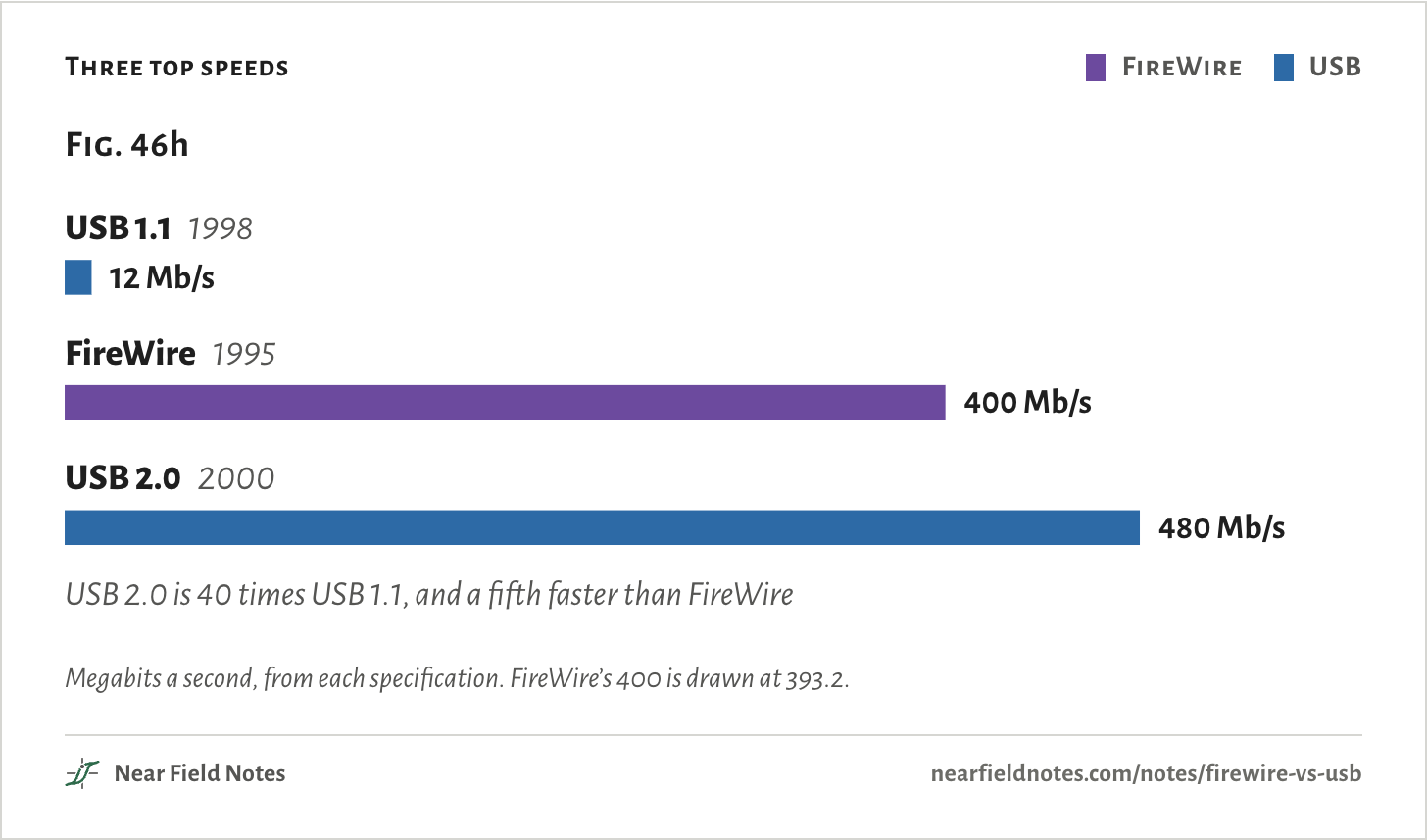
FireWire was over 30 times faster than USB, and it became a standard 34 days earlier. It still lost. In January 1999 word got out that Apple wanted $1 for every FireWire port. That year Intel left FireWire out of its chipsets and went ahead with USB 2.0, which came out in 2000 at 480 megabits a second with no royalty. Two people who were there disagree on whether the fee was the cause.
FireWire against USB
Speed, date and fee
FireWire
USB
FireWire’s 400 is 393.2 megabits a second, 32.8 times USB 1.0’s 12. The fee is as The Register reported it on 15 January 1999.
Two ports, a month apart
December 1995 and January 1996
Both were meant to replace the pile of different ports on the back of a computer with one. FireWire is the common name for IEEE 1394, a fast bus for video and disks. The IEEE approved it on 12 December 1995.
USB 1.0 followed on 15 January 1996. Intel and six other companies wrote it for keyboards, mice and printers, at a top speed of 12 megabits a second.
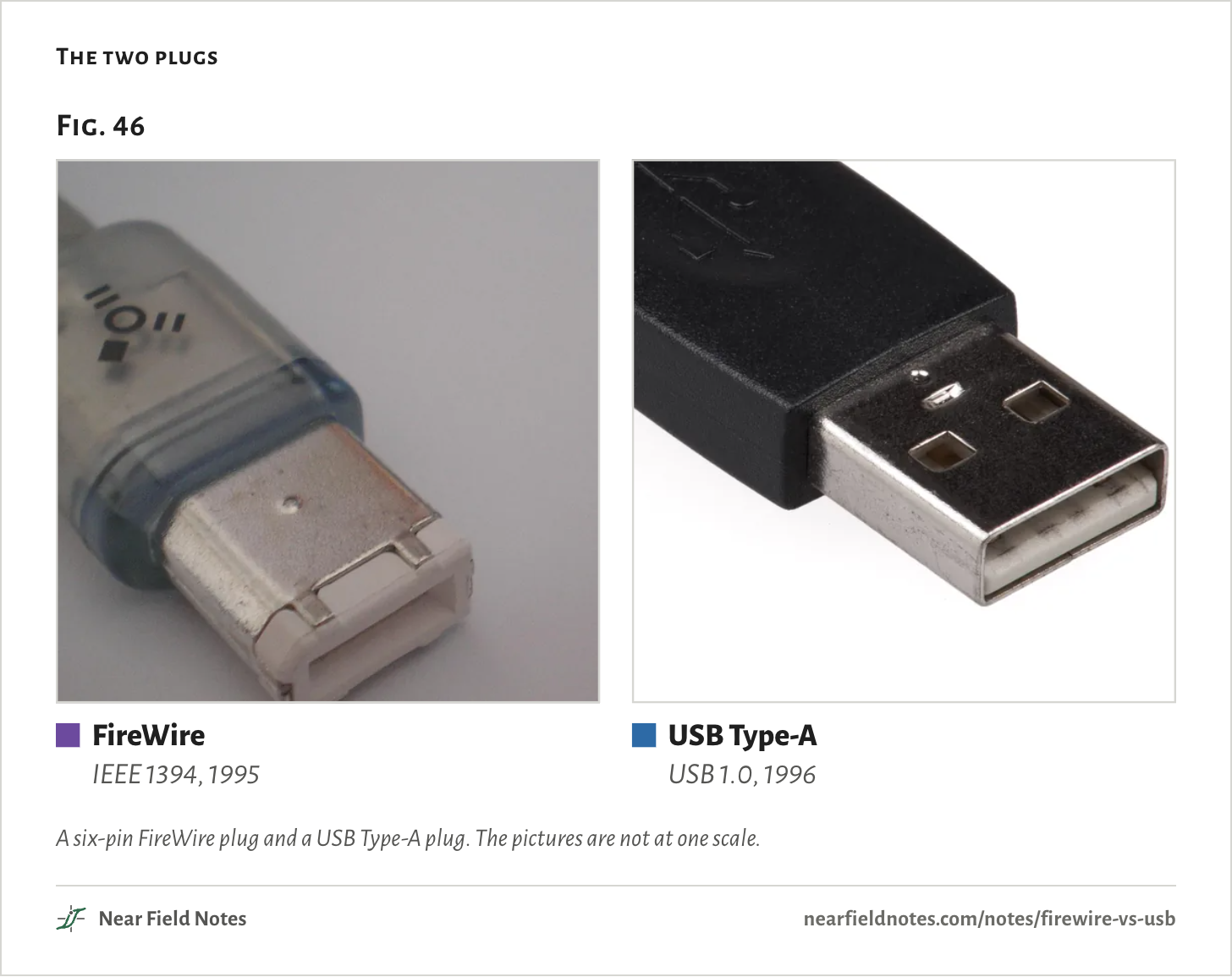
The two plugs
A six-pin FireWire plug and a USB Type-A plug. The pictures are not at one scale.
FireWire: one fast bus
1987 to 1995
Work on the bus began in 1987. Apple picked it up the next year, looking for a successor to its own desktop port, and named it FireWire in 1993. It became an IEEE standard at the end of 1995.
Who talks to whom
FireWire
USB
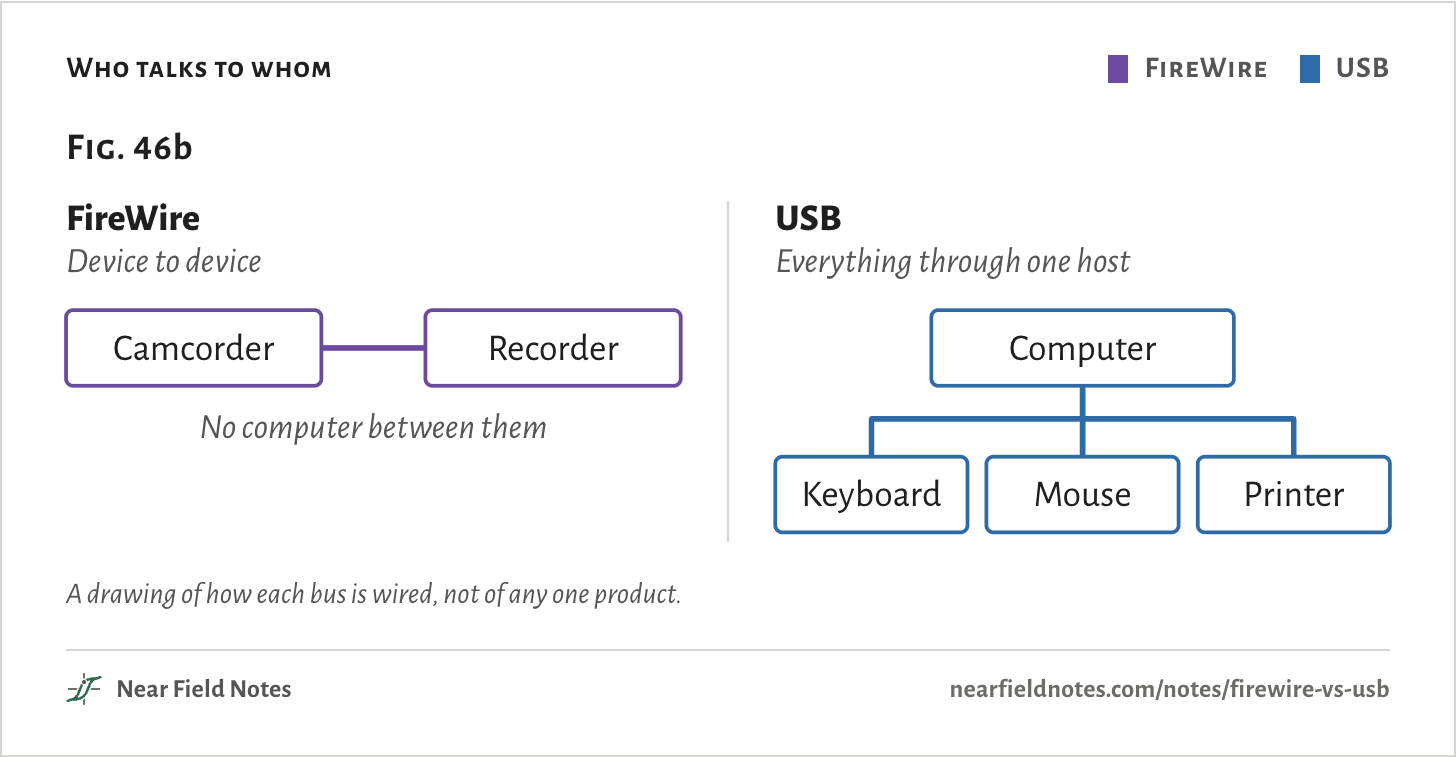
A drawing of how each bus is wired, not of any one product.
460
FireWire, IEEE 1394
Fast, and no computer needed
Field marks. 400 megabits a second. A plug that can go in with the power on. Two devices can talk with no computer between them, and video gets a guaranteed share of the wire.
Look-alike. Sony sold the same bus as i.LINK. On USB every device answers to one host, the computer.
Range. Started in 1987, at Apple from 1988, named in 1993, and an IEEE standard on 12 December 1995.
Habitat. Digital camcorders first. By the late 1990s Intel planned to build it into the chipsets of every PC.
461
USB: built to be cheap
1994 to 1996
USB aimed lower on purpose. Its specification lists the goal as a “Low-cost solution that supports transfer rates up to 12Mb/s”. The six companies with Intel were Compaq, DEC, IBM, Microsoft, NEC and Northern Telecom.
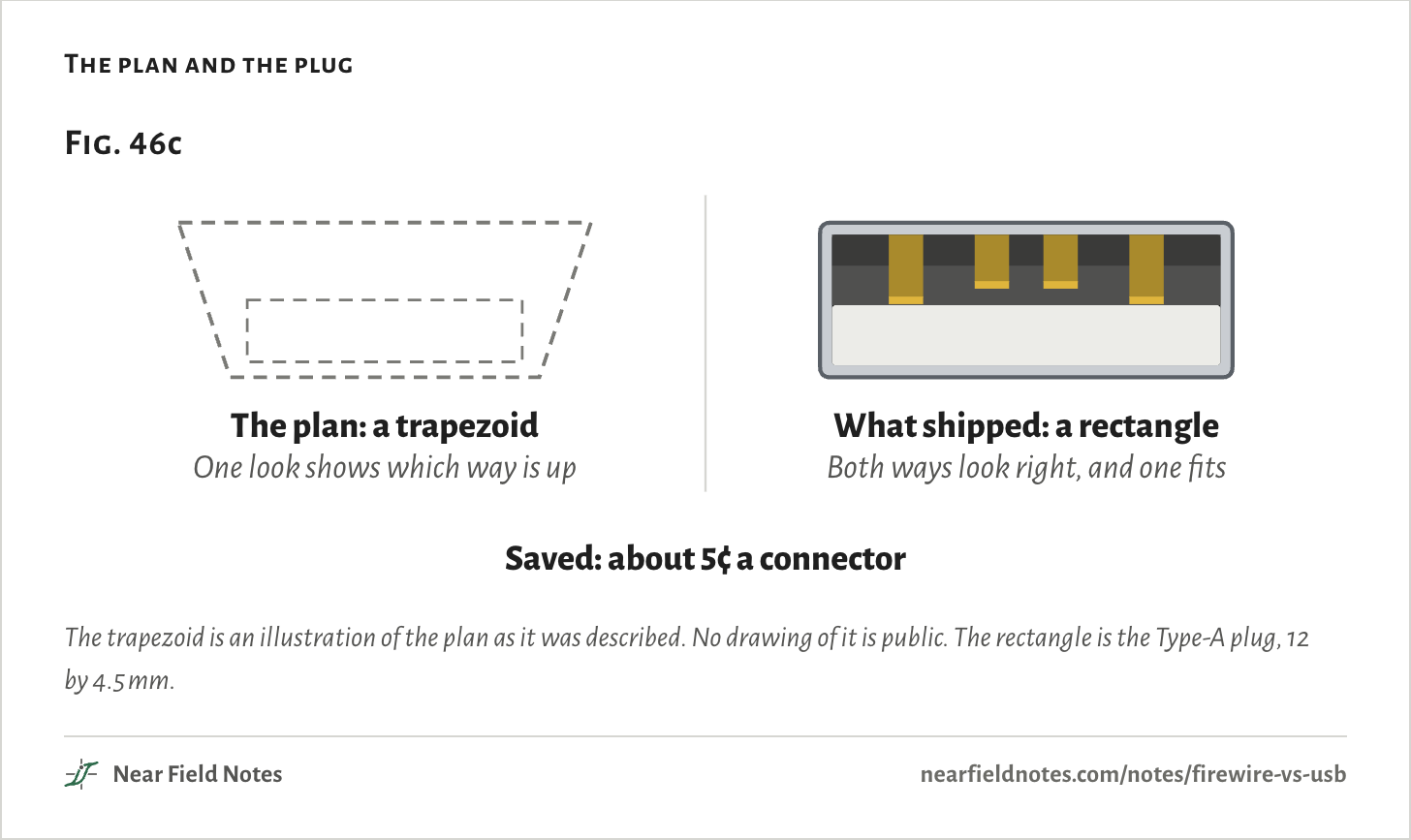
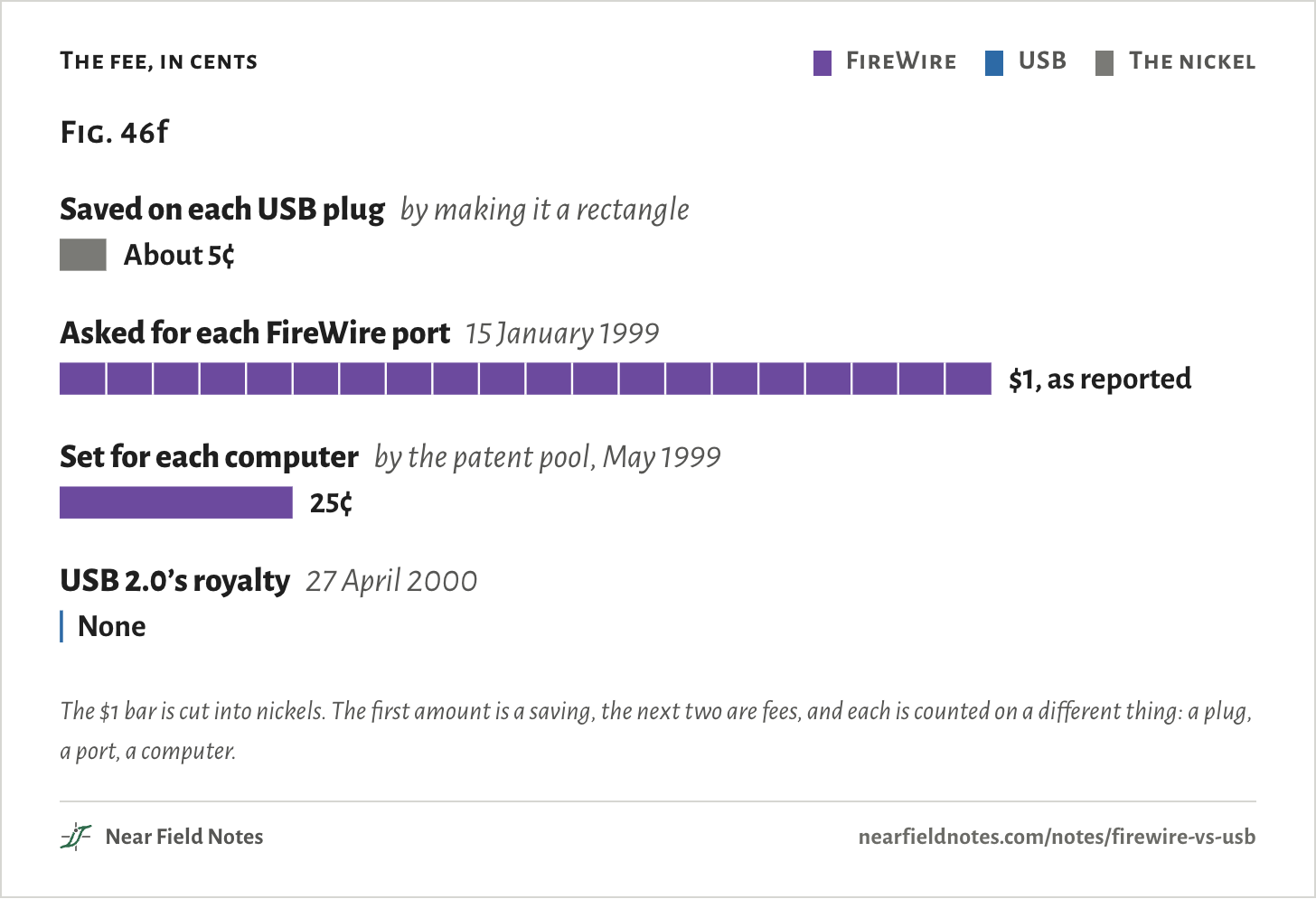
How low was low-cost? The plug was meant to be a trapezoid, so you could see which way it went in. Making it a rectangle saved about a nickel a connector, so it became a rectangle. Intel’s USB lead told that story in 2025 and said he would make the same call again.
That nickel is why you flip a USB plug over, and then flip it back.
The plan and the plug
The trapezoid is an illustration of the plan as it was described. No drawing of it is public. The rectangle is the Type-A plug, 12 by 4.5 mm.
1998: the iMac picks USB
Apple, 15 August 1998
For two years, hardly anyone used USB. About a million PCs had shipped with USB ports and nothing to plug into them, by the count of the man who ran Apple’s hardware then.
The iMac changed that. It went on sale on 15 August 1998 with two USB ports in place of Apple’s own older ports and the floppy drive. Apple lined up HP and Epson to make USB printers for it.
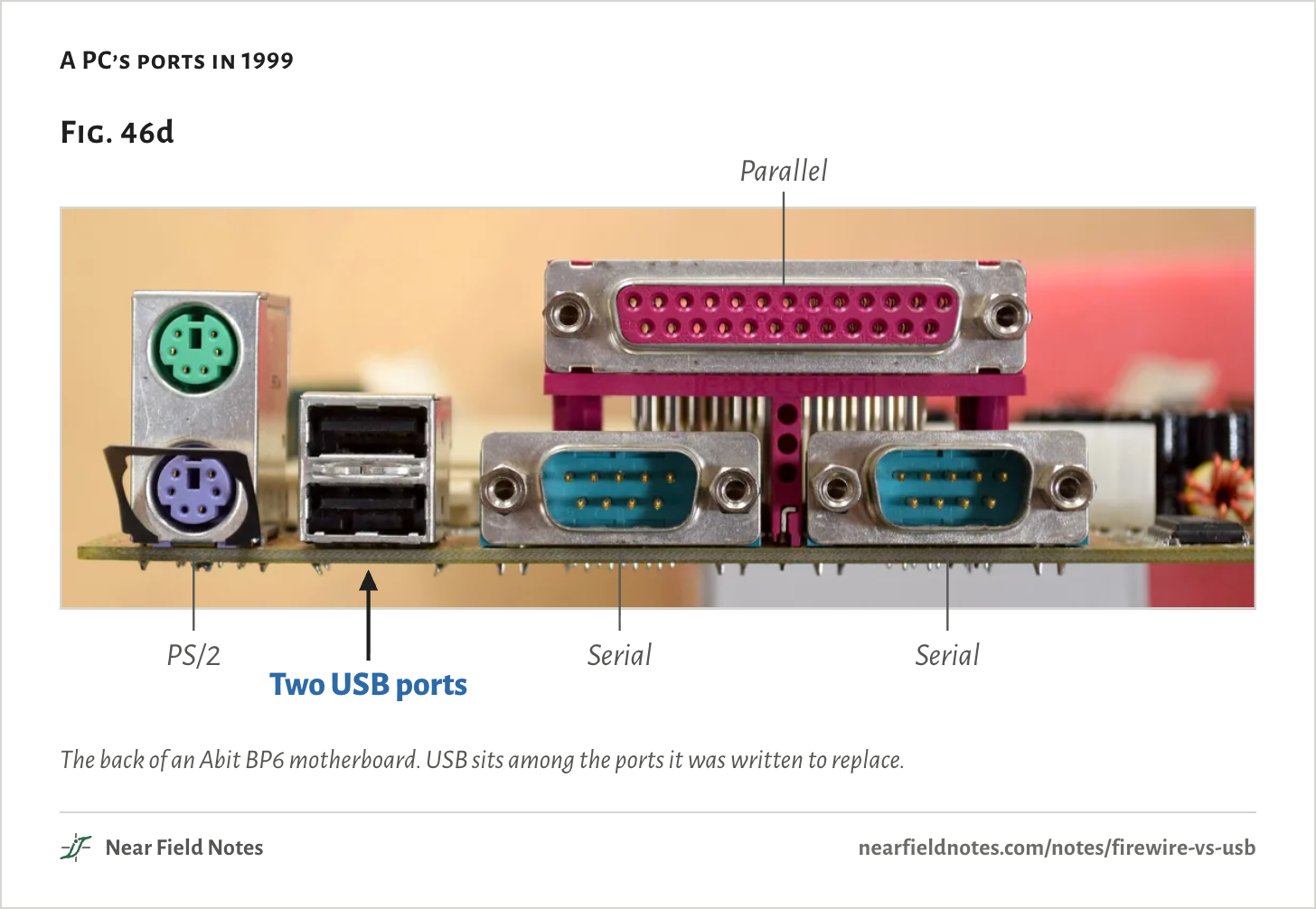
A PC’s ports in 1999
The back of an Abit BP6 motherboard. USB sits among the ports it was written to replace.
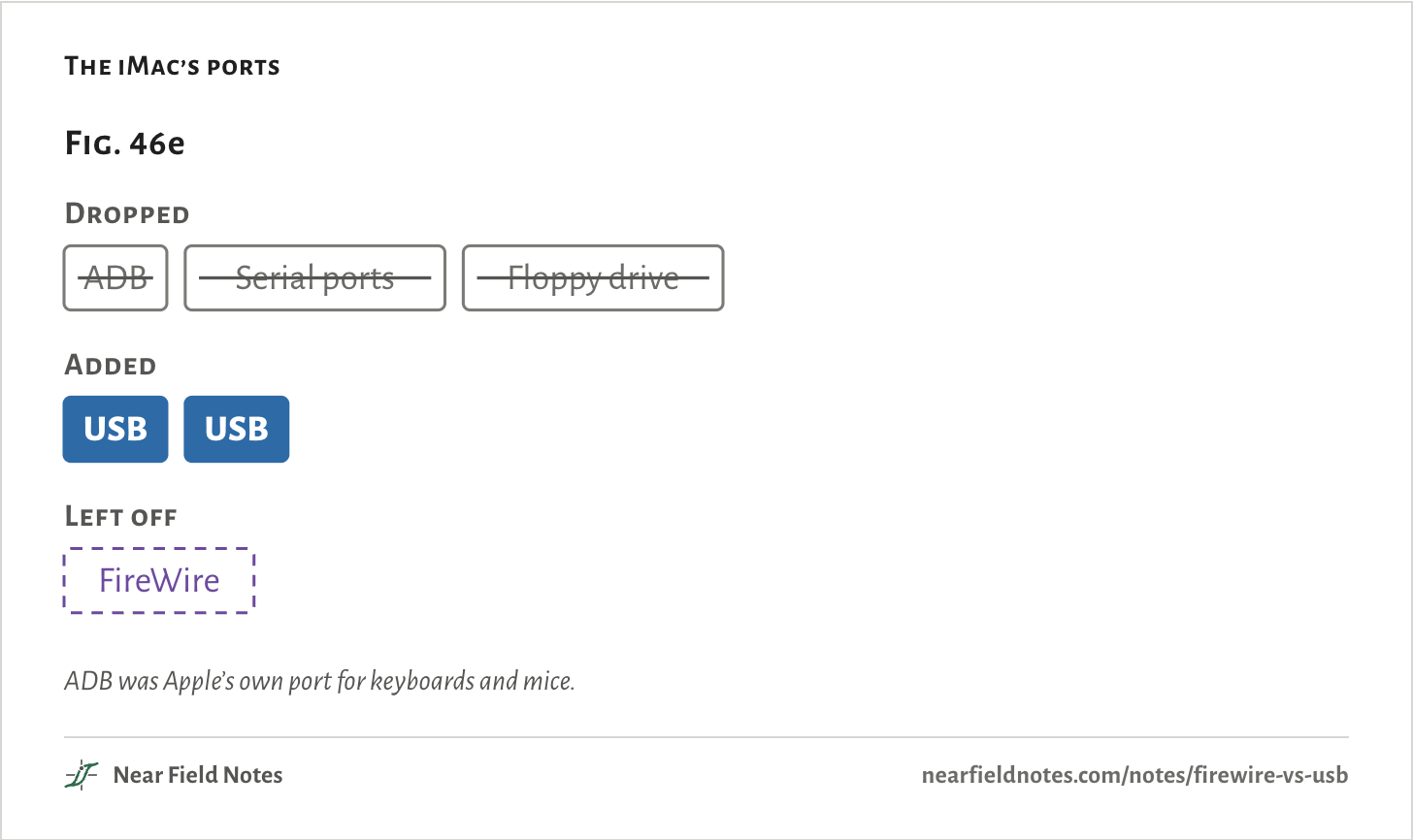
The iMac’s ports
ADB was Apple’s own port for keyboards and mice.
462
The iMac, 1998
USB got a computer that needed it
Field marks. Two USB ports. No ADB, no serial ports and no floppy drive, so a printer or a mouse had to be USB.
Look-alike. It was not waiting for a finished USB. Version 1.1, the bug-fix release, is dated 23 September 1998, 39 days after the iMac went on sale.
Range. USB 1.0 came out on 15 January 1996. The iMac followed two and a half years later.
Habitat. FireWire was left off. It was too expensive for a low-cost computer.
463
1999: the $1 fee
January to May 1999
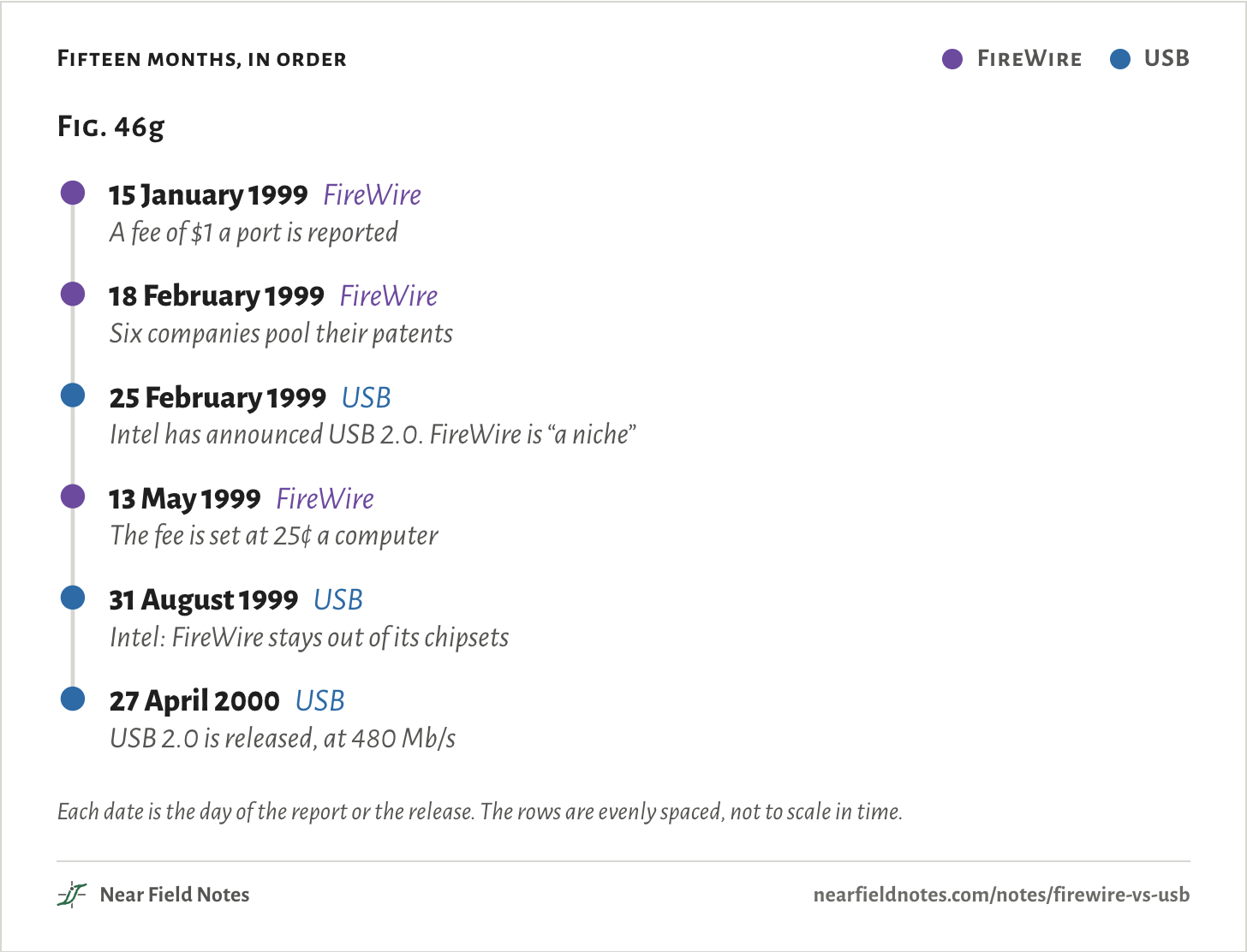
FireWire still had the high end. Then, on 15 January 1999, The Register reported: “Apple’s fee is said to be just $1 per FireWire port.”
This was an industry that had just reshaped a plug to save a nickel. A dollar is 20 nickels, and a computer can have more than one port.
A month later Apple backed down. On 18 February 1999 six companies agreed to pool their FireWire patents: Apple, Compaq, Matsushita, Philips, Sony and Toshiba. By May the fee was 25 cents a computer, however many ports it had.
The fee, in cents
FireWire
USB
The nickel
The $1 bar is cut into nickels. The first amount is a saving, the next two are fees, and each is counted on a different thing: a plug, a port, a computer.
Intel’s answer: USB 2.0
February 1999 to April 2000
That same February, Intel announced that it was working on USB 2.0. One of its executives said of FireWire: “But that’s something of a niche, and it doesn’t make sense to integrate that into our chip-sets.” By August, Intel said FireWire would stay out of its chipsets.
Fifteen months, in order
FireWire
USB
Each date is the day of the report or the release. The rows are evenly spaced, not to scale in time.
464
USB 2.0
40 times faster, and free to use
Field marks. 480 megabits a second, 40 times USB 1.1, on the same Type-A plug.
Look-alike. FireWire’s 400 megabits a second, which USB 2.0 passes by about a fifth on paper.
Range. Announced in February 1999 and released on 27 April 2000.
Habitat. Its license is royalty-free for companies that sign the adopters agreement. FireWire’s cost 25 cents a computer.
465
Speed had been FireWire’s case against USB. After April 2000 the port that came free with every Intel chipset was also the faster one on paper.
Three top speeds
FireWire
USB
Megabits a second, from each specification. FireWire’s 400 is drawn at 393.2.
Why it lost: two accounts
Two oral histories
So why did FireWire lose? Two people who were there have told it to the Computer History Museum, and they tell it differently.
The two accounts
Fig. 46i
Apple’s hardware chief
Intel’s USB lead
Recorded
2019
2025
What sank FireWire
The fee. Intel would not pay it, and pulled FireWire from its chips.
PC makers did not trust FireWire. It tried to do too much, and it was always a year away.
On the fee
“Basically that doomed FireWire.”
Never mentions it
The turning point
Intel going ahead with USB 2.0
Intel going ahead with USB 2.0
From the two oral histories. Each is one person’s memory, recorded twenty years or more after the events.
The record does not settle it. The fee was reported in January 1999, and Intel’s public turn came that February and August. Intel’s USB lead says his company had held USB 2.0 back for FireWire’s sake, and restarted it when FireWire stayed a year away.
Either way, the free port beat the fast one.
USB by committee
2000 to 2008
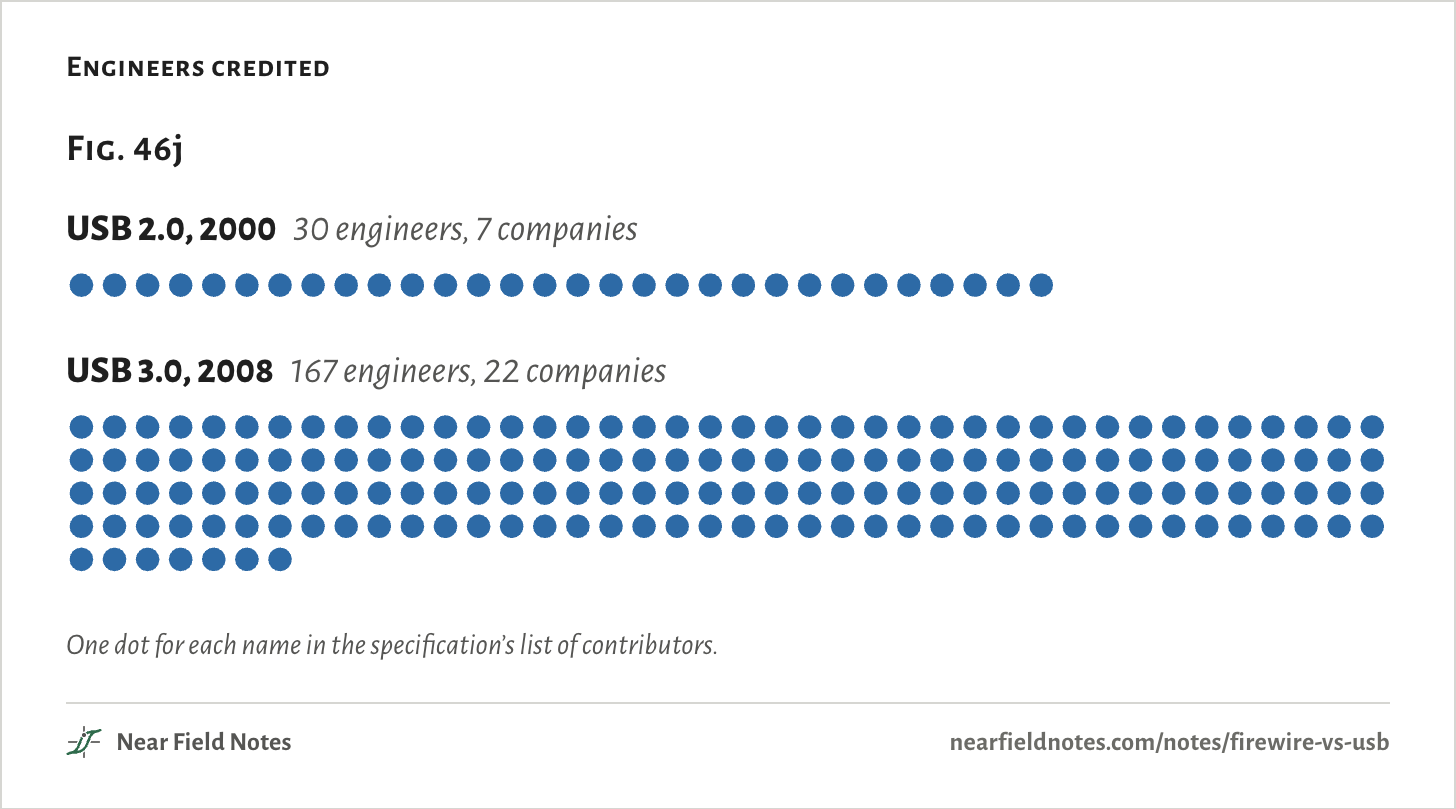
After that, USB grew by committee. The USB 2.0 specification credits 30 engineers from 7 companies. USB 3.0, released on 12 November 2008, credits 167 from 22.
Nobody from Apple is on either list.
Engineers credited
One dot for each name in the specification’s list of contributors.
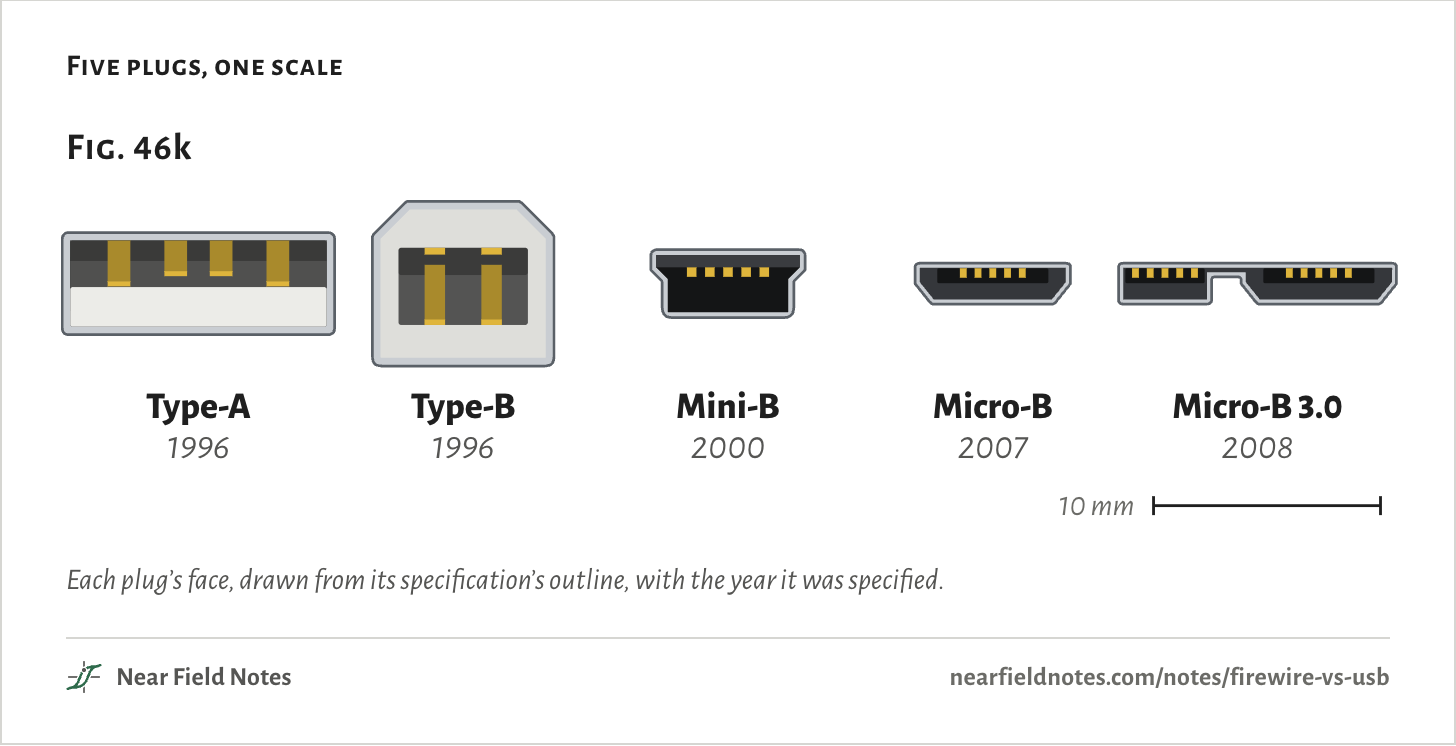
The plugs multiplied too. Type-A and Type-B came with USB 1.0. Mini-B followed in 2000 and Micro-B in 2007. USB 3.0 added a wide Micro-B, the one on many portable hard drives.
Every one of them only goes in one way.
Five plugs, one scale
Each plug’s face, drawn from its specification’s outline, with the year it was specified.
The names
As each specification prints them
A specification’s only credit is a list of names. These are the two lists, with each company as the list prints it and the companies in A to Z order. Roles such as chair or editor are left off. The USB 2.0 list has 40 entries because 10 of its 30 people sit in both of its working groups. Each is listed once here.
USB 2.0, April 2000. 30 engineers, 7 companies
Compaq Computer Corporation
Ken Stufflebeam
David Wooten
Hewlett-Packard Company
Matt Nieberger
Larry Taugher
Intel Corporation
John Garney
John Howard
Venkat Iyer
Steve McGowan
Jon Lueker
Mike Pennell
Todd West
Lucent Technologies Inc
Jim Clee
Jim Guziak
Dave Thompson
Par Parikh
Microsoft Corporation
John Fuller
Nathan Sherman
Mark Williams
Ed Giaimo
NEC Corporation
Nobuo Furuya
Toshimi Sakurai
Moto Sato
Katsuya Suzuki
Toshihiko Ohtani
Kugao Ouchi
Toshio Tasaki
Royal Philips Electronics
Geert Knapen
Zong Liang Wu
Gerrit den Besten
Marq Kole
USB 3.0, November 2008. 167 engineers, 22 companies
Acon
Glen Chandler
John Chen
Roger Hou
Charles Wang
Norman Wu
Steven Yang
George Yee
Contech Research
George Olear
Electronics Testing Center, Taiwan (ETC)
Sophia Liu
FCI
William Northey
Tom Sultzer
Foxconn
Garry Biddle
Kuan-Yu Chen
Jason Chou
Gustavo Duenas
Bob Hall
Jiayong He
Jim Koser
Joe Ortega
Ash Raheja
James Sabo
Pei Tsao
Kevin Walker
Tsuneki Watanabe
Chong Yi
Hewlett-Packard Company
Alan Berkema
Walter Fry
Anthony Hudson
David Roderick
Hirose Electric
Taro Hishinuma
Kaz Ichikawa
Ryozo Koyama
Karl Kwiat
Tadashi Sakaizawa
Shinya Tono
Eiji Wakatsuki
Intel Corporation
Kok Hong Chan
Huimin Chen
Bob Dunstan
Dan Froelich
Howard Heck
John Howard
Rahman Ismail
John Keys
Yun Ling
Andy Martwick
Steve McGowan
Ramin Neshati
Duane Quiet
Jeff Ravencraft
Brad Saunders
Joe Schaefer
Sarah Sharp
Micah Sheller
Gary Solomon
Karthi Vadivelu
Clint Walker
Jim Walsh
Japan Aviation Electronics Industry Ltd. (JAE)
Takashi Ehara
Ron Muir
Kazuhiro Saito
Microsoft Corporation
Randy Aull
Fred Bhesania
Martin Borve
Jim Bovee
Stephen Cooper
Lars Giusti
Robbie Harris
Allen Marshall
Kiran Muthabatulla
Tomas Perez-Rodriguez
Mukund Sankaranarayan
Nathan Sherman
Glen Slick
David Wooten
Rob Young
Mitsumi
Hitoshi Kawamura
Takashi Kawasaki
Atsushi Nishio
Yasuhiko Shinohara
Molex Inc.
Tom Lu
Edmund Poh
Scott Sommers
Jason Squire
NEC Corporation
Nobuo Furuya
Hiroshi Kariya
Masami Katagiri
Yuichi Mizoguchi
Kats Nakazawa
Nobuyuki Mizukoshi
Yutaka Noguchi
Hajime Nozaki
Kenji Oguma
Satoshi Ohtani
Takanori Saeki
Eiji Sakai
Hiro Sakamoto
Hajime Sakuma
Makoto Sato
Hock Seow
Yoshiyuki Tomoda
Satomi Yamauchi
Yoshiyuki Yamada
Susumu Yasuda
Nokia
Jan Fahllund
Richard Petrie
Panu Ylihaavisto
NTS/National Technical System
Dat Ba Nguyen
NXP Semiconductors, B.V.
Knud Holtvoeth
Martin Klein
Geert Knapen
Christian Paquet
Bart Vertenten
Seagate Technology LLC
Martin Furuhjelm
Julian Gorfajn
Marc Hildebrant
Tony Priborsky
Harold To
ST-NXP Wireless
Alan Chang
Wing Yan Chung
Socol Constantin
Linus Kerk
Chee Ee Lee
Veerappan Rajaram
Shaun Reemeyer
Dave Sroka
Chee-Yen TEE
Jerome Tjia
Hock Meng Yeo
Synopsys, Inc.
Robert Lefferts
Saleem Mohammad
Matthew Myers
Daniel Weinlader
Tektronix, Inc.
Mike Engbretson
Texas Instruments
Olivier Alavoine
David Arciniega
Richard Baker
Sujoy Chakravarty
T. Y. Chan
Romit Dasgupta
Alex Davidson
Eric Desmarchelier
Christophe Gautier
Dan Harmon
Will Harris
Richard Hubbard
Ivo Huber
Scott Kim
Grant Ley
Karl Muth
Lee Myers
Julie Nirchi
Wes Ray
Matthew Rowley
Bill Sherry
Mitsuru Shimada
James Skidmore
Yoram Solomon
Sue Vining
Jin-sheng Wang
Roy Wojciechowski
Tyco Electronics
Thomas Grzysiewicz
Masaaki Iwasaki
Kazukiyo Osada
Hiroshi Shirai
Scott Shuey
Masaru Ueno
The story in dates
1987 to 2008
FireWire and USB
1987Work begins on one fast bus
1988Apple picks it up
1993It is named FireWire
1995IEEE 1394 is approved on 12 December
1996USB 1.0 comes out on 15 January
1998The iMac goes on sale with two USB ports. USB 1.1 follows
1999The $1 fee is reported. Intel leaves FireWire out of its chipsets
2000USB 2.0, at 480 megabits a second, and the Mini-B plug
2007The Micro-B plug
2008USB 3.0, with a wide Micro-B of its own
466
USB in 2008
One bus, too many plugs
Field marks. By 2008 USB had won: one bus, five plugs, and none of them reversible.
Look-alike. Apple’s own iPod began on FireWire. It moved to USB 2.0 once USB 2.0 was out, by its hardware chief’s account.
Range. The story goes on in Note 47, where everyone tries to fix the plug with a port of their own. It ends in Note 48, where Thunderbolt and USB become one.
467
Conditions
Speeds
FireWire’s 400 is the S400 rate of IEEE 1394, four times the 98.304 megabit base rate. USB 1.x full speed is 12 megabits a second and USB 2.0 high speed is 480. These are signaling rates on the wire, not measured file transfers.
Dates
IEEE 1394 by the IEEE Standards Board’s approval. USB releases by each specification’s own revision history or title page. The iMac by Apple’s press release of 19 August 1998.
The fee
As reported by The Register and Computergram in 1999. Each date is the day of the report.
The two accounts
Oral histories recorded by the Computer History Museum in 2019 and 2025. The trapezoid plug and the million PCs come from them too.
Counts
Different names in each specification’s list of contributors, counted from the lists themselves.
Plugs
Type-A and Type-B from USB 1.0, Mini-B from the USB 2.0 change notice of 20 October 2000, Micro-B from Micro-USB 1.01 of 4 April 2007, and the wide Micro-B from USB 3.0.
Sourced, not measured. Every number here comes from a public record, and nothing was simulated.
Limits
The $1 fee was reported by a news site as what Apple “is said to” charge. No Apple document giving the figure was found.
The two accounts are recollections. Neither can be checked against records from inside Apple or Intel.
Nobody has published a drawing of the trapezoid plug. Fig. 46c shows the idea, not a design.
“About a million PCs” is one person’s figure, given from memory.
A top speed on paper is not a transfer speed. This note does not compare how fast real FireWire and USB 2.0 devices were.
Same name is not always same person. The counts take each list as printed.
Files
data/contributors.csvEach contributor list, as printed
report/thread/thread.mdEvery number and date, with the document it came from
refs/photos/manifest.mdEach photograph, with its author and license