Near Field Notes

Note 18PowerRev 1Watch the video · 3:04

LiPo vs LiFePO4

How does a LiFePO4 cell differ from a LiPo?

A LiFePO4 cell, or LiFe, holds less energy for its weight, lasts longer and fails more gently, but its flat voltage hides how full it is. Read with the same 10 mV error, a half-full LiPo could be 47 to 53% and a half-full LiFe anywhere from 42 to 71%. So a LiFe needs a gauge that counts charge and a charger set for 3.60 V a cell.

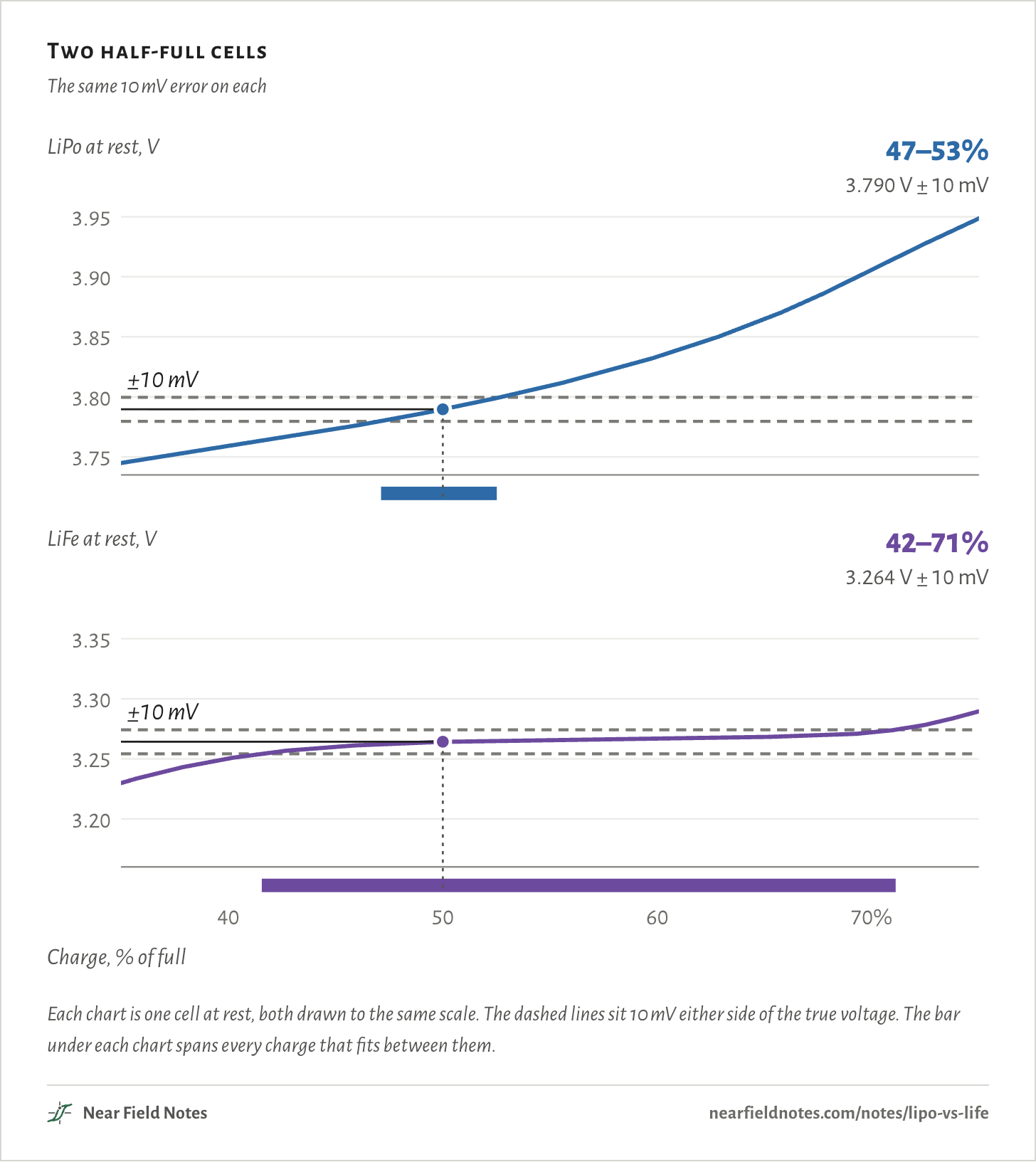
The figure reads each half-full cell with a meter that is up to 10 mV off, first low, then high.

Two half-full cells

The same 10 mV error on each

LiPo at rest, V47–53%3.790 V ± 10 mV3.753.803.853.903.95±10 mVLiFe at rest, V42–71%3.264 V ± 10 mV3.203.253.303.35±10 mV40506070%Charge, % of fullLiPo at rest, V47–53%3.790 V ± 10 mV3.753.803.853.903.95±10 mVLiFe at rest, V42–71%3.264 V ± 10 mV3.203.253.303.35±10 mV40506070%Charge, % of fullLiPo at rest, V47–53%3.790 V ± 10 mV3.753.803.853.903.95±10 mVLiFe at rest, V42–71%3.264 V ± 10 mV3.203.253.303.35±10 mV40506070%Charge, % of full

Each chart is one cell at rest, both drawn to the same scale. The dashed lines sit 10 mV either side of the true voltage. The bar under each chart spans every charge that fits between them.

The numbers
CellTrue chargeAt restReadingCharges that fit
LiPo50%3.790 V3.780 to 3.800 V47–53%
LiFe50%3.264 V3.254 to 3.274 V42–71%

A LiPo cell and a LiFe cell

What differs inside

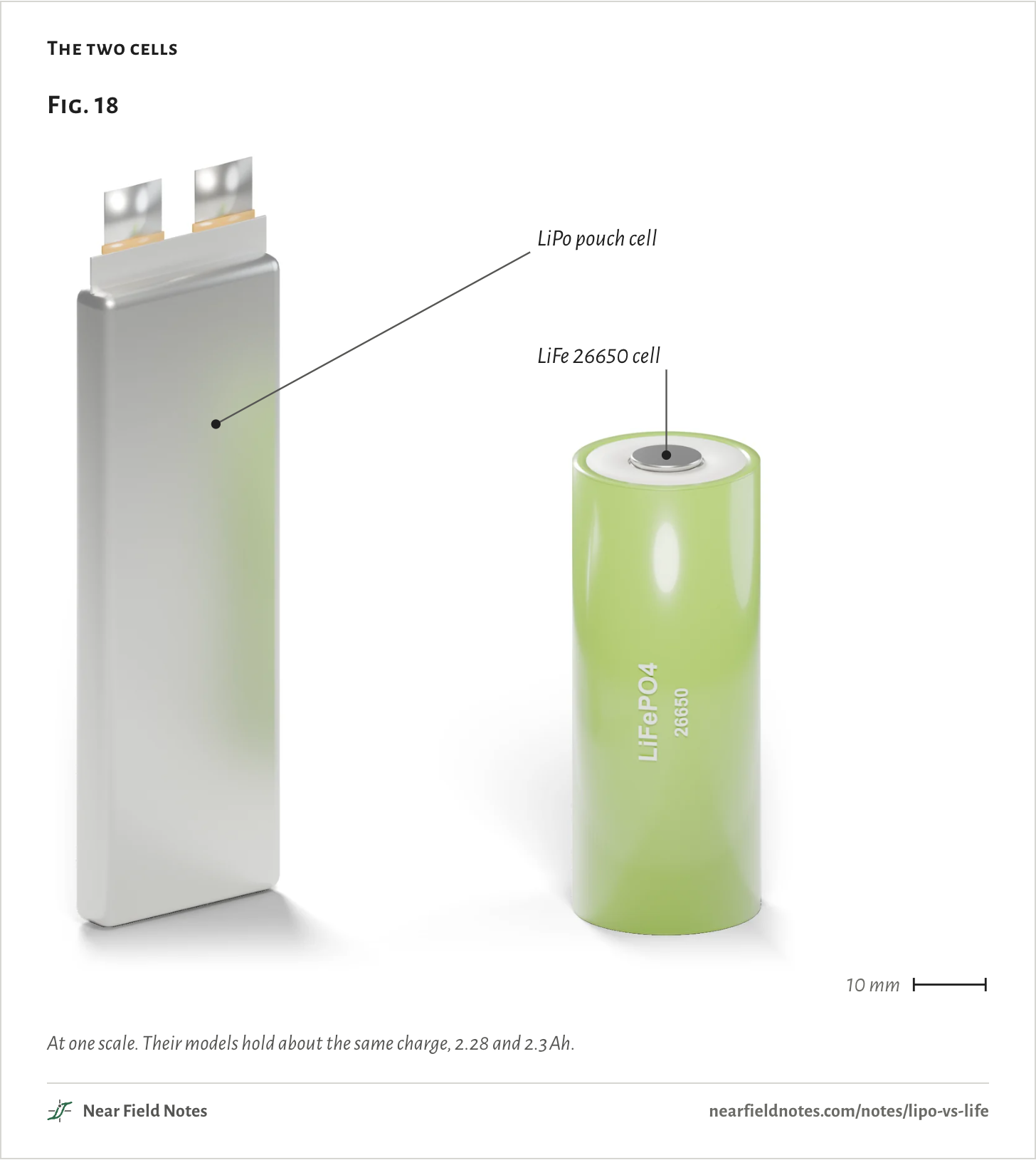
A LiPo is a lithium cobalt oxide cell in a soft foil pouch, like the cells in a hobby pack. It is full at 4.20 V and averages 3.7 V.

The LiFe here is A123’s ANR26650M1, a metal can 26 mm across and 65 mm long. It is full at 3.60 V and averages 3.3 V.

The two cells
Fig. 18LiPo pouch cellLiFe 26650 cell10 mmFig. 18LiPo pouch cellLiFe 26650 cell10 mmFig. 18LiPo pouch cellLiFe 26650 cell10 mm

At one scale. Their models hold about the same charge, 2.28 and 2.3 Ah.

The numbers
CellCathodeCapacityFullNominalEmpty
LiPoLiCoO₂2.28 Ah4.20 V3.7 V3.0 V
LiFeLiFePO₄2.3 Ah3.60 V3.3 V2.0 V

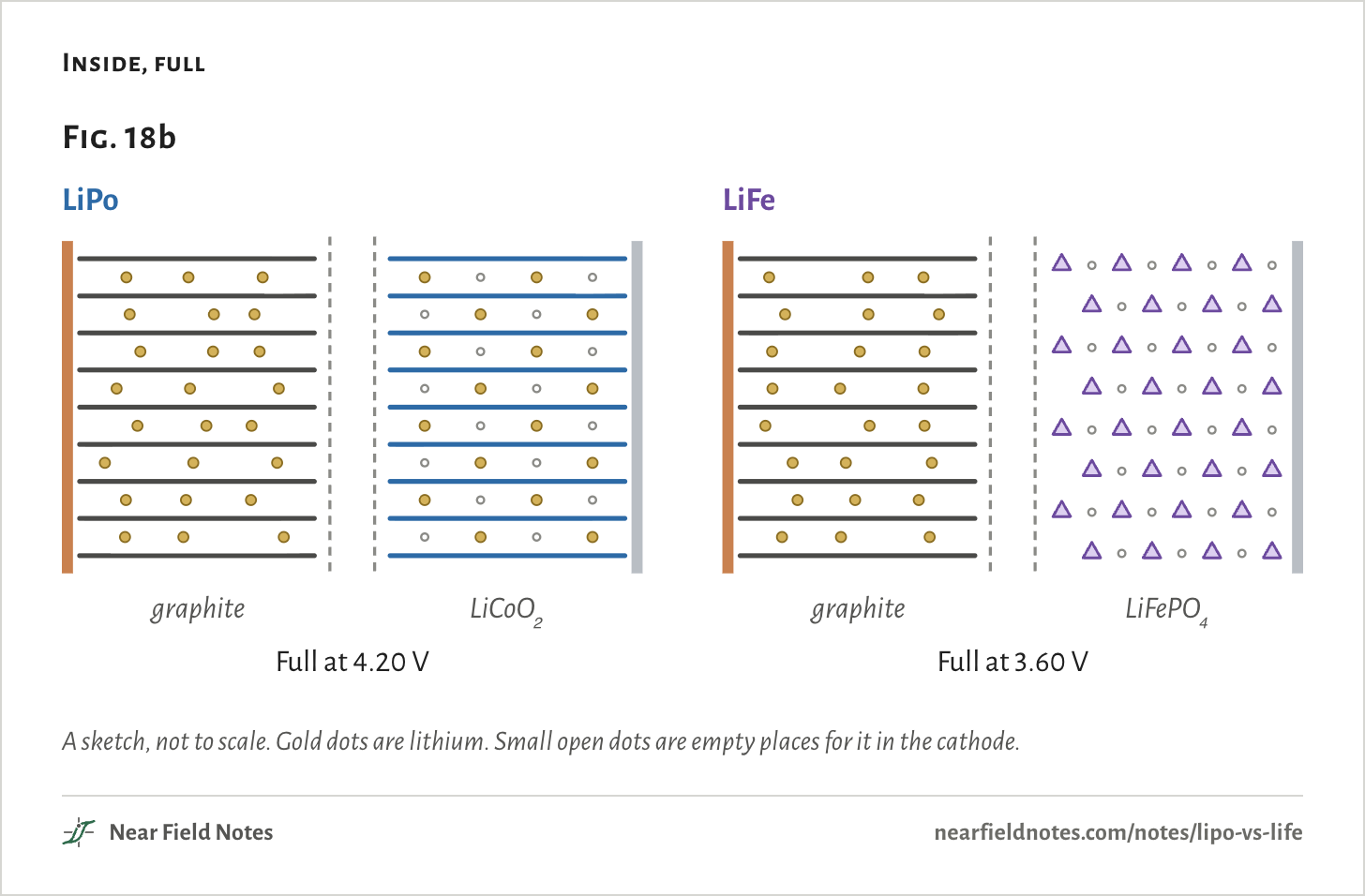
Inside, both have the same anode: graphite on copper foil. Charging pulls lithium out of the cathode and packs it between the graphite’s layers.

The cathodes differ. A full LiCoO2 cathode still holds half its lithium. A full LiFePO4 cathode holds none, so it has nothing left to give if a charger keeps pushing.

Inside, full
Fig. 18bLiPographiteLiCoO₂Full at 4.20 VLiFegraphiteLiFePO₄Full at 3.60 VFig. 18bLiPographiteLiCoO₂Full at 4.20 VLiFegraphiteLiFePO₄Full at 3.60 VFig. 18bLiPographiteLiCoO₂Full at 4.20 VLiFegraphiteLiFePO₄Full at 3.60 V

A sketch, not to scale. Gold dots are lithium. Small open dots are empty places for it in the cathode.

The numbers
CellAnodeCathodeLithium left in the cathode when fullFull at
LiPoGraphiteLiCoO₂, layeredHalf4.20 V
LiFeGraphiteLiFePO₄, olivineNone3.60 V

Voltage against charge

Steep against flat

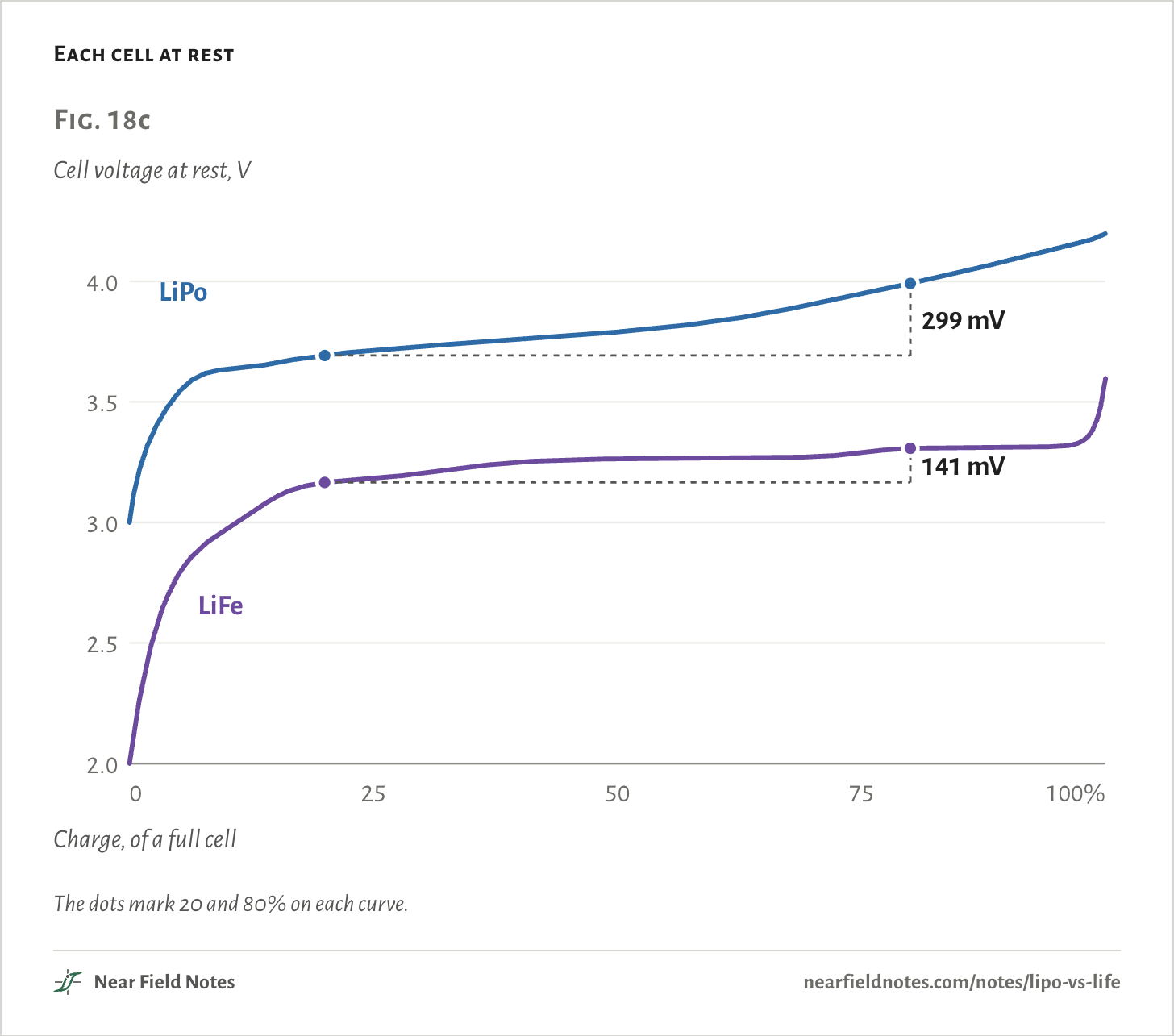
Rested, each cell’s voltage follows its charge. From 20 to 80% the LiPo climbs 299 mV.

The LiFe climbs 141 mV, from 3.17 V to 3.31 V. Most of its charge sits on a voltage that barely moves.

Each cell at rest
Fig. 18cCell voltage at rest, V2.02.53.03.54.00255075100%Charge, of a full cell299 mV141 mVLiPoLiFeFig. 18cCell voltage at rest, V2.02.53.03.54.00255075100%Charge, of a full cell299 mV141 mVLiPoLiFeFig. 18cCell voltage at rest, V2.02.53.03.54.00255075100%Charge, of a full cell299 mV141 mVLiPoLiFe

The dots mark 20 and 80% on each curve.

The numbers
ChargeLiPo at restLiFe at rest
0%3.000 V2.000 V
10%3.636 V2.975 V
20%3.692 V3.166 V
30%3.730 V3.203 V
40%3.759 V3.250 V
50%3.790 V3.264 V
60%3.833 V3.267 V
70%3.906 V3.272 V
80%3.991 V3.307 V
90%4.084 V3.312 V
100%4.197 V3.598 V

So a meter’s error becomes a charge error, divided by how steeply the curve climbs:

Δq≈ΔVs

LiPo:10 mV3.6 mV/%=2.8%

LiFe:10 mV0.58 mV/%=17%

Those slopes are at half full. The LiFe’s changes along the way, so its range in the opening figure is lopsided: 8 points below half and 21 above.

Charging

1C from 10%

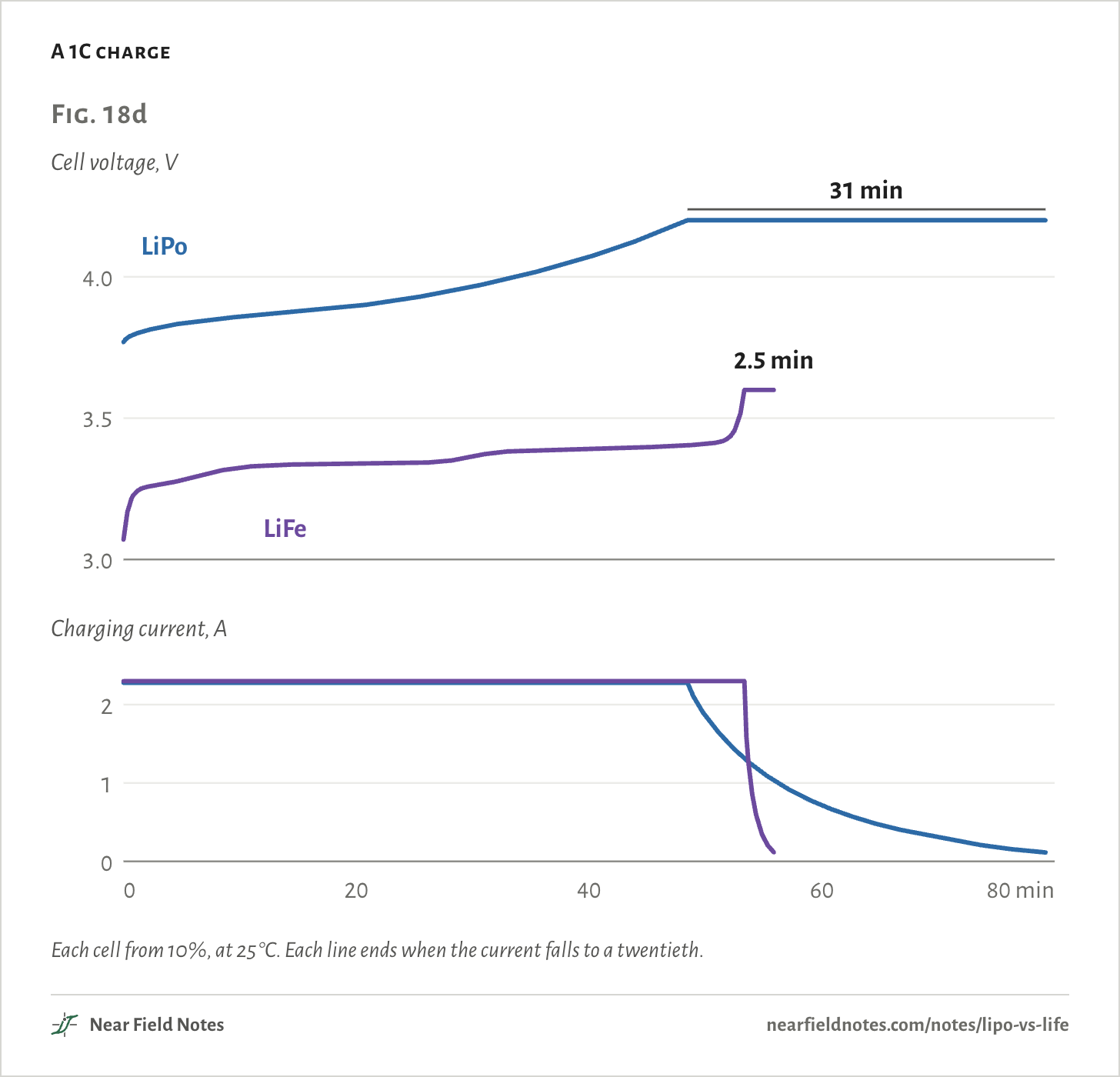
Both charge the same way. A constant current runs until the cell reaches its full voltage. Then the charger holds that voltage while the current tapers to a twentieth.

The LiPo reaches 4.20 V at 48 min and holds it for 31 min. The LiFe stays flat almost to the end, then climbs from 3.5 to 3.6 V in 27 s. It holds 3.60 V for only 2.5 min.

That last climb is all the warning a LiFe gives that it is full.

A 1C charge
Fig. 18dCell voltage, V3.03.54.0Charging current, A012020406080 min31 min2.5 minLiPoLiFeFig. 18dCell voltage, V3.03.54.0Charging current, A012020406080 min31 min2.5 minLiPoLiFeFig. 18dCell voltage, V3.03.54.0Charging current, A012020406080 min31 min2.5 minLiPoLiFe

Each cell from 10%, at 25 °C. Each line ends when the current falls to a twentieth.

The numbers
CellHoldsReaches it atThen holds it forDone atCharge taken
LiPo4.20 V48 min30.8 min79 min2.20 Ah
LiFe3.60 V53 min2.5 min56 min2.07 Ah

The wrong setting

LiPo and LiFe on one charger

Hobby chargers charge both, and you pick the chemistry from a menu. On the LiPo setting, a charger aims for 4.20 V a cell. A LiFe is full at 3.60.

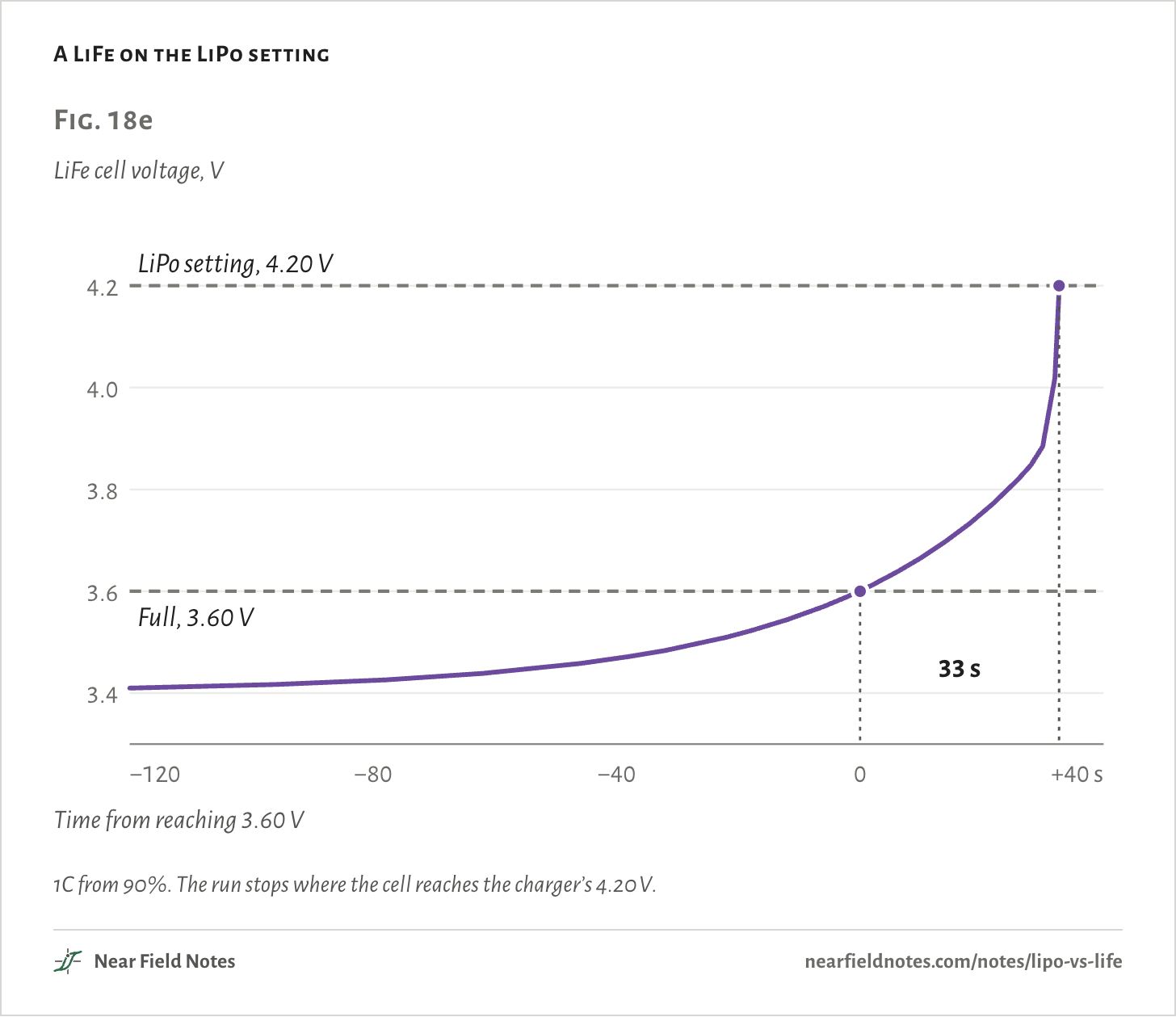
In the model, a LiFe on the LiPo setting goes from 3.60 to 4.20 V in 33 s, taking only 21 mAh more. Its cathode has no lithium left to give. In overcharge tests, a LiFe starts heating up at 100% of full, a LiCoO2 cell only near 150%.

A LiFe on the LiPo setting
Fig. 18eLiFe cell voltage, V3.43.63.84.04.2−120−80−400+40 sTime from reaching 3.60 VFull, 3.60 VLiPo setting, 4.20 V33 sFig. 18eLiFe cell voltage, V3.43.63.84.04.2−120−80−400+40 sTime from reaching 3.60 VFull, 3.60 VLiPo setting, 4.20 V33 sFig. 18eLiFe cell voltage, V3.43.63.84.04.2−120−80−400+40 sTime from reaching 3.60 VFull, 3.60 VLiPo setting, 4.20 V33 s

1C from 90%. The run stops where the cell reaches the charger’s 4.20 V.

The numbers
Seconds from 3.60 VLiFe cell
−1203.410 V
−603.441 V
−303.489 V
−103.552 V
03.601 V
+103.666 V
+203.753 V
+303.884 V
32.74.200 V
356

One weak cell

A 4S LiFe pack on a plain charger

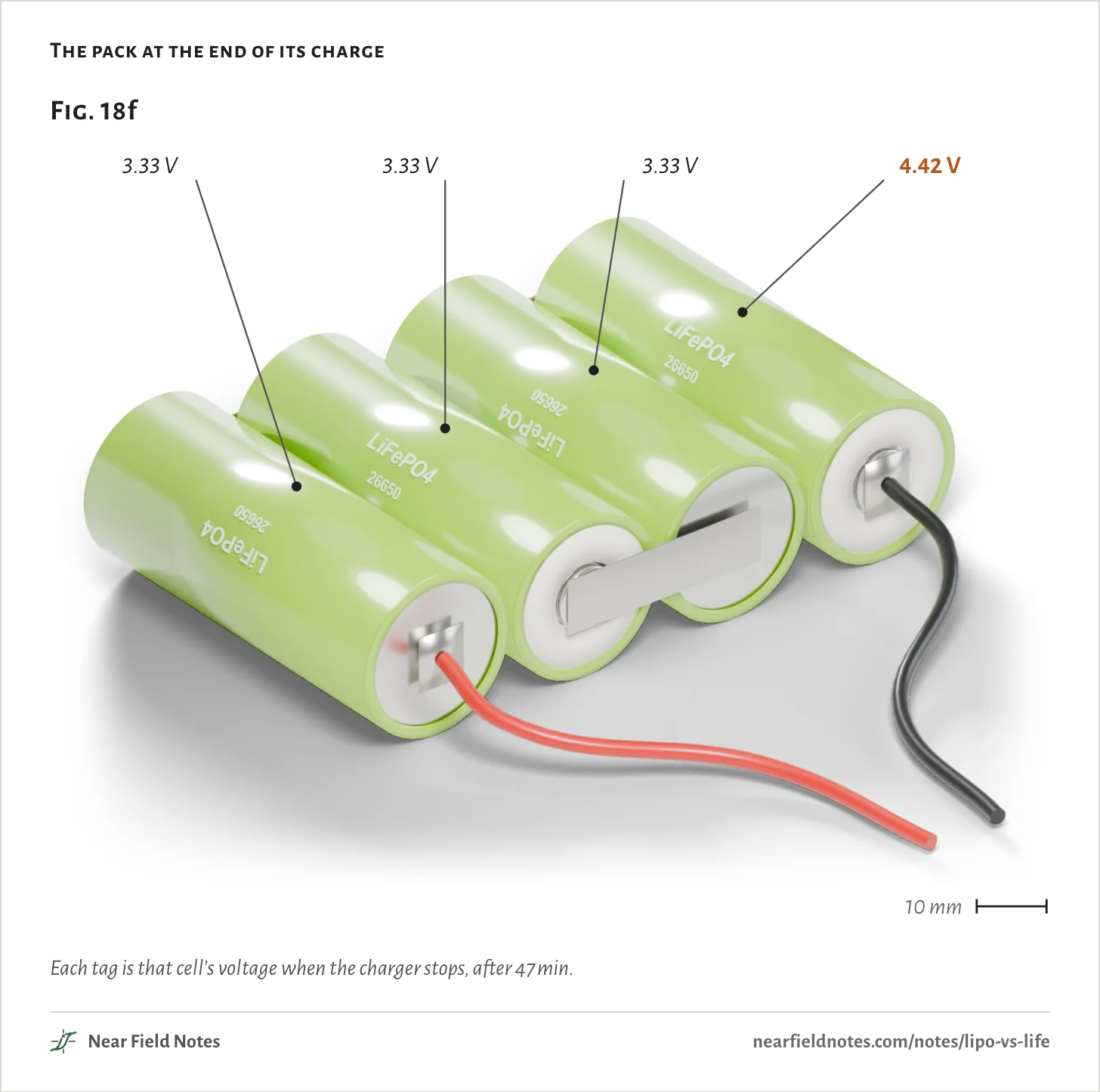
Four LiFe cells in series make a 12 V battery, charged to 14.4 V. Here the far cell holds 5% less than the others. A plain charger sees only the total:

Vpack=V1+V2+V3+V4

3.328+3.328+3.328+4.416=14.40 V

The total is right at the end of the charge. The cells aren’t. The far cell ends at 4.42 V, the others at 3.33 V.

The pack at the end of its charge
Fig. 18f3.33 V3.33 V3.33 V4.42 V10 mmFig. 18f3.33 V3.33 V3.33 V4.42 V10 mmFig. 18f3.33 V3.33 V3.33 V4.42 V10 mm

Each tag is that cell’s voltage when the charger stops, after 47 min.

The numbers
CellHoldsEnds at
1100%3.328 V
2100%3.328 V
3100%3.328 V
4, the far one95%4.416 V

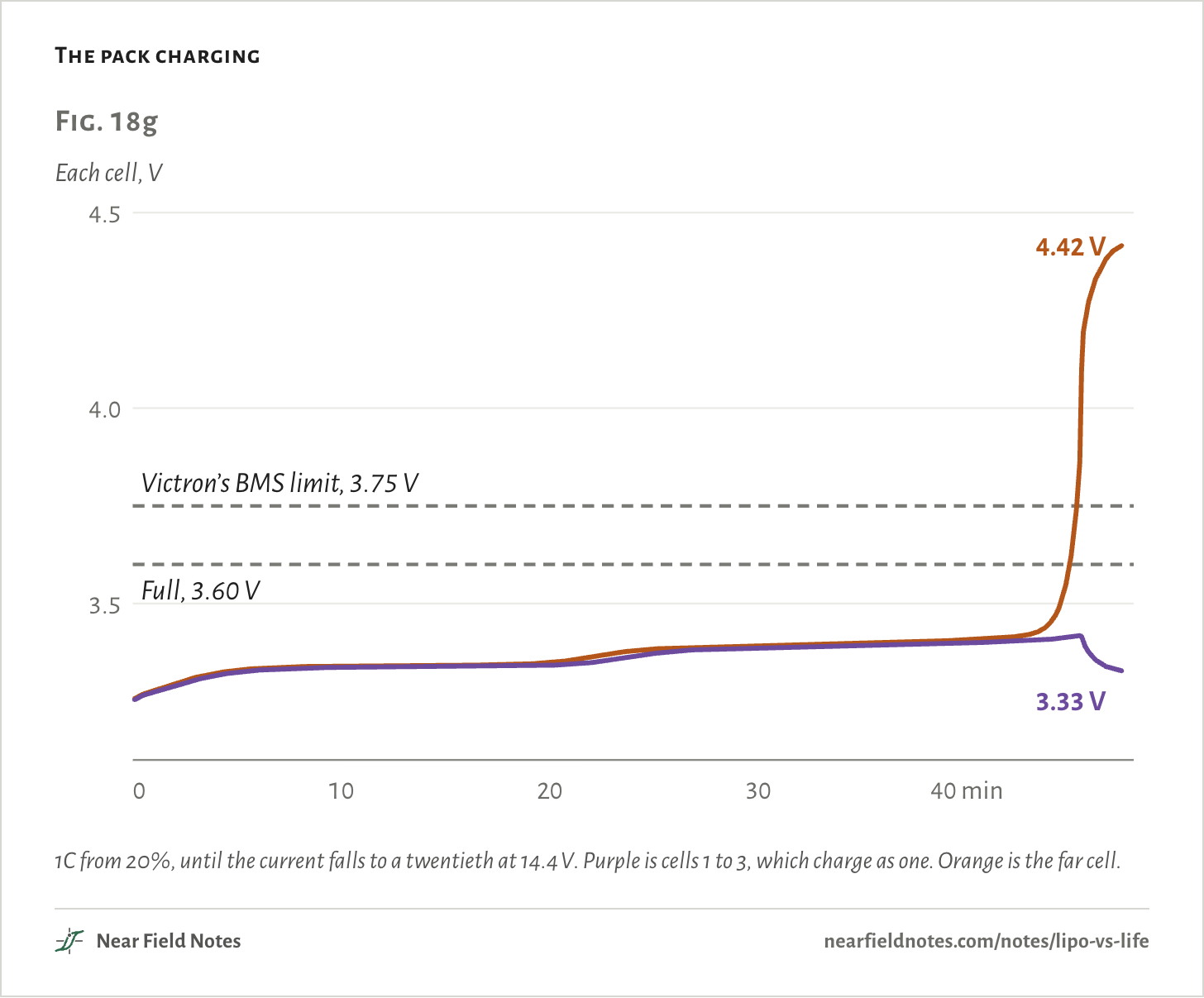
For most of the charge, all four sit on the flat part, within 17 mV of each other until 43 min. Then the small cell reaches its steep end first. It passes 3.60 V at 45 min and ends past the 3.75 V where Victron’s BMS stops a charge.

The same small cell in a 3S LiPo pack ends at 4.23 V, as in Note 15, which covers balancing. A LiPo’s slope shows the gap all through the charge. A LiFe hides it until the last minutes. TI warns that this steep end of charge “can lead to significant cell-to-cell voltage divergence”.

The pack charging
Fig. 18gEach cell, V3.54.04.5010203040 minFull, 3.60 VVictron’s BMS limit, 3.75 V4.42 V3.33 VFig. 18gEach cell, V3.54.04.5010203040 minFull, 3.60 VVictron’s BMS limit, 3.75 V4.42 V3.33 VFig. 18gEach cell, V3.54.04.5010203040 minFull, 3.60 VVictron’s BMS limit, 3.75 V4.42 V3.33 V

1C from 20%, until the current falls to a twentieth at 14.4 V. Purple is cells 1 to 3, which charge as one. Orange is the far cell.

The numbers
MinuteCells 1 to 3Cell 4Pack
03.254 V3.257 V13.02 V
103.337 V3.340 V13.35 V
203.342 V3.349 V13.38 V
303.387 V3.392 V13.55 V
403.399 V3.407 V13.60 V
433.405 V3.421 V13.64 V
453.414 V3.623 V13.86 V
47.4, end3.328 V4.416 V14.40 V

Counting charge

When the voltage can’t say

So a LiFe gauge counts charge instead. It reads the current through a shunt and adds it up, in and out.

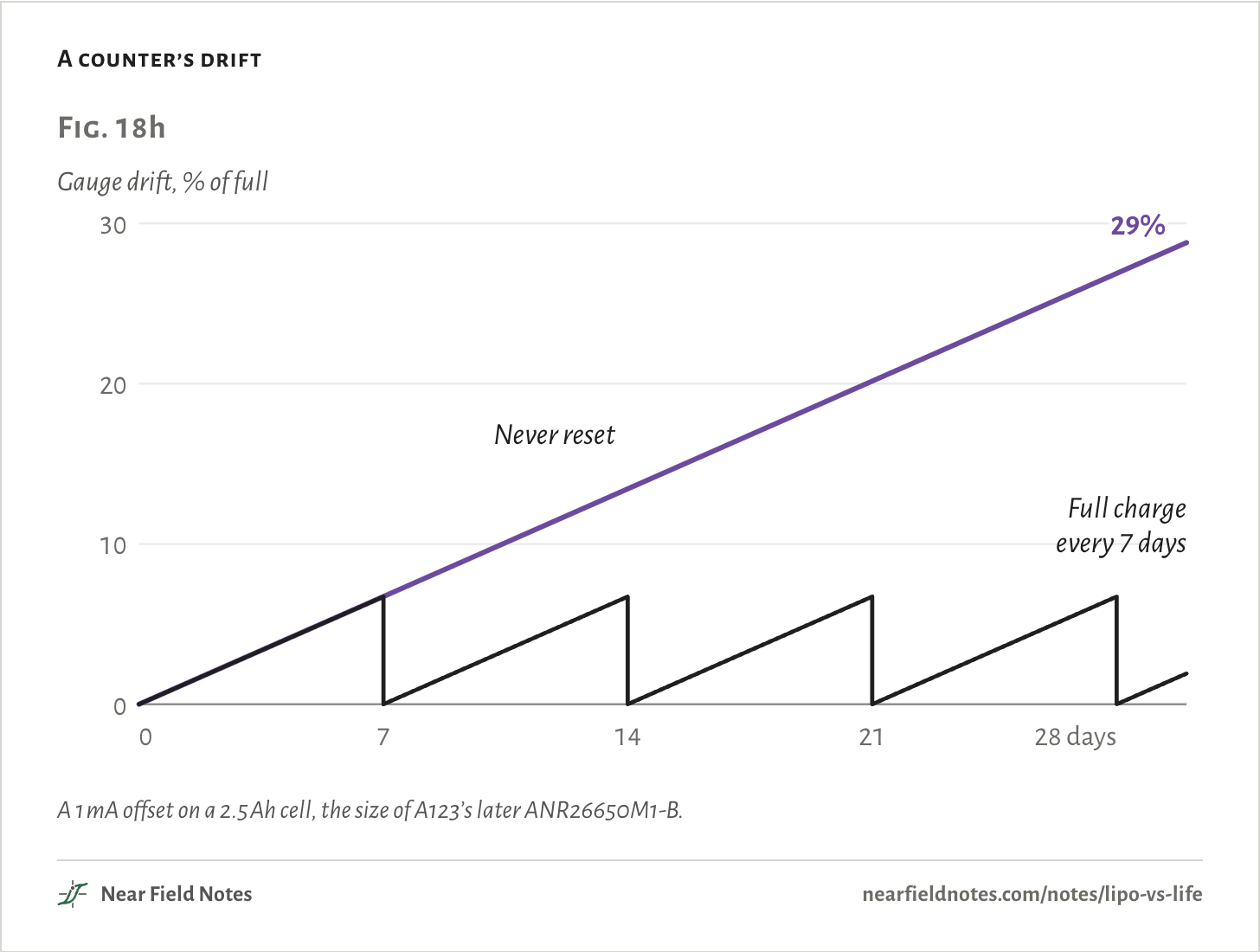
Counting drifts. Any offset in the current reading adds up too:

Δqdrift=IofftQ

=1 mA × 720 h2.5 Ah=29%

TI’s example offset is 1 mA. Never corrected, it walks a 2.5 Ah gauge 29% off in 30 days. Real gauges trim their offset, so this is the size of the problem, not a typical result.

A counter needs a fixed point. A full charge is one. Held at 3.60 V until the current tapers off, the cell is full whatever the count says.

Victron’s SmartShunt resets at a full charge, once the voltage passes its charged level and the current tapers. It asks for one regularly to stop the drift. Reset every 7 days, the same offset never gets past 6.7%.

A counter’s drift
Fig. 18hGauge drift, % of full102030007142128 daysNever resetFull chargeevery 7 days29%Fig. 18hGauge drift, % of full102030007142128 daysNever resetFull chargeevery 7 days29%Fig. 18hGauge drift, % of full102030007142128 daysNever resetFull chargeevery 7 days29%

A 1 mA offset on a 2.5 Ah cell, the size of A123’s later ANR26650M1-B.

The numbers
DayNever resetFull charge every 7 days
00.0%0.0%
76.7%6.7%, then 0
1413.4%6.7%, then 0
2120.2%6.7%, then 0
2826.9%6.7%, then 0
3028.8%1.9%

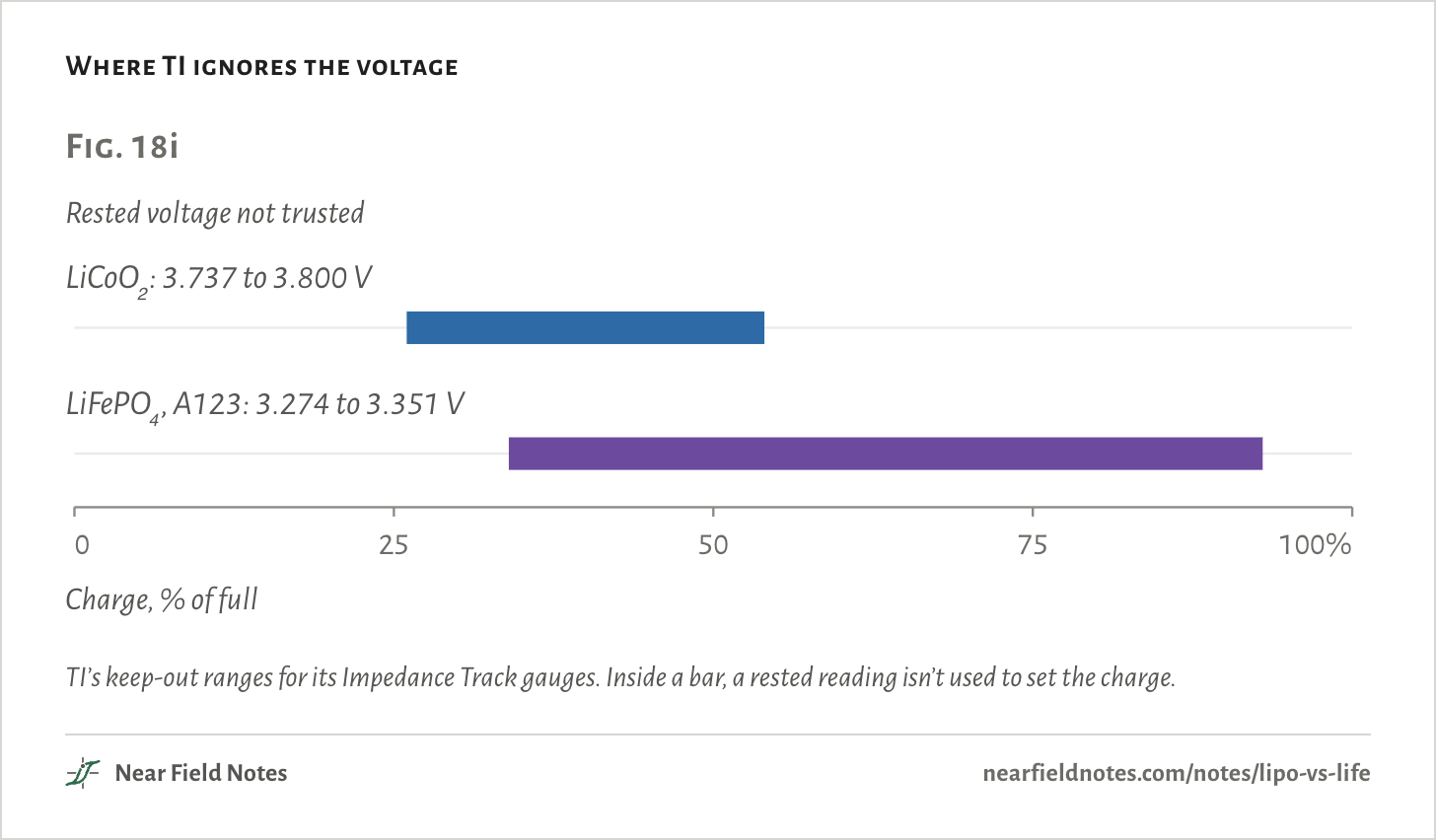
The other fixed point is a rested voltage, away from the flat part. TI’s gauge won’t trust one from A123’s cell between 34 and 93%, and waits 5 hours after a charge before trusting one at all. Its default wait is 30 minutes.

Even rested, a LiFe’s voltage depends on whether it was last charged or discharged. In one 20 Ah cell the gap was about 15 mV at half charge, more than the opening figure’s 10 mV error.

Where TI ignores the voltage
Fig. 18iRested voltage not trustedLiCoO₂: 3.737 to 3.800 VLiFePO₄, A123: 3.274 to 3.351 V0255075100%Charge, % of fullFig. 18iRested voltage not trustedLiCoO₂: 3.737 to 3.800 VLiFePO₄, A123: 3.274 to 3.351 V0255075100%Charge, % of fullFig. 18iRested voltage not trustedLiCoO₂: 3.737 to 3.800 VLiFePO₄, A123: 3.274 to 3.351 V0255075100%Charge, % of full

TI’s keep-out ranges for its Impedance Track gauges. Inside a bar, a rested reading isn’t used to set the charge.

The numbers
ChemistryTI IDNot trusted fromToCharge
LiCoO₂1003737 mV3800 mV26 to 54%
LiFePO₄, A1234043274 mV3351 mV34 to 93%
358

Charging in the cold

Same graphite, same limit

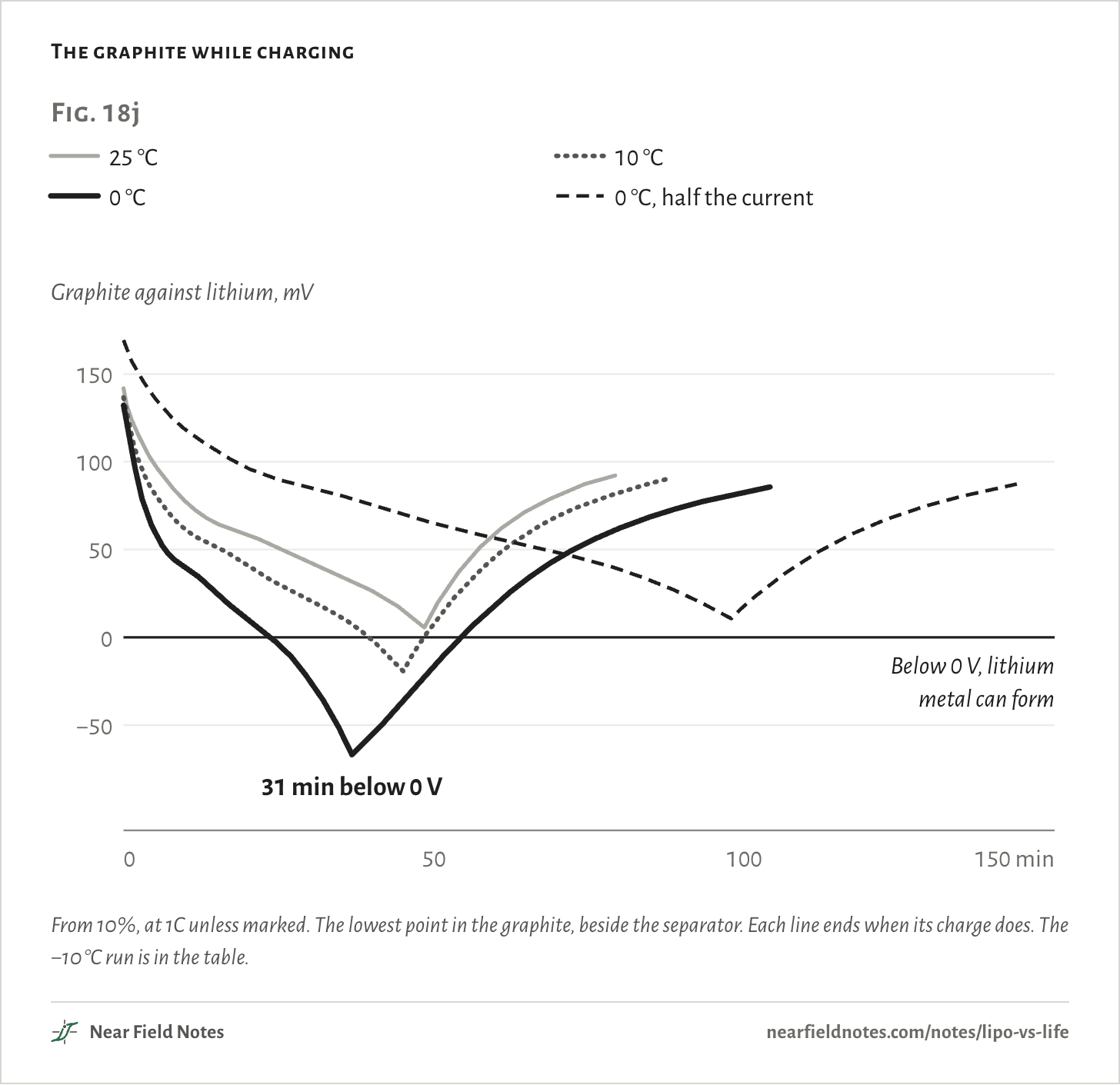
Charging pushes lithium into the graphite. In the cold it moves in slowly, and the graphite’s voltage against lithium falls. Below 0 V, lithium metal can build up on the anode’s surface instead.

Both cells use graphite, so this model is the LiPo’s. At 1C and 25 °C the graphite bottoms out at 5.6 mV. At 10 °C it spends 9 min below 0 V, at 0 °C 31 min, and at −10 °C 105 min.

Half the current at 0 °C keeps it above 0 V, at 11 mV. The charge takes 144 min instead of 104 min.

The graphite while charging
Fig. 18j25 °C10 °C0 °C0 °C, halfGraphite against lithium, mV−5050100150050100150 min0Below 0 V, lithiummetal can form31 min below 0 VFig. 18j25 °C10 °C0 °C0 °C, half the currentGraphite against lithium, mV−5050100150050100150 min0Below 0 V, lithiummetal can form31 min below 0 VFig. 18j25 °C10 °C0 °C0 °C, half the currentGraphite against lithium, mV−5050100150050100150 min0Below 0 V, lithiummetal can form31 min below 0 V

From 10%, at 1C unless marked. The lowest point in the graphite, beside the separator. Each line ends when its charge does. The −10 °C run is in the table.

The numbers
TemperatureCurrentLowestBelow 0 V forCharge took
25 °C1C+5.6 mVnever79 min
10 °C1C−19.3 mV9.0 min87 min
0 °C1C−66.9 mV30.8 min104 min
−10 °C1C−99.9 mV104.7 min185 min
0 °CC/2+10.6 mVnever144 min

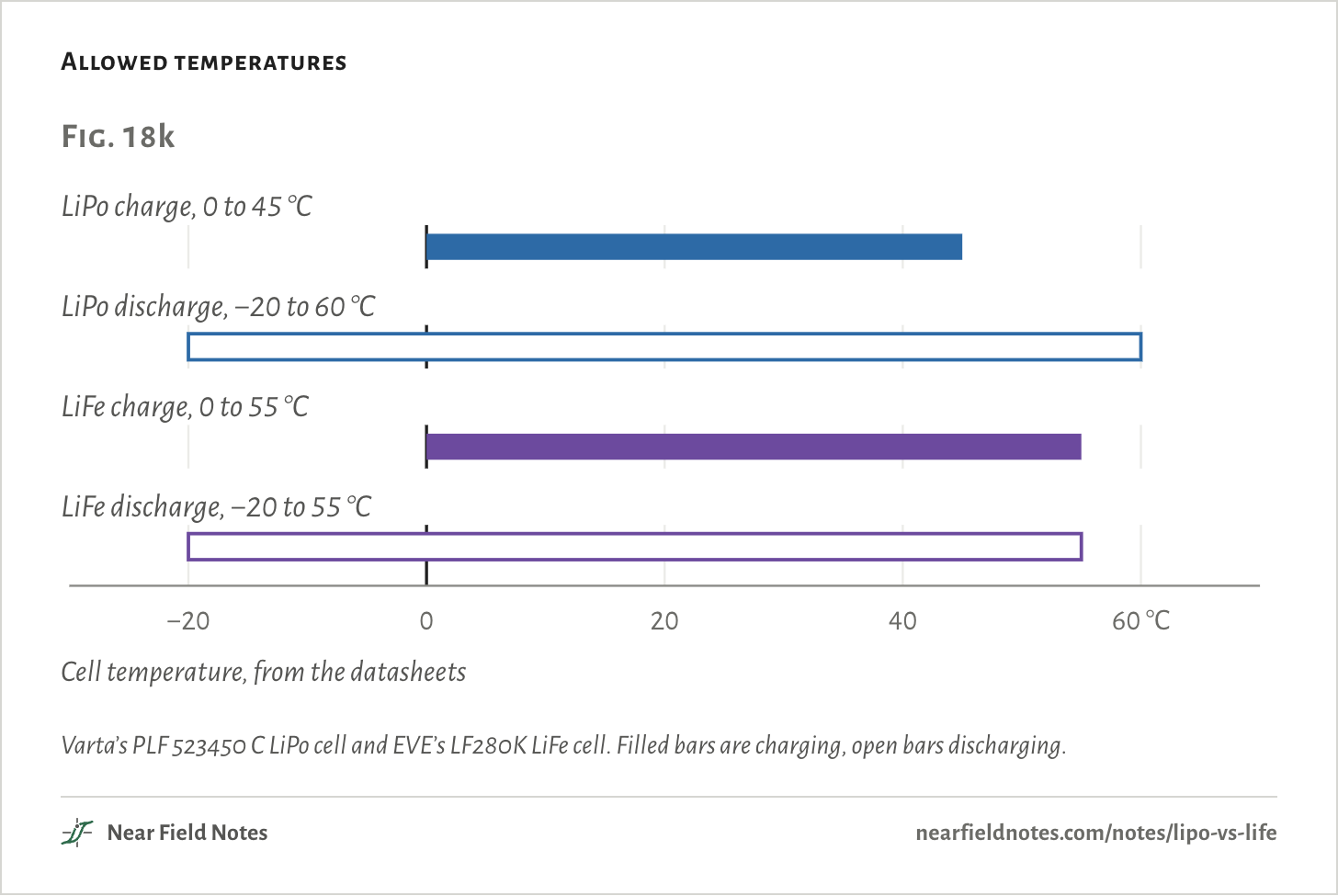
So both datasheets stop charging at 0 °C. The LiFe’s allows charging up to 55 °C, the LiPo’s up to 45 °C.

Allowed temperatures
Fig. 18kLiPo charge, 0 to 45 °CLiPo discharge, −20 to 60 °CLiFe charge, 0 to 55 °CLiFe discharge, −20 to 55 °C−200204060 °CCell temperature, from the datasheetsFig. 18kLiPo charge, 0 to 45 °CLiPo discharge, −20 to 60 °CLiFe charge, 0 to 55 °CLiFe discharge, −20 to 55 °C−200204060 °CCell temperature, from the datasheetsFig. 18kLiPo charge, 0 to 45 °CLiPo discharge, −20 to 60 °CLiFe charge, 0 to 55 °CLiFe discharge, −20 to 55 °C−200204060 °CCell temperature, from the datasheets

Varta’s PLF 523450 C LiPo cell and EVE’s LF280K LiFe cell. Filled bars are charging, open bars discharging.

The numbers
CellChargeDischargeDatasheet
LiPo0 to 45 °C−20 to 60 °CVarta PLF 523450 C
LiFe0 to 55 °C−20 to 55 °CEVE LF280K
360

Heat

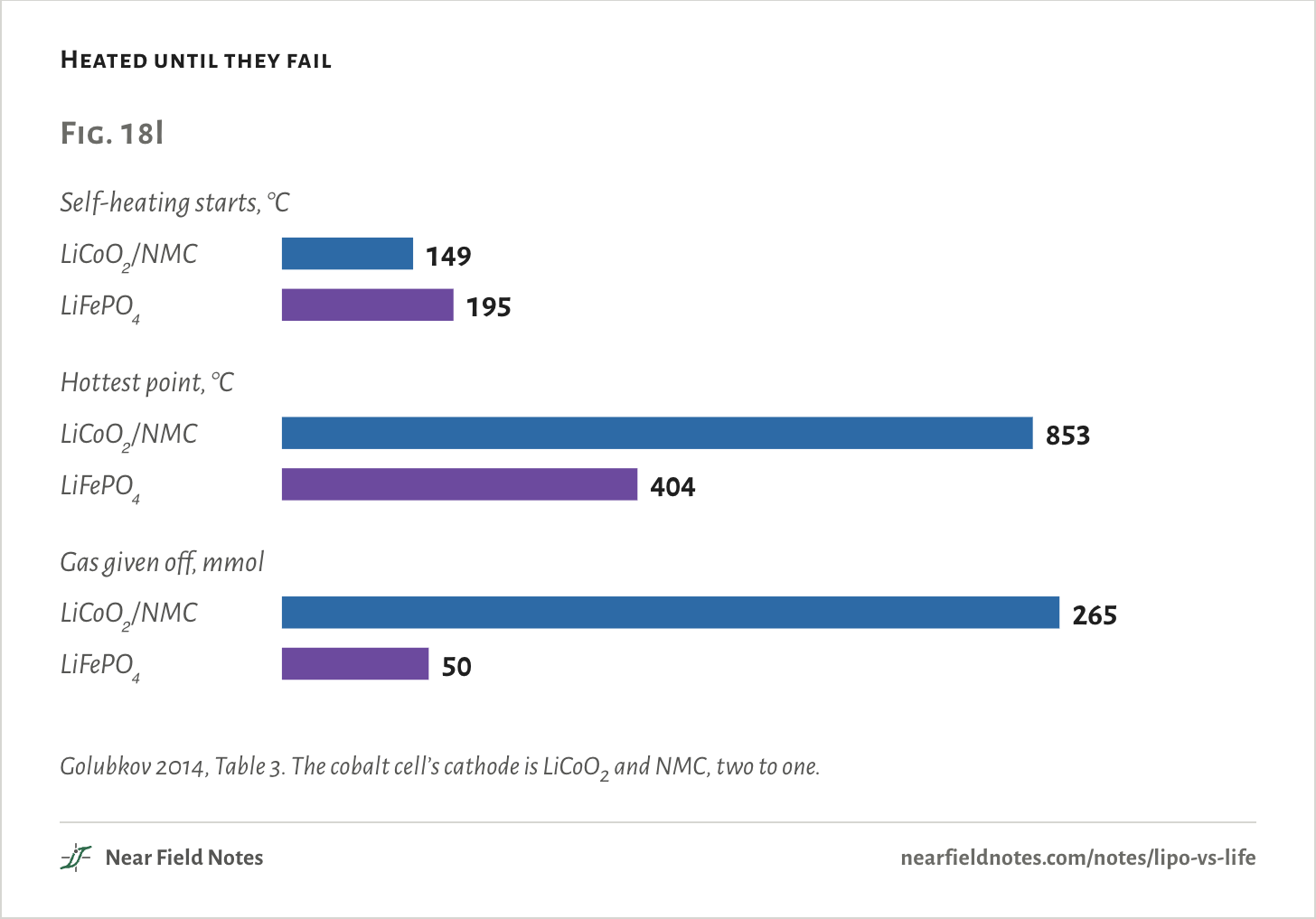
Heated until they fail

Golubkov and colleagues heated 18650 cells in argon until they failed. The LiFePO4 cell began heating itself later, at 195 °C against 149. It peaked at 404 °C against 853, and gave off a fifth of the gas.

The reason is oxygen. Hot LiCoO2 breaks down and gives off oxygen, which burns with the electrolyte. LiFePO4 keeps its oxygen even when it breaks down.

Part of the gap is size. The LiFePO4 cell held 3.5 Wh, the other about 9.9.

Heated until they fail
Fig. 18lSelf-heating starts, °CLiCoO₂/NMC149LiFePO₄195Hottest point, °CLiCoO₂/NMC853LiFePO₄404Gas given off, mmolLiCoO₂/NMC265LiFePO₄50Fig. 18lSelf-heating starts, °CLiCoO₂/NMC149LiFePO₄195Hottest point, °CLiCoO₂/NMC853LiFePO₄404Gas given off, mmolLiCoO₂/NMC265LiFePO₄50Fig. 18lSelf-heating starts, °CLiCoO₂/NMC149LiFePO₄195Hottest point, °CLiCoO₂/NMC853LiFePO₄404Gas given off, mmolLiCoO₂/NMC265LiFePO₄50

Golubkov 2014, Table 3. The cobalt cell’s cathode is LiCoO2 and NMC, two to one.

The numbers
MeasureLiCoO₂/NMC 18650LiFePO₄ 18650
Self-heating starts149 °C195 °C
Hottest point853 °C404 °C
Gas given off265 mmol50 mmol

Heat still wears a LiFe out. EVE rates its LF280K for 6,000 cycles at 25 °C and 2,500 at 45 °C.

Storage and shipping

Neither likes sitting full

Store a LiPo at 3.8 V a cell, about half full. Hobby chargers have a storage mode that charges or discharges a pack to it.

Store a LiFe at 30 to 50%, as EVE specifies for its LF280K.

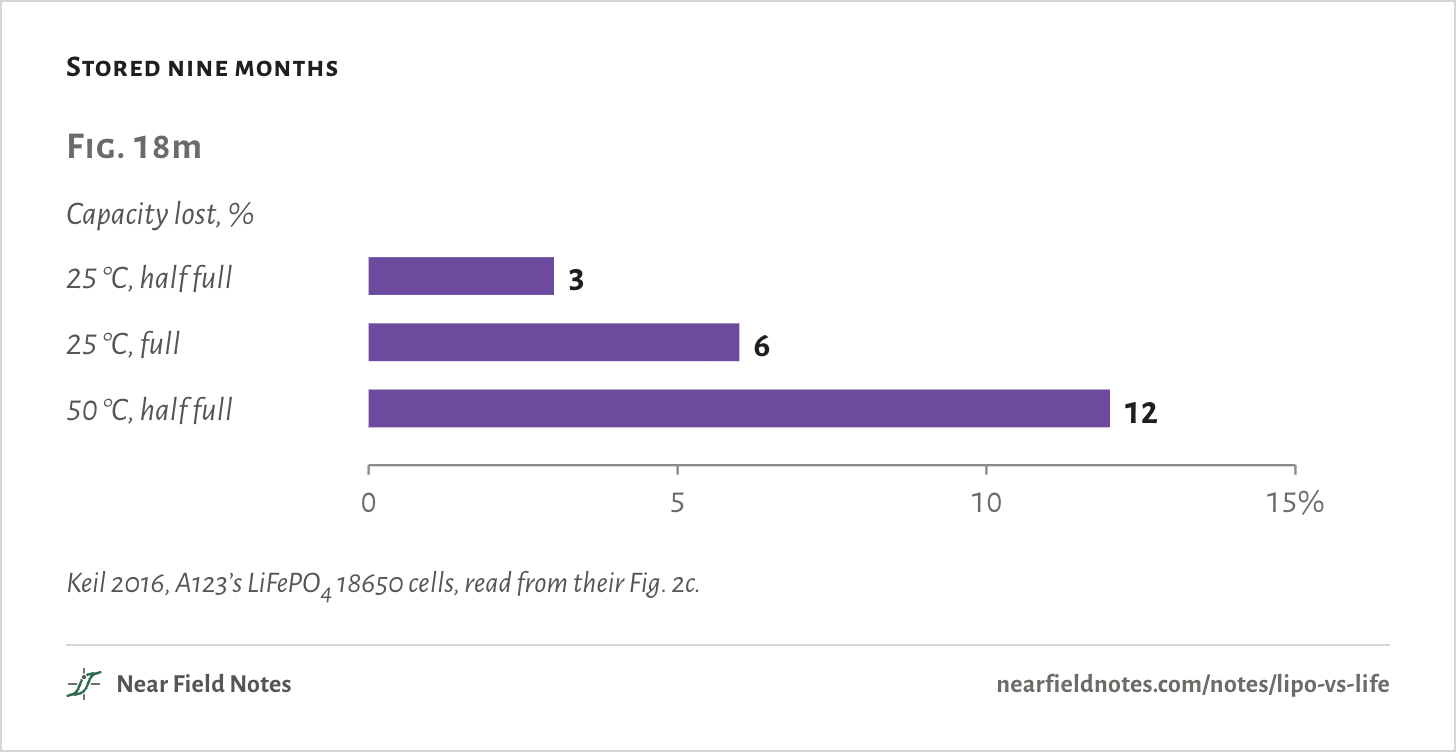
Sitting full costs it too, and heat costs more. Keil’s A123 cells lost twice as much stored full as half full. Half full at 50 °C, they lost four times as much.

Stored nine months
Fig. 18mCapacity lost, %25 °C, half full325 °C, full650 °C, half full12051015%Fig. 18mCapacity lost, %25 °C, half full325 °C, full650 °C, half full12051015%Fig. 18mCapacity lost, %25 °C, half full325 °C, full650 °C, half full12051015%

Keil 2016, A123’s LiFePO4 18650 cells, read from their Fig. 2c.

The numbers
Stored nine monthsCapacity lost
25 °C, half fullabout 3%
25 °C, fullabout 6%
50 °C, half fullabout 12%

Shipped alone by air, both count as lithium-ion. Since 1 April 2016 they fly on cargo aircraft only, at 30% charge or less.

The two cells

Side by side
LiPo
Fig. 18n10 mmFig. 18n10 mmFig. 18n10 mm

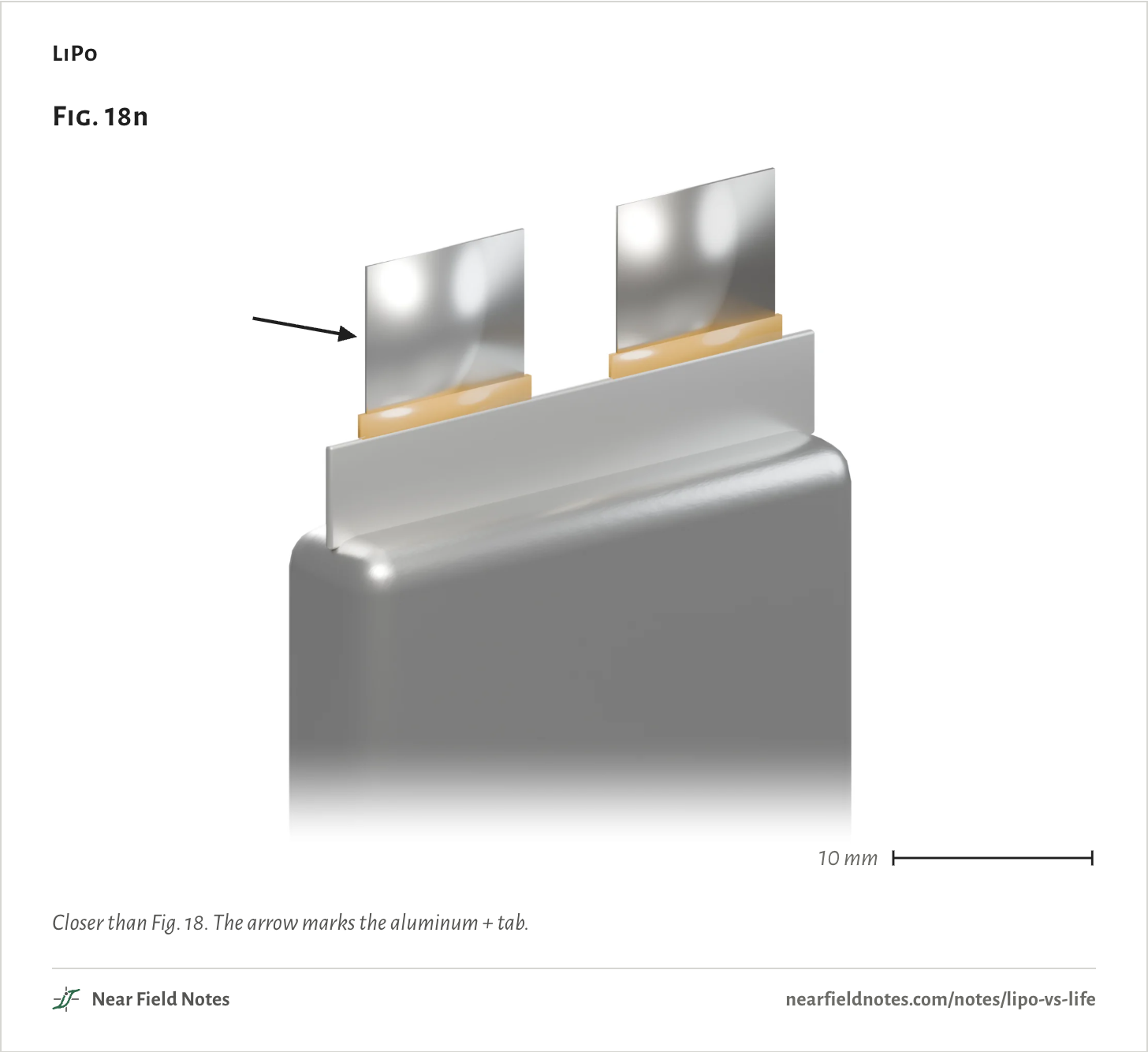
Closer than Fig. 18. The arrow marks the aluminum + tab.

The numbers
Field markLiPo
CaseSoft foil pouch
TerminalsTwo flat tabs, aluminum + and nickel −
Full4.20 V
Nominal3.7 V
362
LiFe
Fig. 18o10 mmFig. 18o10 mmFig. 18o10 mm

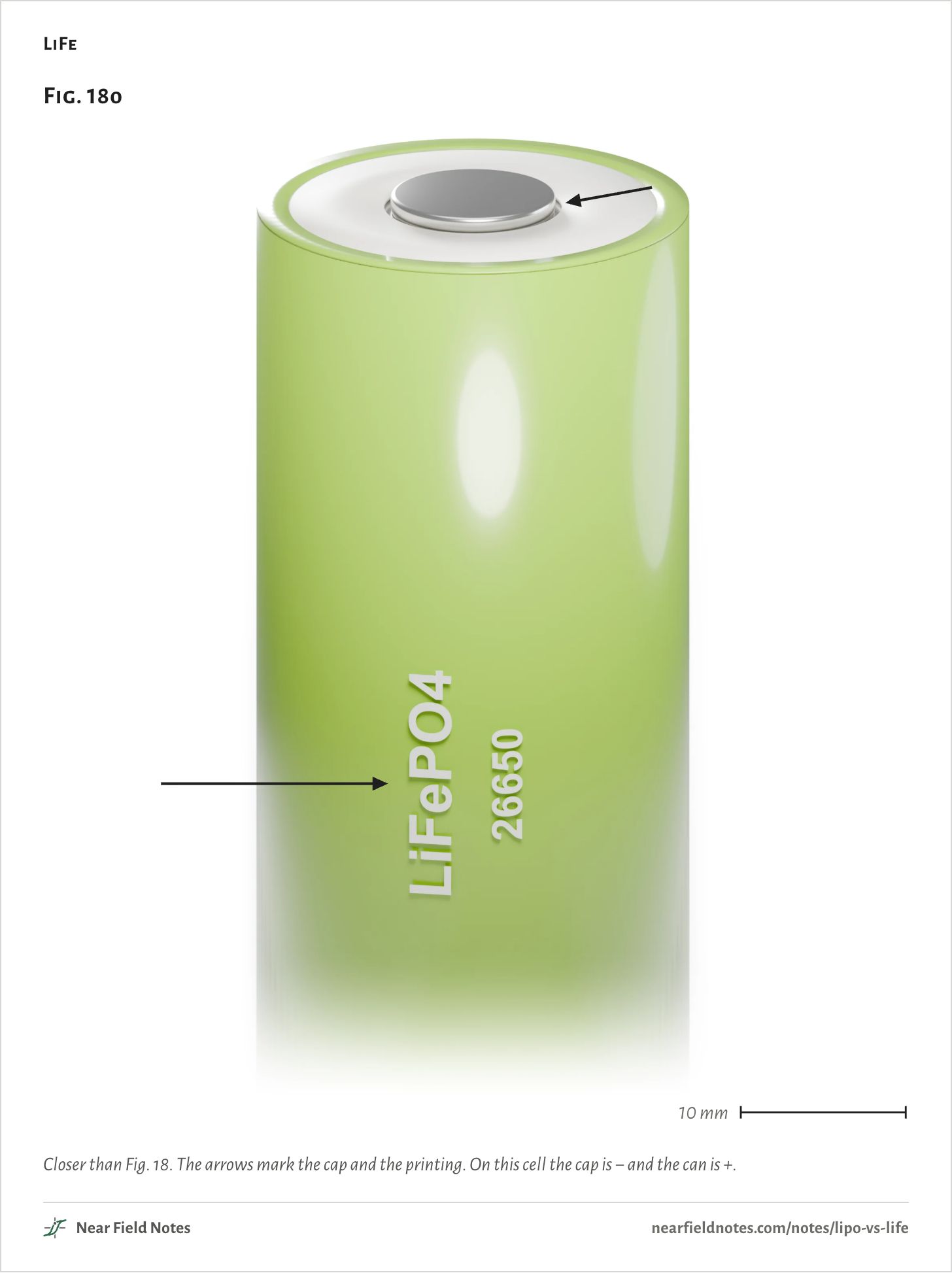
Closer than Fig. 18. The arrows mark the cap and the printing. On this cell the cap is − and the can is +.

The numbers
Field markLiFe
CaseMetal can in a printed sleeve
TerminalsThe cap on top is −, the can is +
Size26 × 65 mm
Full3.60 V
Nominal3.3 V
364

Which cell

A key

Key to LiPo and LiFe

Which cell, and what does it need?

  1. 1aEvery gram countsLiPo, charged to 4.20 V a cell
  2. 1bLife and safety count more than weightGo to 2
  3. 2aIt must charge below 0 °CEither cell, with a heater
  4. 2bIt charges above 0 °CGo to 3
  5. 3aIts charge must be read from voltage aloneLiPo
  6. 3bIt can have a shunt and a coulomb counterLiFe, charged to 3.60 V a cell, with a BMS on every cell

Both cells share 2a: their graphite takes no charge below 0 °C.

Read a cell yourself

68 readings, every one drawn

Pick how full both cells really are and how far off the meter is. The thick part of each curve, and the bar under it, is every charge that reading could mean.

The LiFe’s curve isn’t flat everywhere. Below about a third full it slopes, and a reading there is as good as a LiPo’s. TI’s keep-out range for A123’s cell starts at 34% too.

50%
Meter error, either way
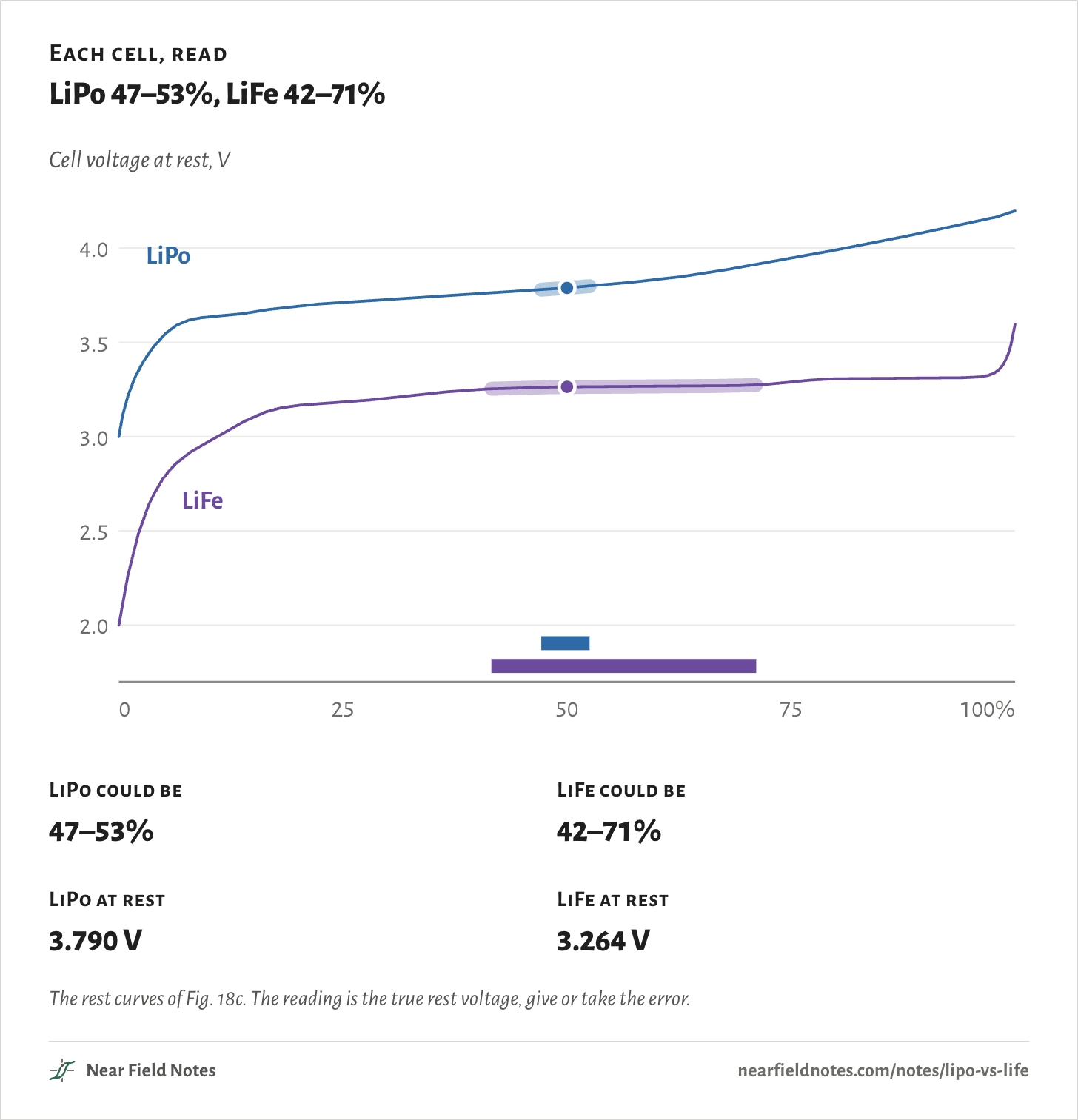
Each cell, read

LiPo 47–53%, LiFe 42–71%

Cell voltage at rest, V2.02.53.03.54.00255075100%LiPoLiFeCell voltage at rest, V2.02.53.03.54.00255075100%LiPoLiFeCell voltage at rest, V2.02.53.03.54.00255075100%LiPoLiFe
LiPo could be
47–53%
LiFe could be
42–71%
LiPo at rest
3.790 V
LiFe at rest
3.264 V

The rest curves of Fig. 18c. The reading is the true rest voltage, give or take the error.

Every case, as a table
True chargeMeter errorLiPo at restLiPo could beLiFe at restLiFe could be
10%±1 mV3.636 V10%2.975 V10%
10%±5 mV3.636 V9–11%2.975 V10%
10%±10 mV3.636 V9–12%2.975 V10%
10%±20 mV3.636 V8–14%2.975 V9–11%
15%±1 mV3.662 V15%3.105 V15%
15%±5 mV3.662 V15–16%3.105 V15%
15%±10 mV3.662 V14–16%3.105 V15%
15%±20 mV3.662 V12–18%3.105 V14–16%
20%±1 mV3.692 V20%3.166 V20%
20%±5 mV3.692 V19–21%3.166 V19–21%
20%±10 mV3.692 V18–22%3.166 V19–23%
20%±20 mV3.692 V16–24%3.166 V18–26%
25%±1 mV3.714 V25%3.183 V25%
25%±5 mV3.714 V24–26%3.183 V23–26%
25%±10 mV3.714 V22–28%3.183 V22–28%
25%±20 mV3.714 V20–31%3.183 V20–30%
30%±1 mV3.730 V30%3.203 V30%
30%±5 mV3.730 V29–32%3.203 V29–31%
30%±10 mV3.730 V27–33%3.203 V28–32%
30%±20 mV3.730 V24–37%3.203 V25–34%
35%±1 mV3.745 V35%3.230 V35%
35%±5 mV3.745 V33–37%3.230 V34–36%
35%±10 mV3.745 V32–38%3.230 V33–37%
35%±20 mV3.745 V29–42%3.230 V31–40%
40%±1 mV3.759 V40%3.250 V40%
40%±5 mV3.759 V38–42%3.250 V39–42%
40%±10 mV3.759 V36–44%3.250 V37–45%
40%±20 mV3.759 V33–47%3.250 V35–69%
45%±1 mV3.773 V45%3.260 V44–46%
45%±5 mV3.773 V43–47%3.260 V42–52%
45%±10 mV3.773 V42–48%3.260 V40–69%
45%±20 mV3.773 V38–51%3.260 V37–73%
50%±1 mV3.790 V50%3.264 V48–52%
50%±5 mV3.790 V49–51%3.264 V44–67%
50%±10 mV3.790 V47–53%3.264 V42–71%
50%±20 mV3.790 V44–55%3.264 V38–74%
55%±1 mV3.809 V55%3.266 V52–60%
55%±5 mV3.809 V54–56%3.266 V46–69%
55%±10 mV3.809 V53–57%3.266 V42–72%
55%±20 mV3.809 V50–59%3.266 V39–74%
60%±1 mV3.833 V60%3.267 V55–65%
60%±5 mV3.833 V59–61%3.267 V47–70%
60%±10 mV3.833 V58–62%3.267 V43–72%
60%±20 mV3.833 V56–63%3.267 V39–74%
65%±1 mV3.865 V65%3.268 V61–67%
65%±5 mV3.865 V64–66%3.268 V48–71%
65%±10 mV3.865 V64–66%3.268 V44–72%
65%±20 mV3.865 V62–67%3.268 V39–75%
70%±1 mV3.906 V70%3.272 V69–70%
70%±5 mV3.906 V69–71%3.272 V59–72%
70%±10 mV3.906 V69–71%3.272 V47–73%
70%±20 mV3.906 V68–72%3.272 V41–75%
75%±1 mV3.949 V75%3.290 V75%
75%±5 mV3.949 V74–75%3.290 V74–76%
75%±10 mV3.949 V74–76%3.290 V73–77%
75%±20 mV3.949 V73–77%3.290 V68–82%
80%±1 mV3.991 V80%3.307 V79–81%
80%±5 mV3.991 V79–80%3.307 V78–92%
80%±10 mV3.991 V79–81%3.307 V77–96%
80%±20 mV3.991 V78–82%3.307 V75–97%
85%±1 mV4.037 V85%3.311 V83–90%
85%±5 mV4.037 V85–86%3.311 V79–96%
85%±10 mV4.037 V84–86%3.311 V78–96%
85%±20 mV4.037 V83–87%3.311 V75–97%
90%±1 mV4.084 V90%3.312 V85–94%
90%±5 mV4.084 V90%3.312 V80–96%
90%±10 mV4.084 V89–91%3.312 V78–97%
90%±20 mV4.084 V88–92%3.312 V76–97%

Conditions

Cells
PyBaMM’s Doyle-Fuller-Newman model. LiPo: the Ai2020 parameters, an Enertech LiCoO2/graphite pouch cell of 2.28 Ah, 3.0 to 4.20 V. LiFe: the Prada2013 parameters, A123’s ANR26650M1 LiFePO4/graphite cell of 2.3 Ah, 2.0 to 3.60 V.
Rest curves
A C/50 discharge from full to empty, within a few mV of the rest voltage, from the single-particle model with electrolyte. A reading’s range is every sample whose voltage lies within the error.
Charges
1C until the full voltage, then that voltage until the current falls to C/20. From 10%, at 25 °C.
Wrong settings
LiFe on the LiPo setting: 1C from 90% until 4.20 V. LiPo on the LiFe setting: a full charge to 3.60 V from empty, against one to 4.20 V.
Pack
Four LiFe cells in series, the fourth with 95% of the others’ capacity, all from 20%. 1C until the pack reads 14.40 V, then 14.40 V until C/20.
Cold
The LiPo model, whose parameters change with temperature, held at each temperature throughout. The graphite’s voltage against lithium beside the separator, where it is lowest.
Drift
Arithmetic from TI’s 1 mA offset example on a 2.5 Ah cell
Renders
Blender, both cells at one scale. The LiFe is built to A123’s published size. The LiPo is a generic hobby pouch.

Simulated only. Nothing on this page has been measured on a board yet.

Limits

  • Past 3.60 V the LiFe model runs beyond its fitted range, and past 4.20 V the LiPo’s. Voltages there are indicative.
  • The rest curves are the models’. Real cells differ: TI’s own LiFePO4 curve spans about 105 mV from 20 to 80%.
  • Hysteresis and the hours a LiFe takes to settle are left out of the rest curves.
  • The cold runs hold one temperature and ignore the heat a charge makes.
  • Datasheet and paper figures are for the cells named beside them, not the modeled ones.

Files

  • sim/cells.pyThe two cell models
  • sim/scenarios.pyRest curves, charges, wrong settings and the cold
  • sim/pack.pyThe 4S LiFe pack
  • render/cells.pyThe renders
  • refs/research.mdEvery datasheet and paper figure and its source

Sources

Like this note?

Rev 1 ·
  1. Rev 1First published

Each fix gets a line here, with the reader's name if they want credit.

Did it answer your question?

Want more on this?

Report a problem

What should the next note be? Ask for one