Near Field Notes

Note 2EMCRev 1Watch the video · 0:09

USB-C shell

Should a USB-C shell go straight to ground, or through an RC?

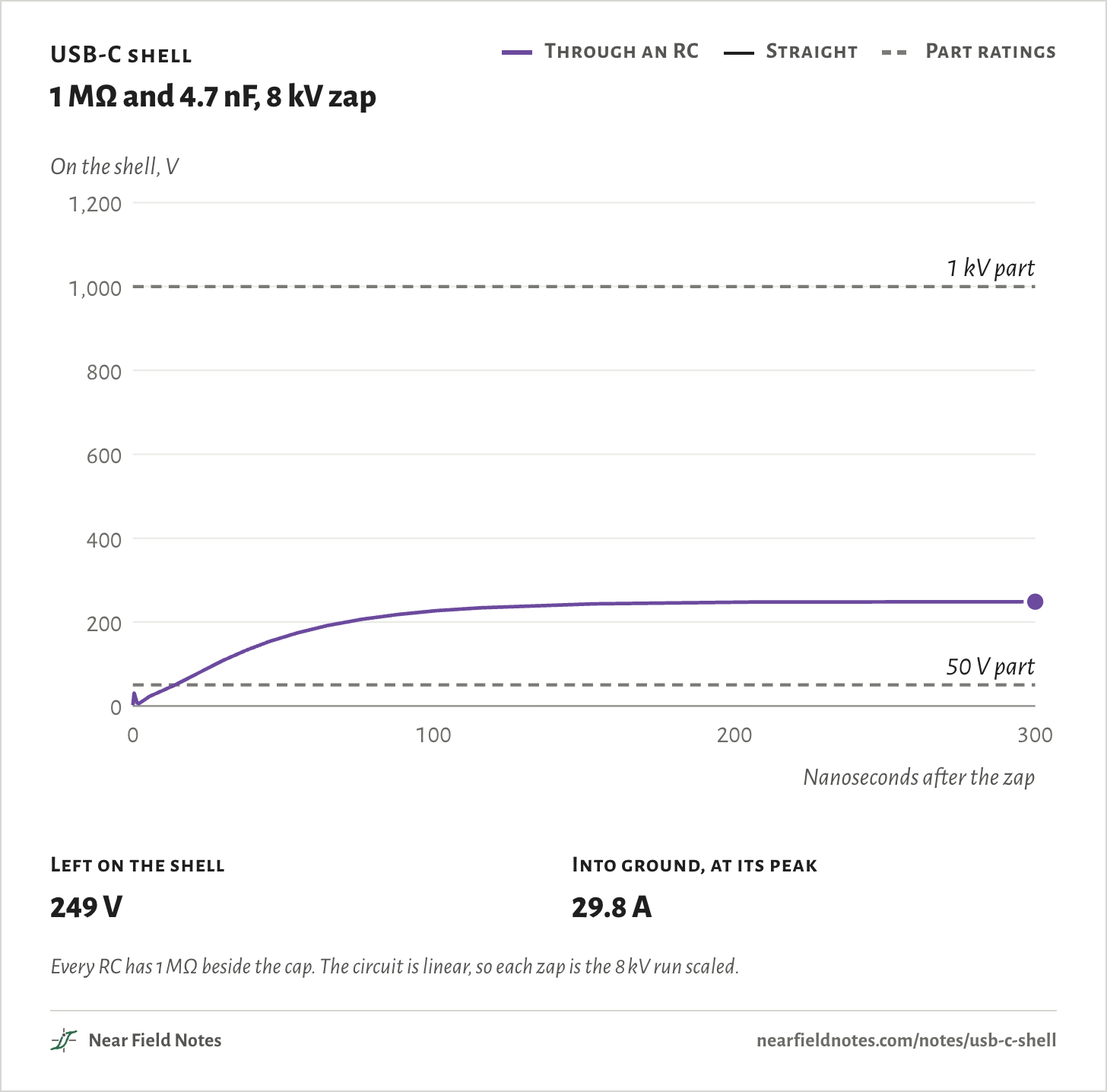
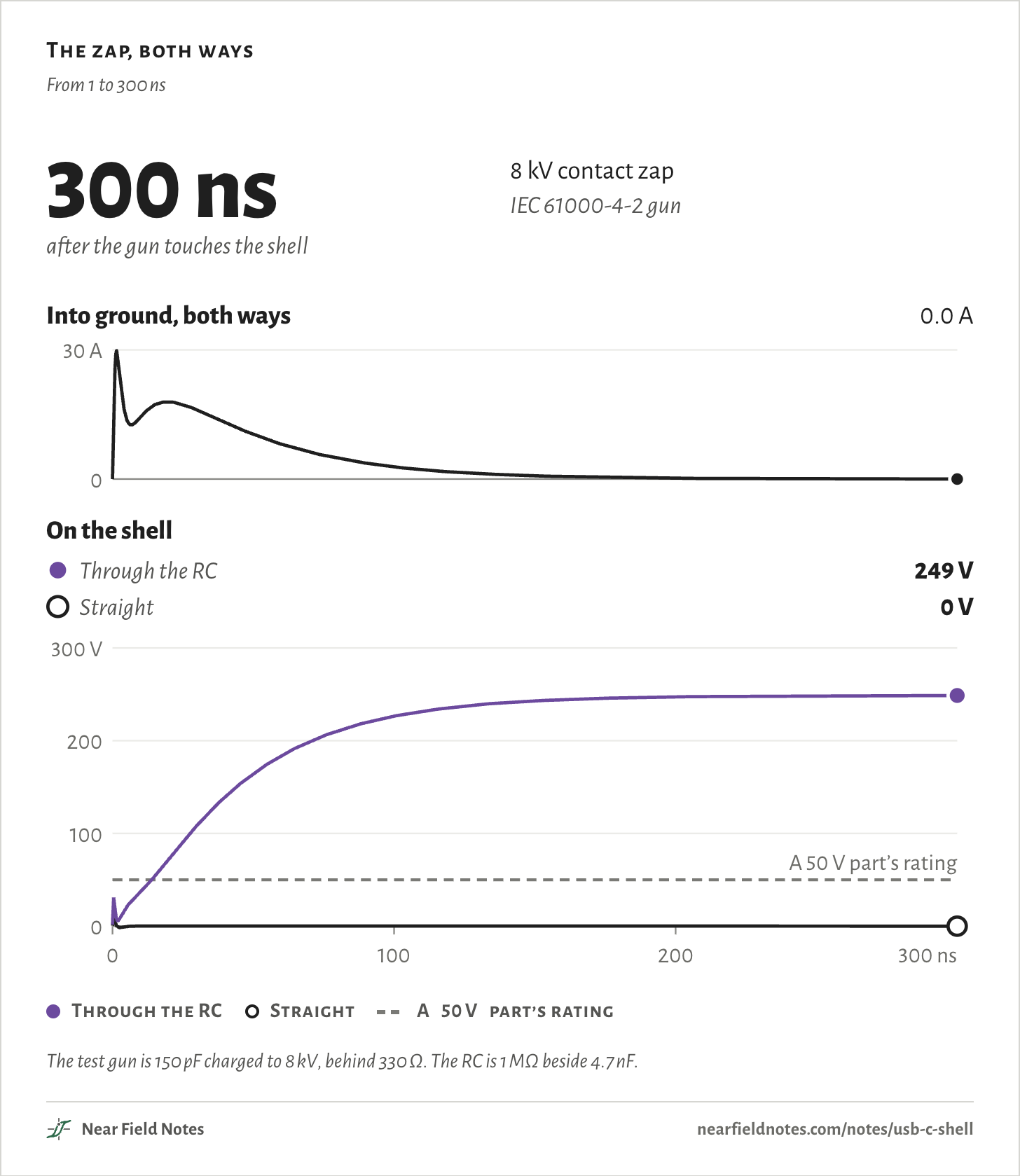
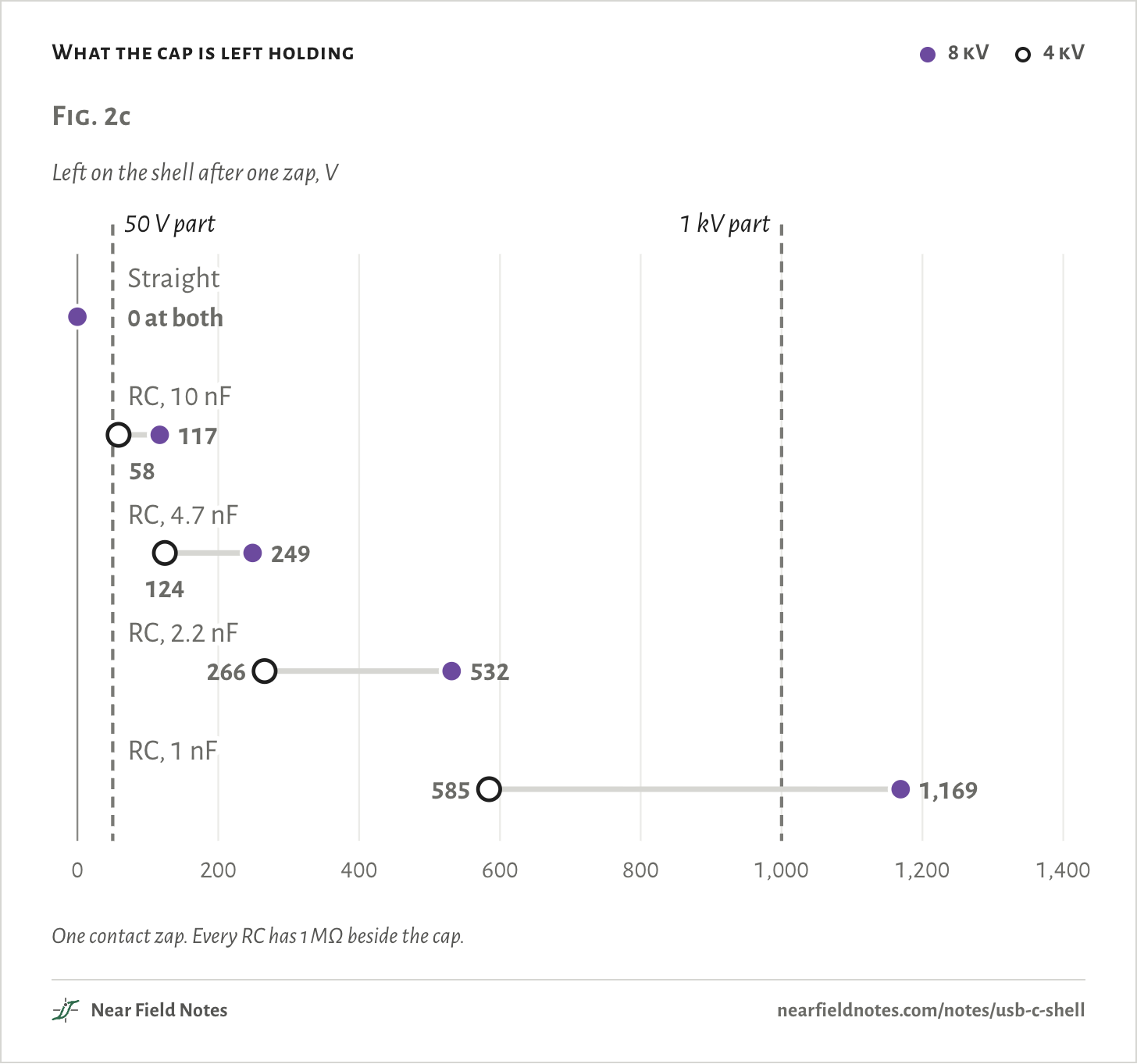
Straight, unless an earthed box or cable shield touches it too. An 8 kV zap puts the same 30 A into the board’s ground either way. Through 1 MΩ beside 4.7 nF, the cap is left holding 249 V. Common 0805 caps are rated 50 V.

The zap, both ways

From 1 to 300 ns

1 ns10 ns30 ns60 ns100 ns300 nsafter the gun touches the shell8 kV contact zapIEC 61000-4-2 gunInto ground, both ways27.1 A14.4 A16.1 A8.1 A2.8 A0.0 A030 AOn the shellThrough the RC15 V37 V109 V184 V226 V249 VStraight3 V0 V0 V0 V0 V0 V0100200300 V50 V part0100200300 ns1 ns10 ns30 ns60 ns100 ns300 nsafter the gun touches the shell8 kV contact zapIEC 61000-4-2 gunInto ground, both ways27.1 A14.4 A16.1 A8.1 A2.8 A0.0 A030 AOn the shellThrough the RC15 V37 V109 V184 V226 V249 VStraight3 V0 V0 V0 V0 V0 V0100200300 VA 50 V part’s rating0100200300 ns1 ns10 ns30 ns60 ns100 ns300 nsafter the gun touches the shell8 kV contact zapIEC 61000-4-2 gunInto ground, both ways27.1 A14.4 A16.1 A8.1 A2.8 A0.0 A030 AOn the shellThrough the RC15 V37 V109 V184 V226 V249 VStraight3 V0 V0 V0 V0 V0 V0100200300 VA 50 V part’s rating0100200300 ns
  • Through the RC
  • Straight
  • A 50 V part’s rating

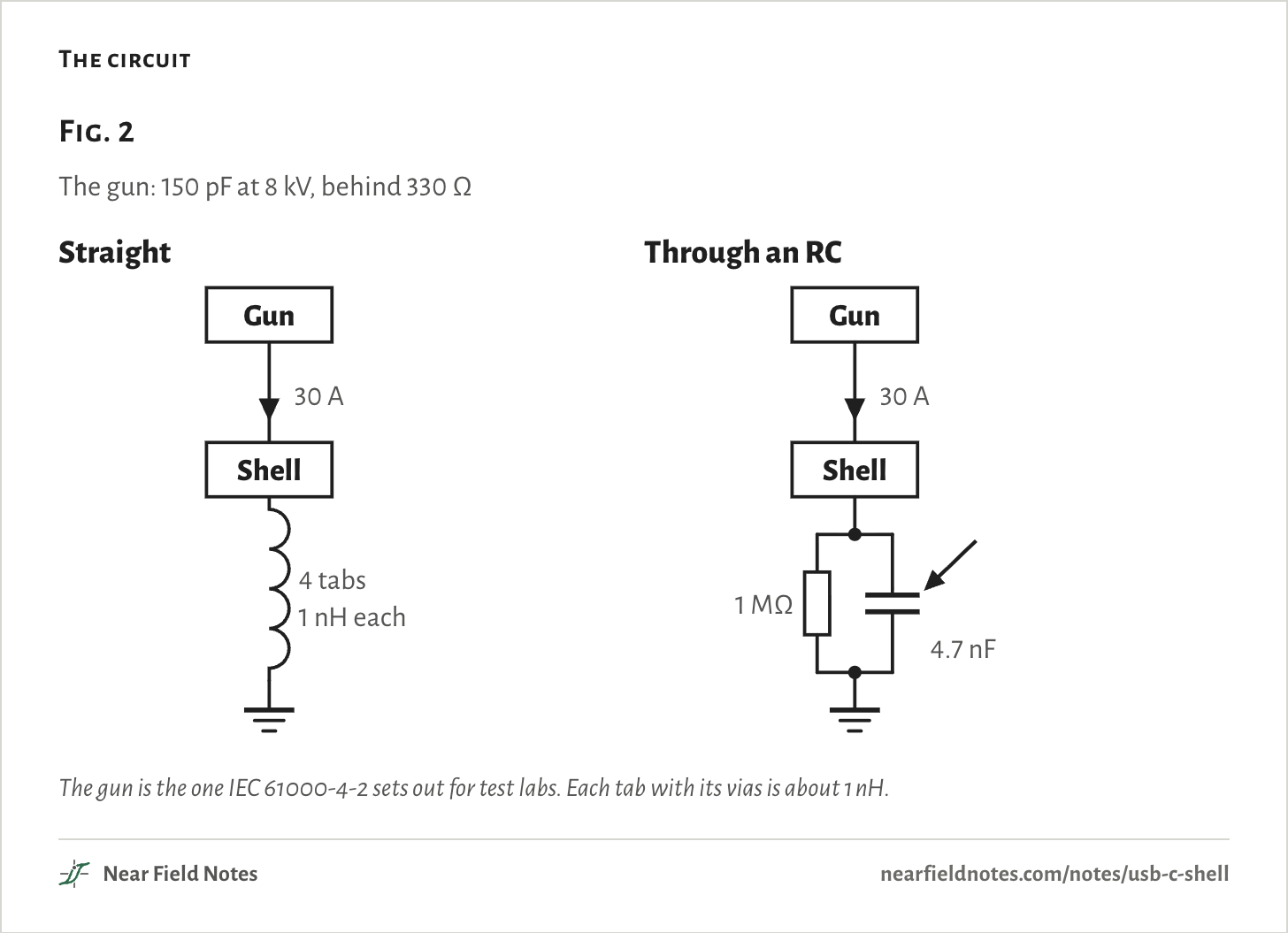
The test gun is 150 pF charged to 8 kV, behind 330 Ω. The RC is 1 MΩ beside 4.7 nF.

Two ways to tie a shell down

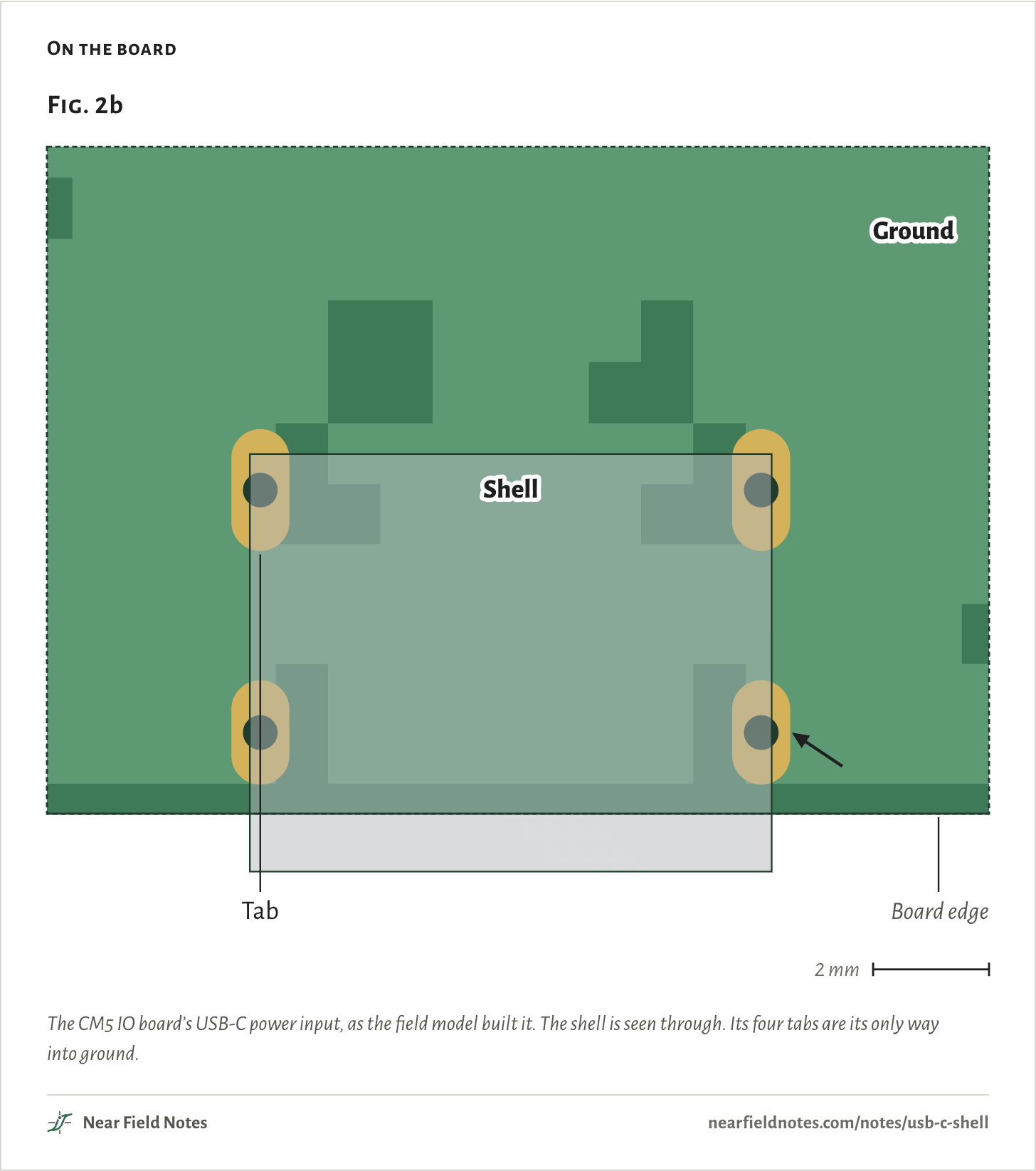
USB-C on Raspberry Pi’s CM5 IO board

A USB-C receptacle has a metal shell, soldered down at four tabs. Reach for the cable with a charged finger and the zap lands on that shell. Open boards tie it to ground one of two ways. Straight puts every tab on the ground net. An RC puts the tabs on a net of their own, tied to ground through 1 MΩ beside a 4.7 nF cap.

The circuit
Fig. 2The gun: 150 pF at 8 kV, behind 330 ΩStraightGun30 AShell4 tabs1 nH eachThrough an RCGun30 AShell1 MΩ4.7 nFFig. 2The gun: 150 pF at 8 kV, behind 330 ΩStraightGun30 AShell4 tabs1 nH eachThrough an RCGun30 AShell1 MΩ4.7 nFFig. 2The gun: 150 pF at 8 kV, behind 330 ΩStraightGun30 AShell4 tabs1 nH eachThrough an RCGun30 AShell1 MΩ4.7 nF

The gun is the one IEC 61000-4-2 sets out for test labs. Each tab with its vias is about 1 nH.

On the board
Fig. 2bShellTabEdgeGround2 mmFig. 2bShellTabBoard edgeGround2 mmFig. 2bShellTabBoard edgeGround2 mm

The CM5 IO board’s USB-C power input, as the field model built it. The shell is seen through. Its four tabs are its only way into ground.

What the cap is left holding
  • 8 kV
  • 4 kV
Fig. 2cLeft on the shell after one zap, V04008001,20050 V part1 kV partStraight0 at bothRC, 10 nF58117RC, 4.7 nF124249RC, 2.2 nF266532RC, 1 nF5851,169Fig. 2cLeft on the shell after one zap, V02004006008001,0001,2001,40050 V part1 kV partStraight0 at bothRC, 10 nF58117RC, 4.7 nF124249RC, 2.2 nF266532RC, 1 nF5851,169Fig. 2cLeft on the shell after one zap, V02004006008001,0001,2001,40050 V part1 kV partStraight0 at bothRC, 10 nF58117RC, 4.7 nF124249RC, 2.2 nF266532RC, 1 nF5851,169

One contact zap. Every RC has 1 MΩ beside the cap.

48

Zap it yourself

5 ties, 1 to 8 kV
Tie
8 kV
USB-C shell

1 MΩ and 4.7 nF, 8 kV zap

  • Through an RC
  • Straight
  • Part ratings
On the shell, V02004006008001,0001,200010020030050 V part1 kV partNanoseconds after the zapOn the shell, V02004006008001,0001,200010020030050 V part1 kV partNanoseconds after the zapOn the shell, V02004006008001,0001,200010020030050 V part1 kV partNanoseconds after the zap
Left on the shell
249 V
Into ground, at its peak
29.8 A

Every RC has 1 MΩ beside the cap. The circuit is linear, so each zap is the 8 kV run scaled.

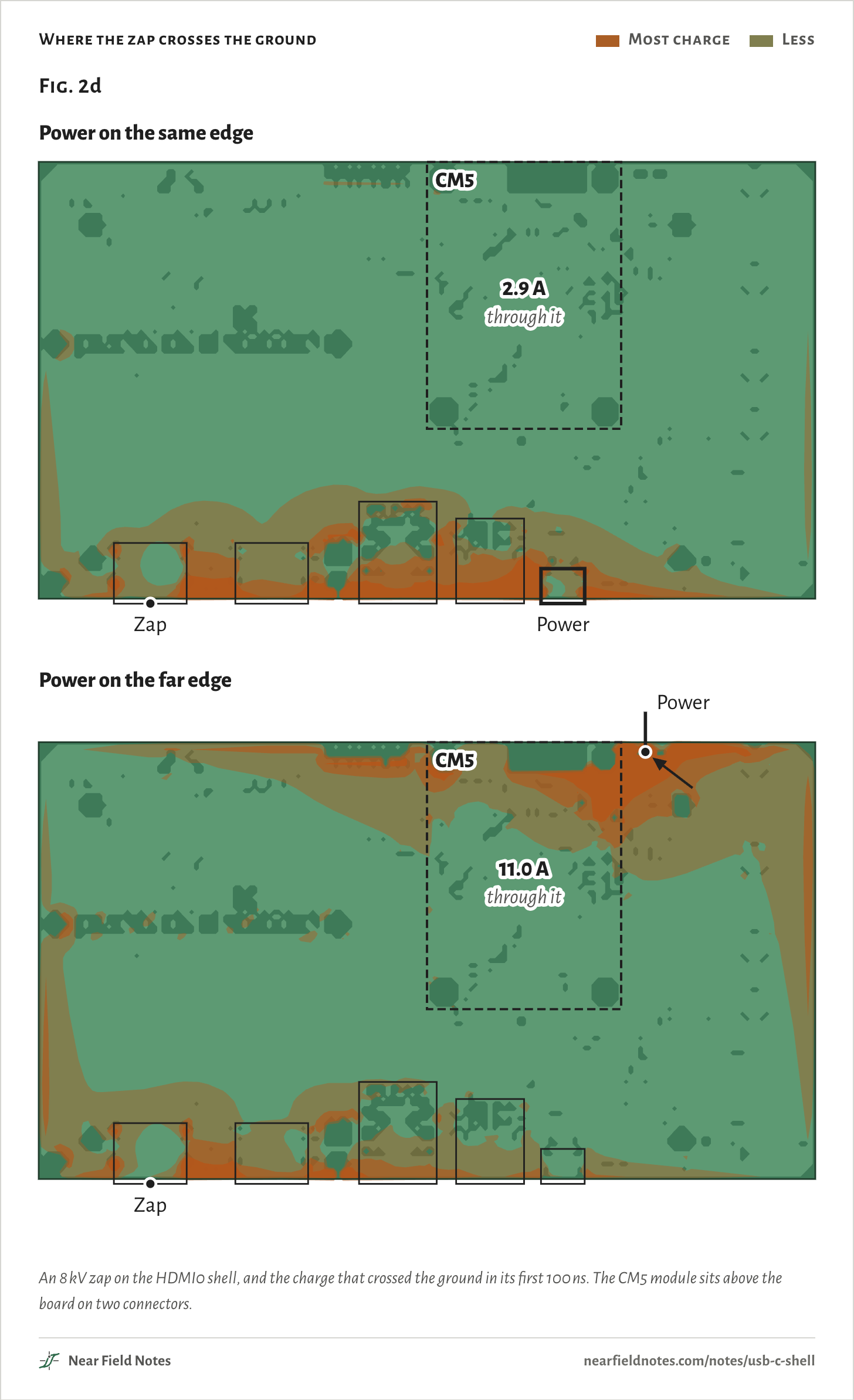
Where the zap crosses the ground
  • Most charge
  • Less
Fig. 2dPower on the same edgeCM52.9 Athrough itZapPowerPower on the far edgeCM511.0 Athrough itZapPowerFig. 2dPower on the same edgeCM52.9 Athrough itZapPowerPower on the far edgeCM511.0 Athrough itZapPowerFig. 2dPower on the same edgeCM52.9 Athrough itZapPowerPower on the far edgeCM511.0 Athrough itZapPower

An 8 kV zap on the HDMI0 shell, and the charge that crossed the ground in its first 100 ns. The CM5 module sits above the board on two connectors.

50

Which to use

Shell ties
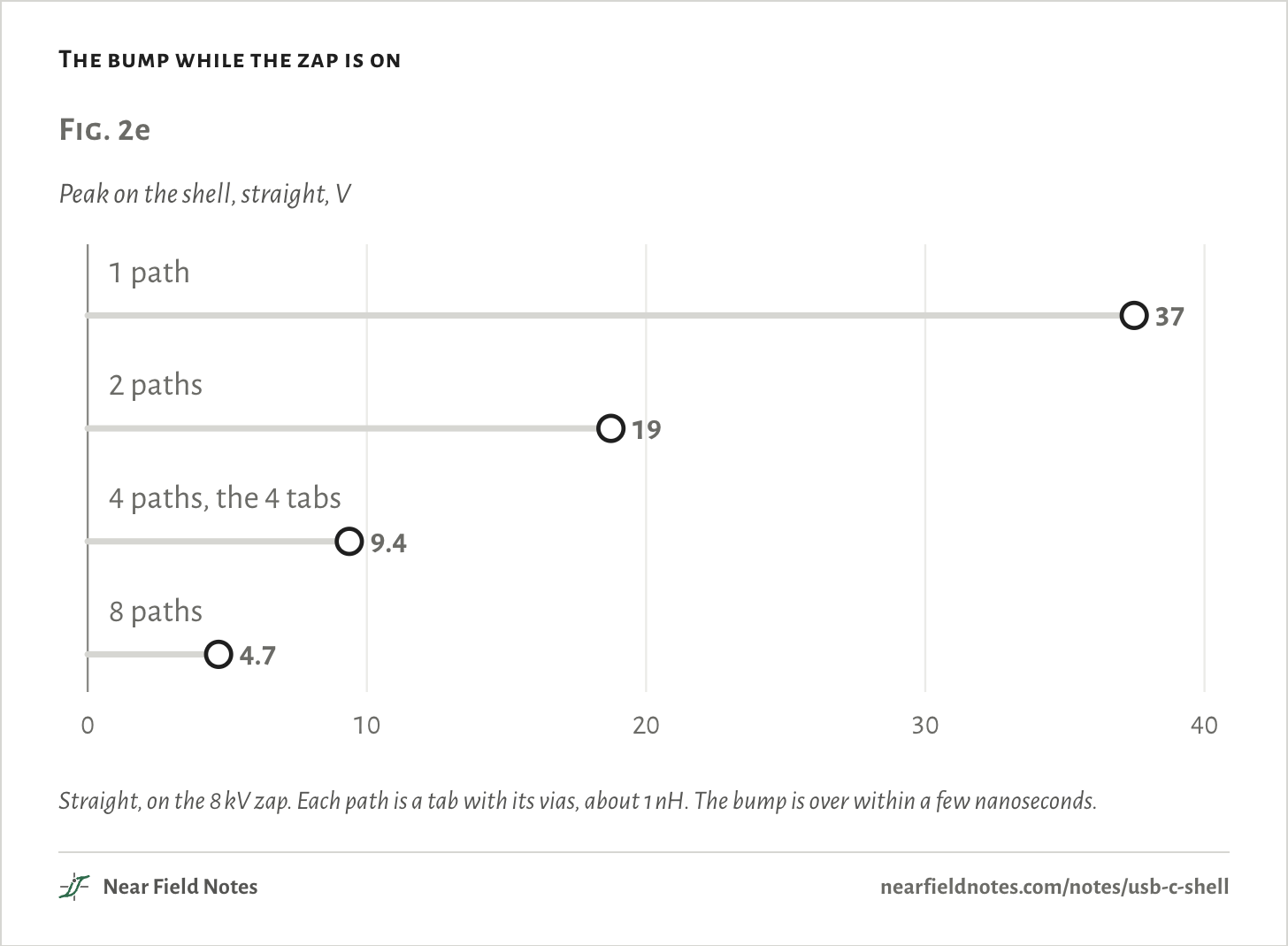
The bump while the zap is on
Fig. 2ePeak on the shell, straight, V0102030401 path372 paths194 paths, the 4 tabs9.48 paths4.7Fig. 2ePeak on the shell, straight, V0102030401 path372 paths194 paths, the 4 tabs9.48 paths4.7Fig. 2ePeak on the shell, straight, V0102030401 path372 paths194 paths, the 4 tabs9.48 paths4.7

Straight, on the 8 kV zap. Each path is a tab with its vias, about 1 nH. The bump is over within a few nanoseconds.

52

Key to shell ties

How should this shell be tied down?

  1. 1aNothing earthed touches itStraight, every tab, 2e
  2. 1bAn earthed metal box, or a cable shield earthed at the far end, touches itGo to 2
  3. 2aYou can fit a cap rated 1 kV or moreAn RC, 2c
  4. 2bOnly a 50 V part fitsStraight, 2c

With an earthed box, the RC keeps mains hum off your ground. Leave footprints for both, so a fix at the test lab is a part swap.

53

Conditions

Zap
IEC 61000-4-2 contact discharge, from the standard’s own formula. At 8 kV its first peak is 30 A, with a 0.8 ns rise.
Gun
150 pF behind 330 Ω, run as a current source. That holds while the shell stays far below 8 kV, which it does here.
Straight
4 paths to ground side by side, each a tab with its vias at about 1 nH
RC
1 MΩ beside one cap with 0.8 nH and 0.05 Ω in series, like a 1206 high-voltage part
Circuit
ngspice, 0.02 ns steps to 400 ns
Board
Raspberry Pi’s CM5 IO board. Its two inner ground planes as one sheet of 1 mm cells, each shell a metal block tied down at its tabs, and the CM5’s ground 1.5 mm above on its 51 ground pins.
Bench
The gun’s rod on the HDMI0 shell, its source 80 mm out. The exit is a wire from the power input to a ground plane 60 mm under the board.
Field
openEMS, solved per ampere up to 1.2 GHz, then put through the 8 kV zap

Simulated only. Nothing on this page has been measured on a board yet.

Limits

  • The bench is smaller than the IEC’s 0.8 m table, and cables are wires. That changes how the outer loop rings, not which way the current runs on the board.
  • FR-4 is lossless and copper is perfect.
  • 1 nH per tab is an estimate.
  • The field model has no RC case. At ESD speeds the cap is a short, so the current spreads as it does straight.

Files

  • esdsim/iec.pyThe IEC 61000-4-2 current
  • esdsim/bond.pyThe shell ties in ngspice
  • esdsim/model.pyThe CM5 IO board’s field model
  • esdsim/synth.pyFrom per-ampere runs to the 8 kV zap

Sources

Like this note?

Rev 1 ·
  1. Rev 1First published

Each fix gets a line here, with the reader's name if they want credit.

Did it answer your question?

Want more on this?

Report a problem

What should the next note be? Ask for one