Near Field Notes

Note 5SensingRev 1Watch the video · 0:19

Shunt taps

Where do you tap a 0.5 mΩ shunt?

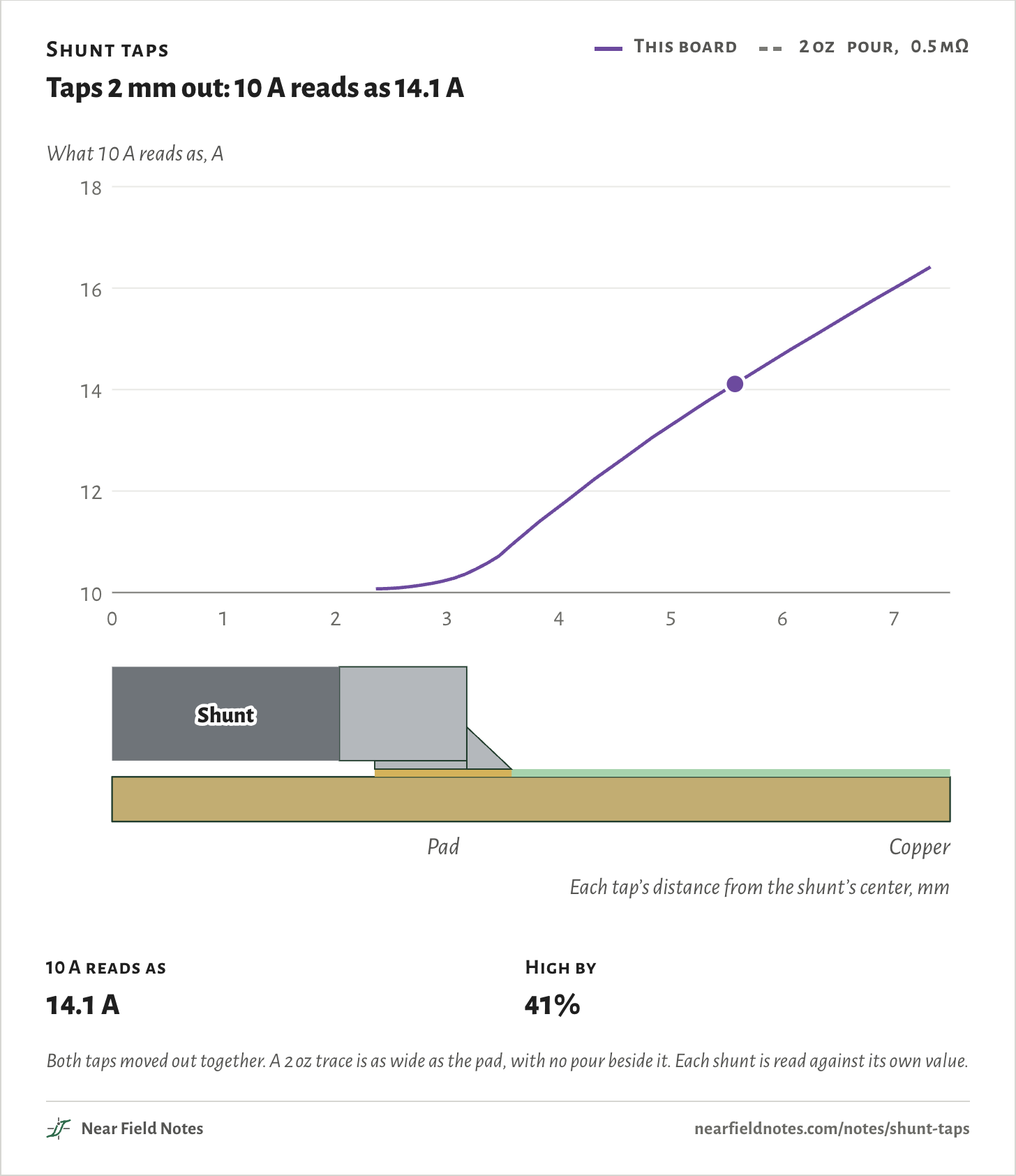
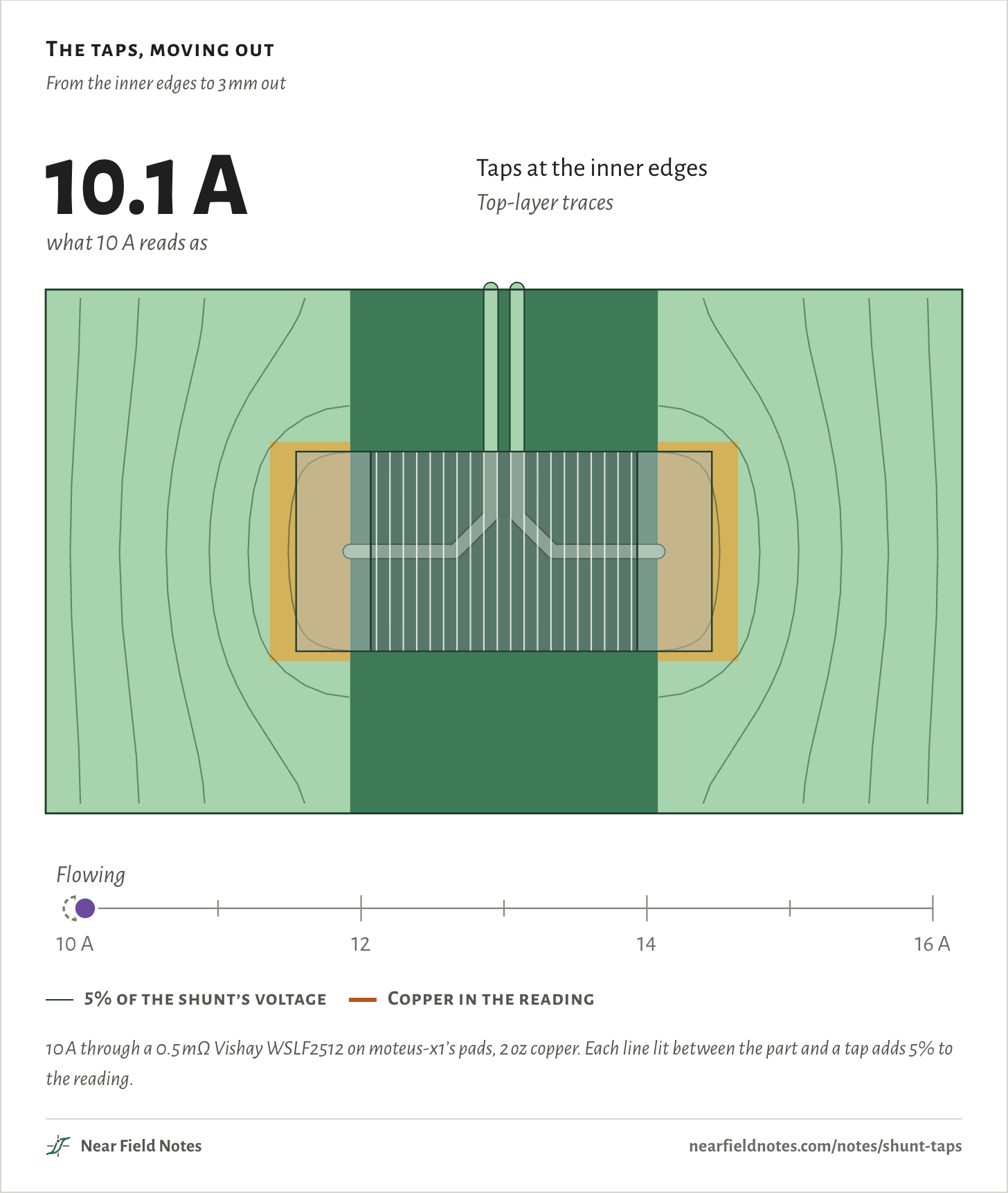
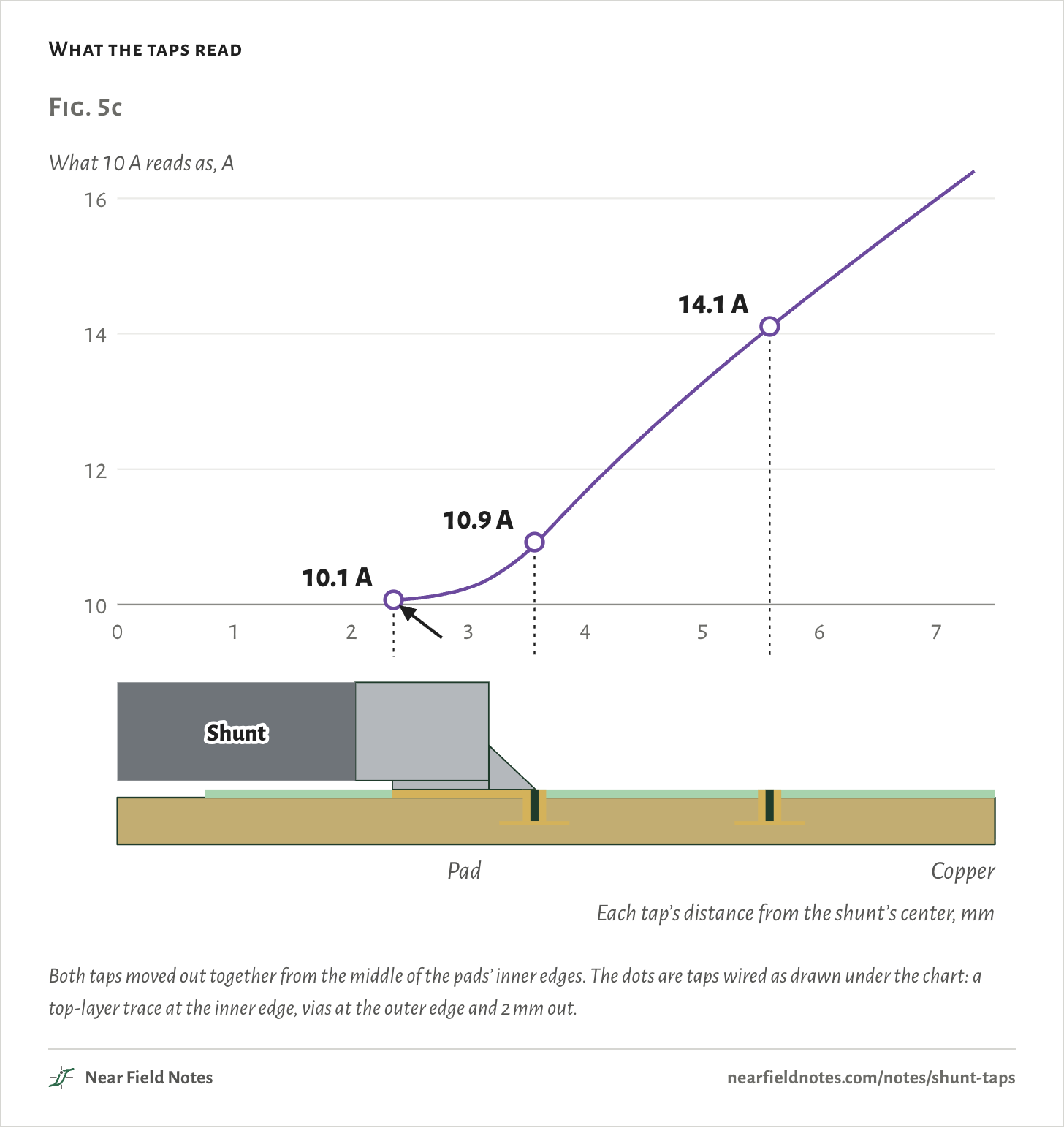
At the middle of the pads’ inner edges. With 10 A through the 0.5 mΩ shunt moteus-x1 uses, sense traces there read 10.1 A. Vias 2 mm out on the copper read 14.1 A.

The taps, moving out

From the inner edges to 3 mm out

10.1 ATaps at the inner edgesTop-layer traces10.9 ATaps at the outer edgesVias to the layer below12.6 ATaps 1 mm outVias to the layer below14.1 ATaps 2 mm outVias to the layer below15.5 ATaps 3 mm outVias to the layer belowwhat 10 A reads as10 A121416 AFlowing10.1 ATaps at the inner edgesTop-layer traces10.9 ATaps at the outer edgesVias to the layer below12.6 ATaps 1 mm outVias to the layer below14.1 ATaps 2 mm outVias to the layer below15.5 ATaps 3 mm outVias to the layer belowwhat 10 A reads as10 A121416 AFlowing10.1 ATaps at the inner edgesTop-layer traces10.9 ATaps at the outer edgesVias to the layer below12.6 ATaps 1 mm outVias to the layer below14.1 ATaps 2 mm outVias to the layer below15.5 ATaps 3 mm outVias to the layer belowwhat 10 A reads as10 A121416 AFlowing
  • 5% of the shunt’s voltage
  • Copper in the reading

10 A through a 0.5 mΩ Vishay WSLF2512 on moteus-x1’s pads, 2 oz copper. Each line lit between the part and a tap adds 5% to the reading.

What a shunt tap is

One of moteus-x1’s phase shunts

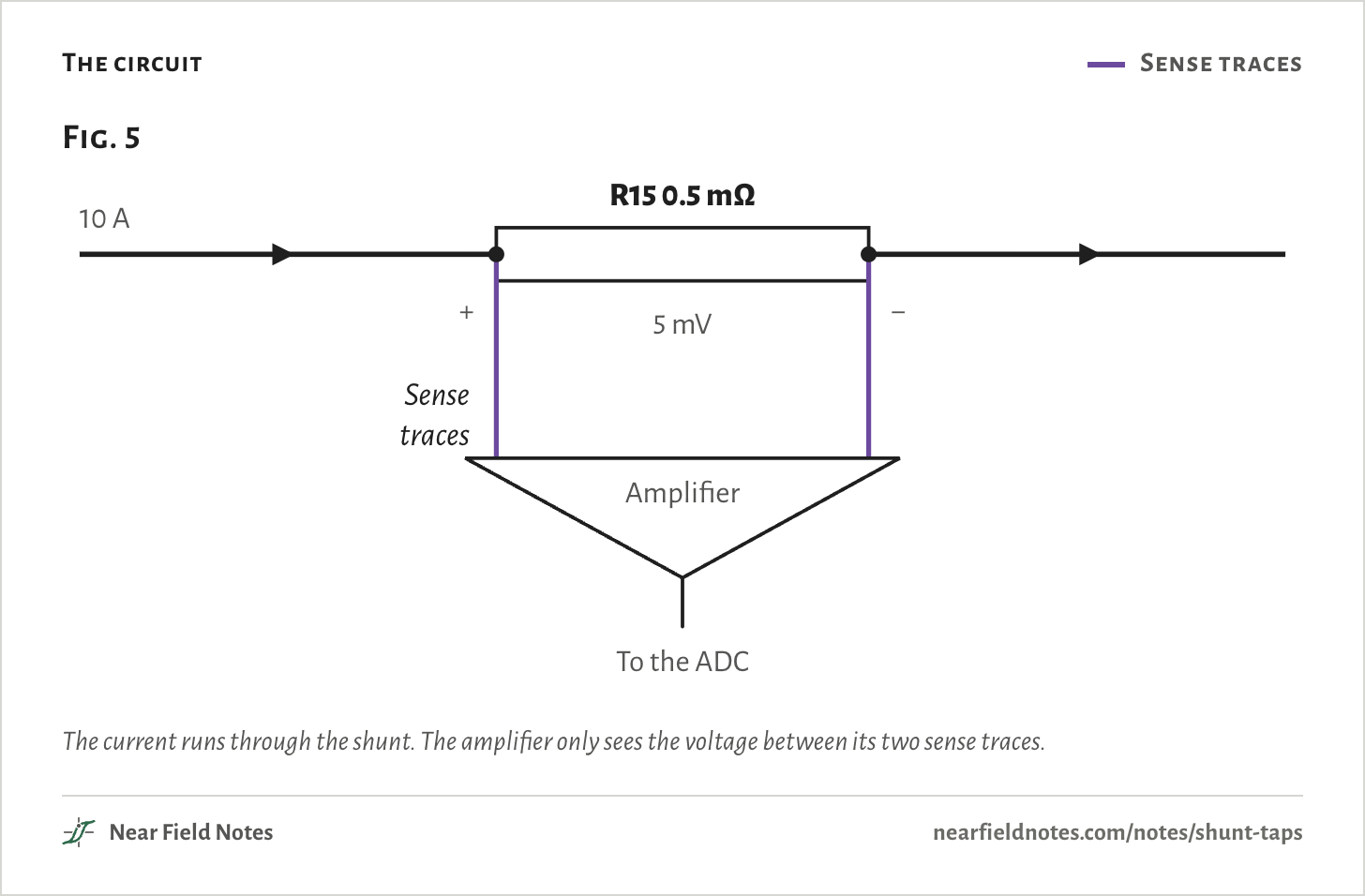
A shunt is a resistor in the current’s path, small enough that 10 A drops only 5 mV across 0.5 mΩ. An amplifier reads that voltage through two sense traces, one from each end. Where each trace meets the copper is its tap. At 0.5 mΩ the shunt is about as resistive as 2 oz copper its own size, so any copper between the part and the taps adds to the reading. Where the shunt sits in the bridge is Note 19.

The circuit
  • Sense traces
Fig. 5R15 0.5 mΩ10 A+−5 mVAmplifierTo the ADCSensetracesFig. 5R15 0.5 mΩ10 A+−5 mVAmplifierTo the ADCSensetracesFig. 5R15 0.5 mΩ10 A+−5 mVAmplifierTo the ADCSensetraces

The current runs through the shunt. The amplifier only sees the voltage between its two sense traces.

On the board
  • Sense traces
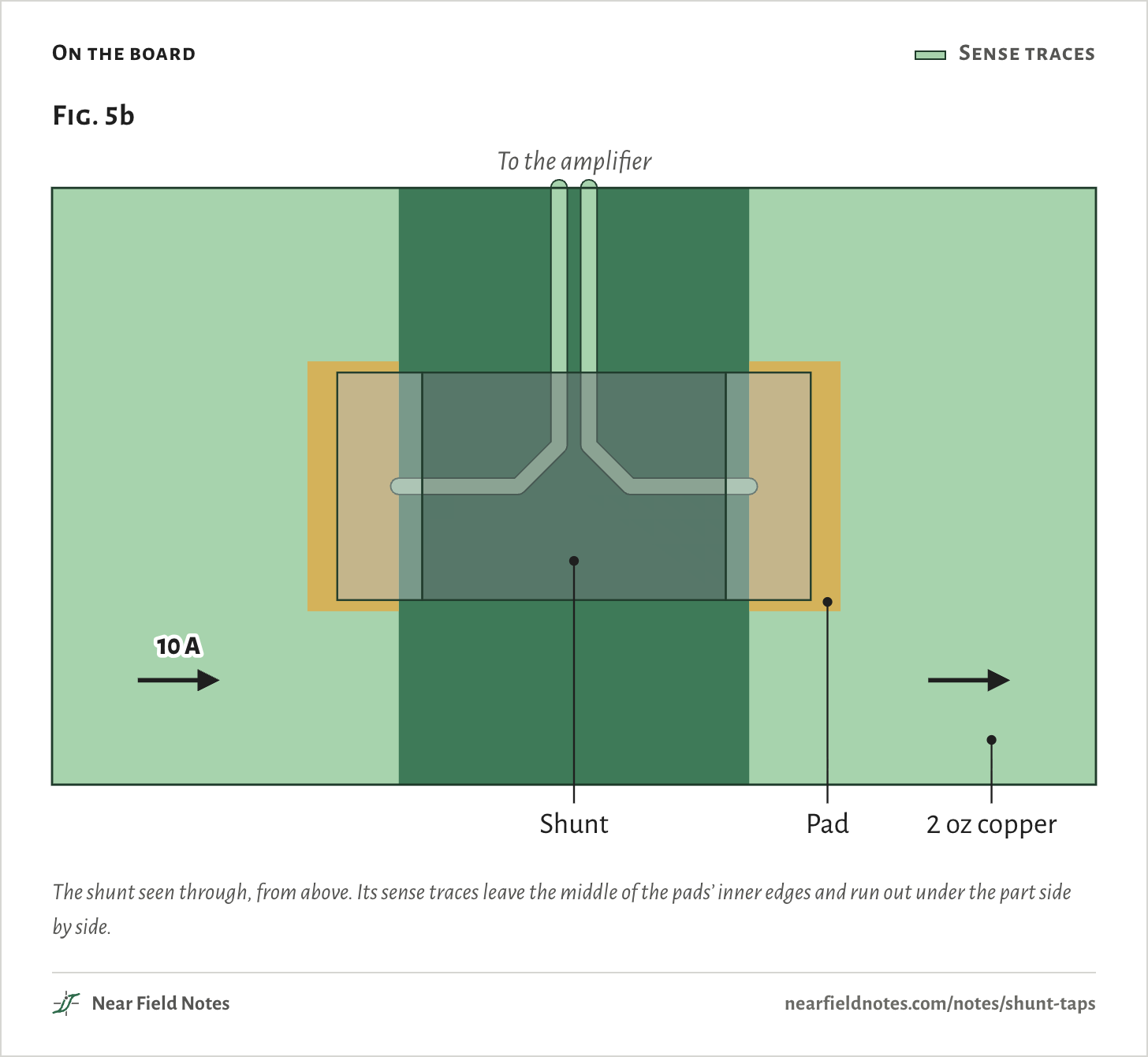
Fig. 5bTo the amplifier10 AShuntPadCopperFig. 5bTo the amplifier10 AShuntPad2 oz copperFig. 5bTo the amplifier10 AShuntPad2 oz copper

The shunt seen through, from above. Its sense traces leave the middle of the pads’ inner edges and run out under the part side by side.

What the taps read
Fig. 5cWhat 10 A reads as, A1012141601234567ShuntPadCopper10.1 A10.9 A14.1 AEach tap’s distance from the shunt’s center, mmFig. 5cWhat 10 A reads as, A1012141601234567ShuntPadCopper10.1 A10.9 A14.1 AEach tap’s distance from the shunt’s center, mmFig. 5cWhat 10 A reads as, A1012141601234567ShuntPadCopper10.1 A10.9 A14.1 AEach tap’s distance from the shunt’s center, mm

Both taps moved out together from the middle of the pads’ inner edges. The dots are taps wired as drawn under the chart: a top-layer trace at the inner edge, vias at the outer edge and 2 mm out.

120

Where on the pad

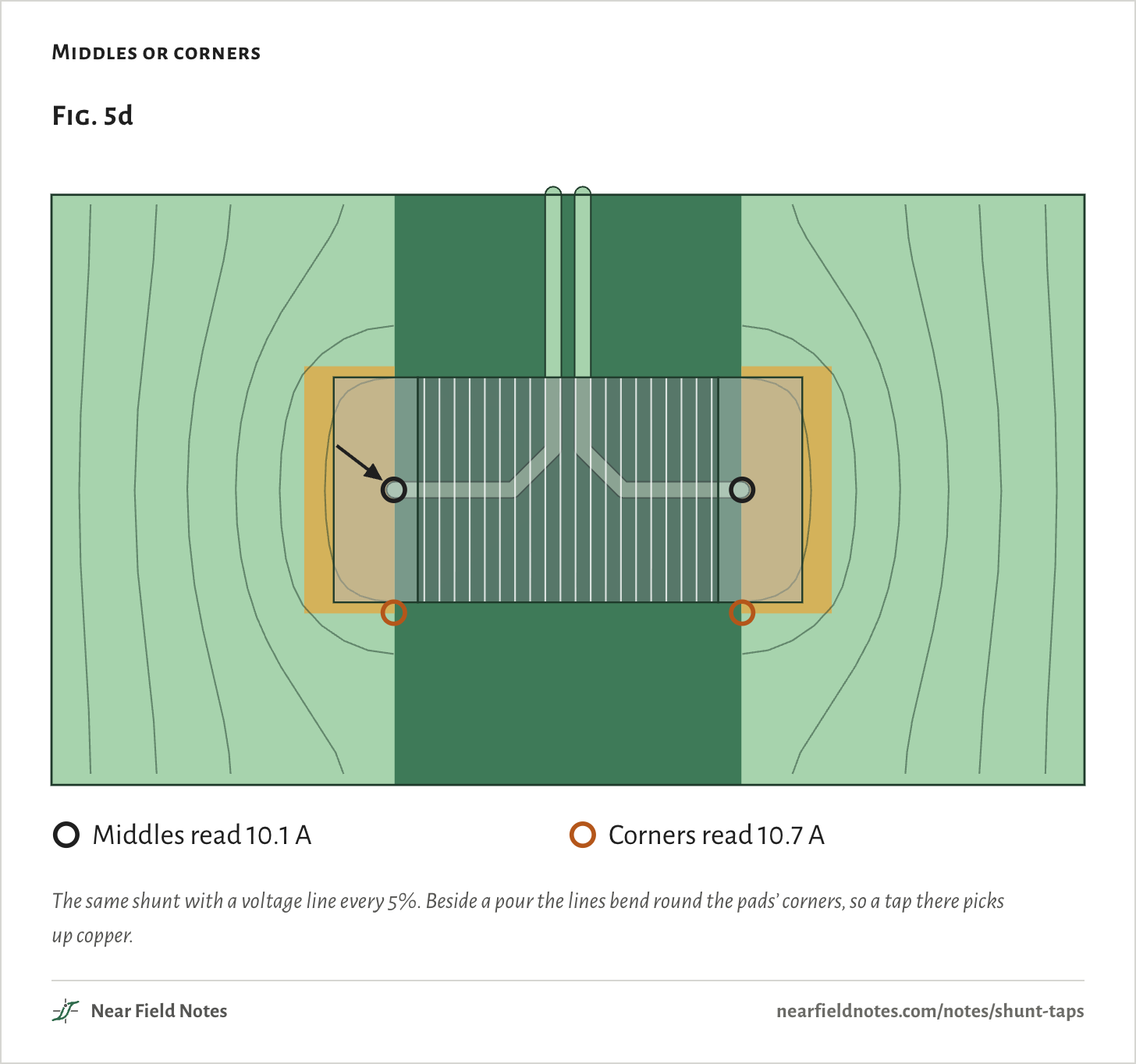
Middles, not corners
Middles or corners
Fig. 5dMiddles read 10.1 ACorners read 10.7 AFig. 5dMiddles read 10.1 ACorners read 10.7 AFig. 5dMiddles read 10.1 ACorners read 10.7 A

The same shunt with a voltage line every 5%. Beside a pour the lines bend round the pads’ corners, so a tap there picks up copper.

122

Key to shunt taps

Where should the sense traces connect?

  1. 1aEach end has its own sense padAnywhere on the sense pads, 5f
  2. 1bOne pad at each endGo to 2
  3. 2aCopper poured beside the padsThe middle of the inner edges, 5d
  4. 2bFed by a trace as wide as the padAnywhere on the inner edges

On moteus-x1’s pads with a pour, the corners of the inner edges read 10.7 A for 10 A. Fed by a pad-wide trace they read 10.2 A. Vishay’s datasheet draws the sense traces at the inner edges, and moteus-x1 routes its own pair that way.

123

Move the taps yourself

3 coppers, 3 shunt values
Copper
Shunt
2 mm out
Shunt taps

Taps 2 mm out: 10 A reads as 14.1 A

  • This board
  • 2 oz pour, 0.5 mΩ
What 10 A reads as, A101214161801234567What 10 A reads as, A1012141601234567What 10 A reads as, A1012141601234567What 10 A reads as, A101418222601234567What 10 A reads as, A101214161801234567What 10 A reads as, A1012141601234567What 10 A reads as, A101418222601234567What 10 A reads as, A101214161801234567What 10 A reads as, A1012141601234567ShuntPadCopperEach tap’s distance from the shunt’s center, mmWhat 10 A reads as, A101214161801234567What 10 A reads as, A1012141601234567What 10 A reads as, A1012141601234567What 10 A reads as, A101418222601234567What 10 A reads as, A101214161801234567What 10 A reads as, A1012141601234567What 10 A reads as, A101418222601234567What 10 A reads as, A101214161801234567What 10 A reads as, A1012141601234567ShuntPadCopperEach tap’s distance from the shunt’s center, mmWhat 10 A reads as, A101214161801234567What 10 A reads as, A1012141601234567What 10 A reads as, A1012141601234567What 10 A reads as, A101418222601234567What 10 A reads as, A101214161801234567What 10 A reads as, A1012141601234567What 10 A reads as, A101418222601234567What 10 A reads as, A101214161801234567What 10 A reads as, A1012141601234567ShuntPadCopperEach tap’s distance from the shunt’s center, mm
10 A reads as
14.1 A
High by
41%

Both taps moved out together. A 2 oz trace is as wide as the pad, with no pour beside it. Each shunt is read against its own value.

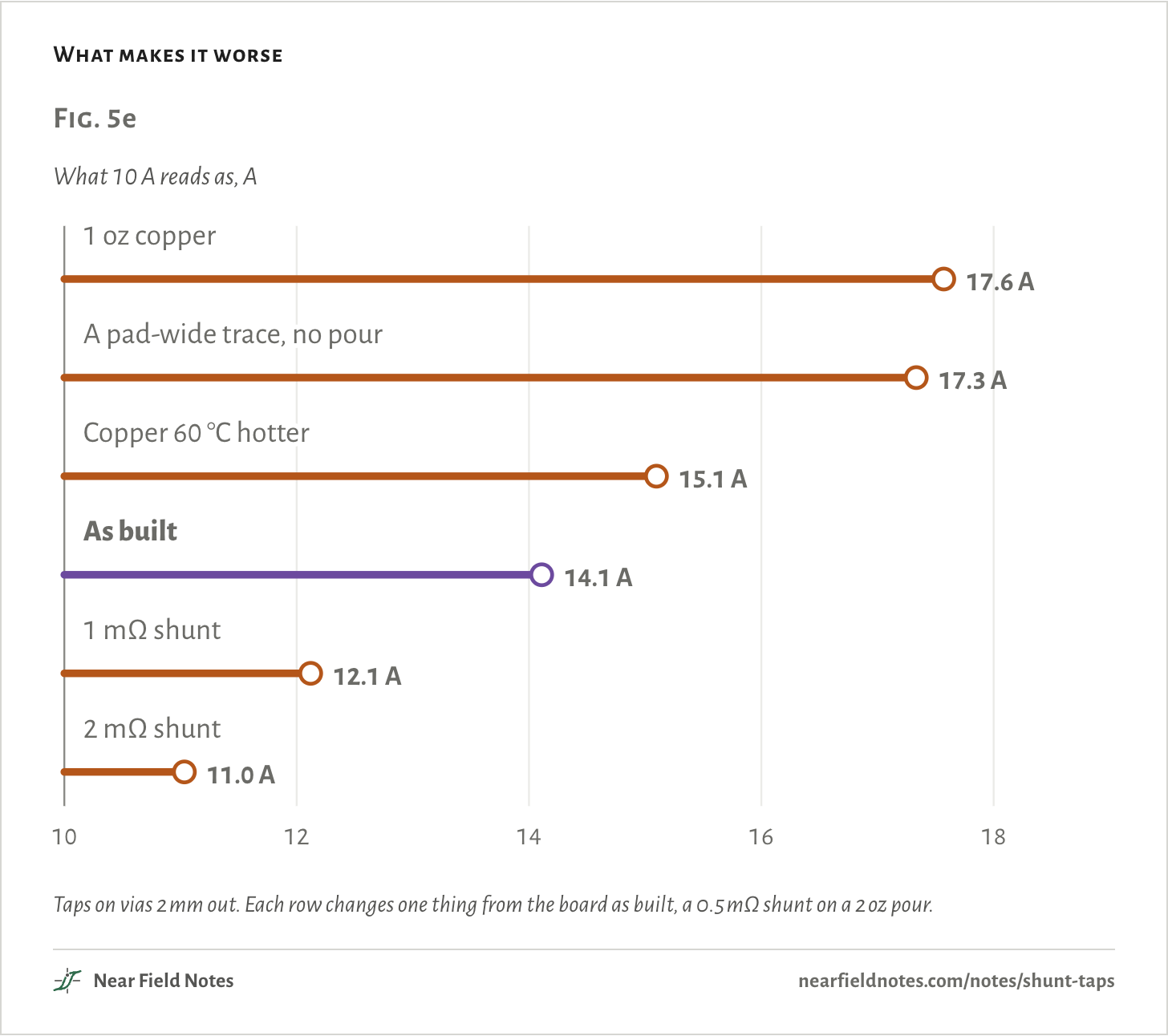
What makes it worse
Fig. 5eWhat 10 A reads as, A10121416181 oz copper17.6 AA pad-wide trace, no pour17.3 ACopper 60 °C hotter15.1 AAs built14.1 A1 mΩ shunt12.1 A2 mΩ shunt11.0 AFig. 5eWhat 10 A reads as, A10121416181 oz copper17.6 AA pad-wide trace, no pour17.3 ACopper 60 °C hotter15.1 AAs built14.1 A1 mΩ shunt12.1 A2 mΩ shunt11.0 AFig. 5eWhat 10 A reads as, A10121416181 oz copper17.6 AA pad-wide trace, no pour17.3 ACopper 60 °C hotter15.1 AAs built14.1 A1 mΩ shunt12.1 A2 mΩ shunt11.0 A

Taps on vias 2 mm out. Each row changes one thing from the board as built, a 0.5 mΩ shunt on a 2 oz pour.

124
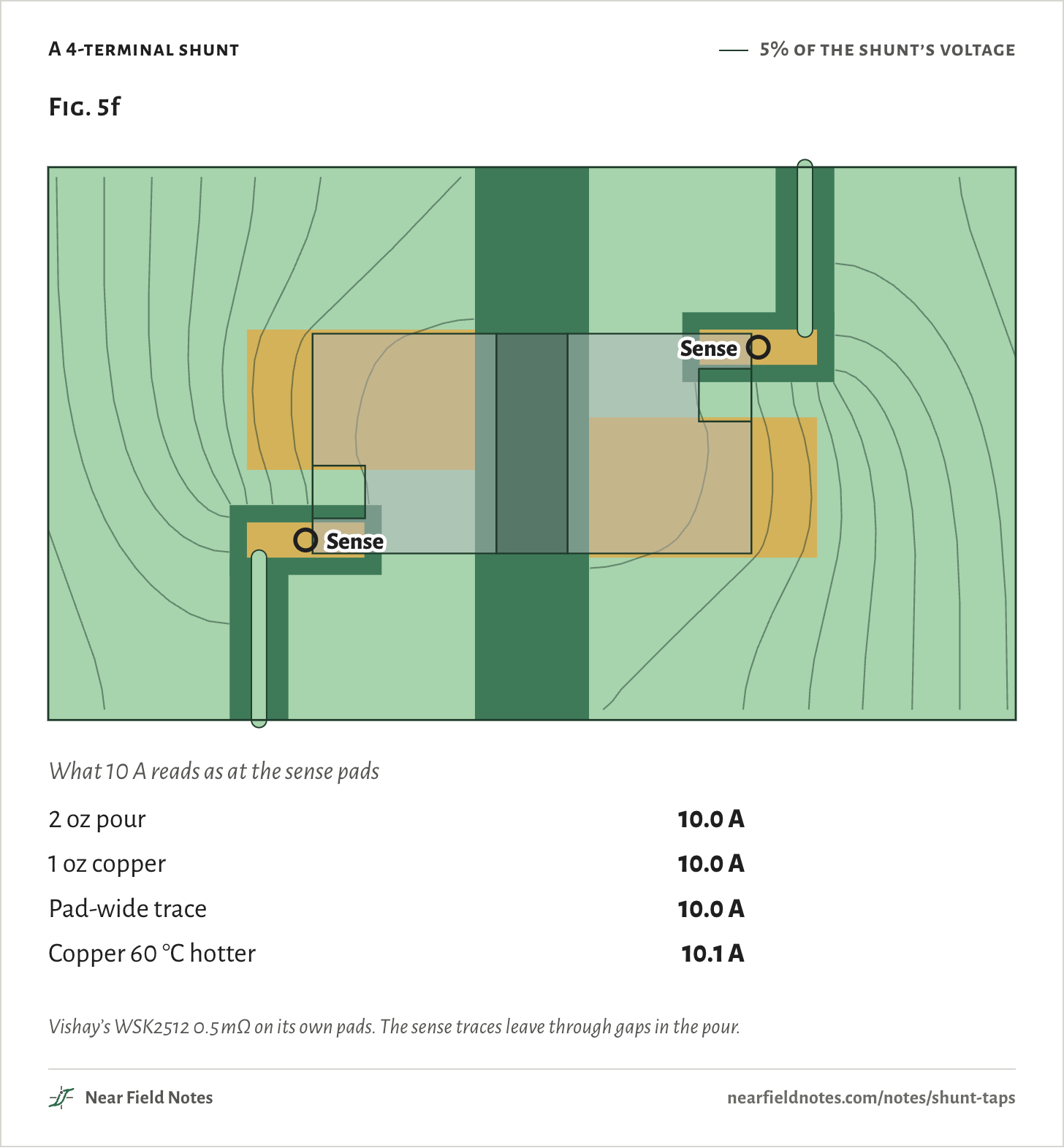
A 4-terminal shunt
  • 5% of the shunt’s voltage
Fig. 5fSenseSenseWhat 10 A reads as at the sense pads2 oz pour10.0 A1 oz copper10.0 APad-wide trace10.0 ACopper 60 °C hotter10.1 AFig. 5fSenseSenseWhat 10 A reads as at the sense pads2 oz pour10.0 A1 oz copper10.0 APad-wide trace10.0 ACopper 60 °C hotter10.1 AFig. 5fSenseSenseWhat 10 A reads as at the sense pads2 oz pour10.0 A1 oz copper10.0 APad-wide trace10.0 ACopper 60 °C hotter10.1 A

Vishay’s WSK2512 0.5 mΩ on its own pads. The sense traces leave through gaps in the pour.

126

Conditions

Part
Vishay WSLF2512L5000FEA, 0.5 mΩ: a manganese-copper element between copper terminals, 6.35 by 3.05 mm. 1 and 2 mΩ parts for comparison.
Pads
KiCad’s R_2512_6332Metric, moteus-x1’s footprint: 1.23 by 3.35 mm, 4.7 mm apart
Copper
2 oz, poured up to the pads’ inner edges, with 75 µm of solder under the terminals and a fillet on their ends
Taps
Top-layer traces at the middle of the inner edges, and 0.2 mm vias from the outer edges out. The explorer’s stops across the pads are points on the pad.
Reading
The voltage between the taps over the current, against the part’s own value
Element
31 µΩ·cm, set so the part reads 0.5 mΩ at the middle of the inner edges on Vishay’s pads. That’s normal for manganese-copper.
Solver
A 3D finite-volume DC solver, 149,000 cells and about a second a case
Check
Halving the mesh moves the readings by 0.1% or less

Simulated only. Nothing on this page has been measured on a board yet.

Limits

  • This is the part and the pads moteus-x1 uses, not its copper. On the board the pour wraps under the part, stitched by vias.
  • DC only. The shunt’s inductance and the amplifier aren’t in the model.
  • The element’s alloy is taken as fixed with temperature. In the 60 °C case only the copper and the solder warm up.

Files

  • shuntsim/fv.pyThe DC solver
  • shuntsim/geom.pyThe parts, their pads and the copper
  • shuntsim/run.pyEvery reading on this page

Sources

Like this note?

Rev 1 ·
  1. Rev 1First published

Each fix gets a line here, with the reader's name if they want credit.

Did it answer your question?

Want more on this?

Report a problem

What should the next note be? Ask for one