Near Field Notes

Note 13PowerRev 1Watch the video · 2:39

Capacitors

Which kind of capacitor should feed a load?

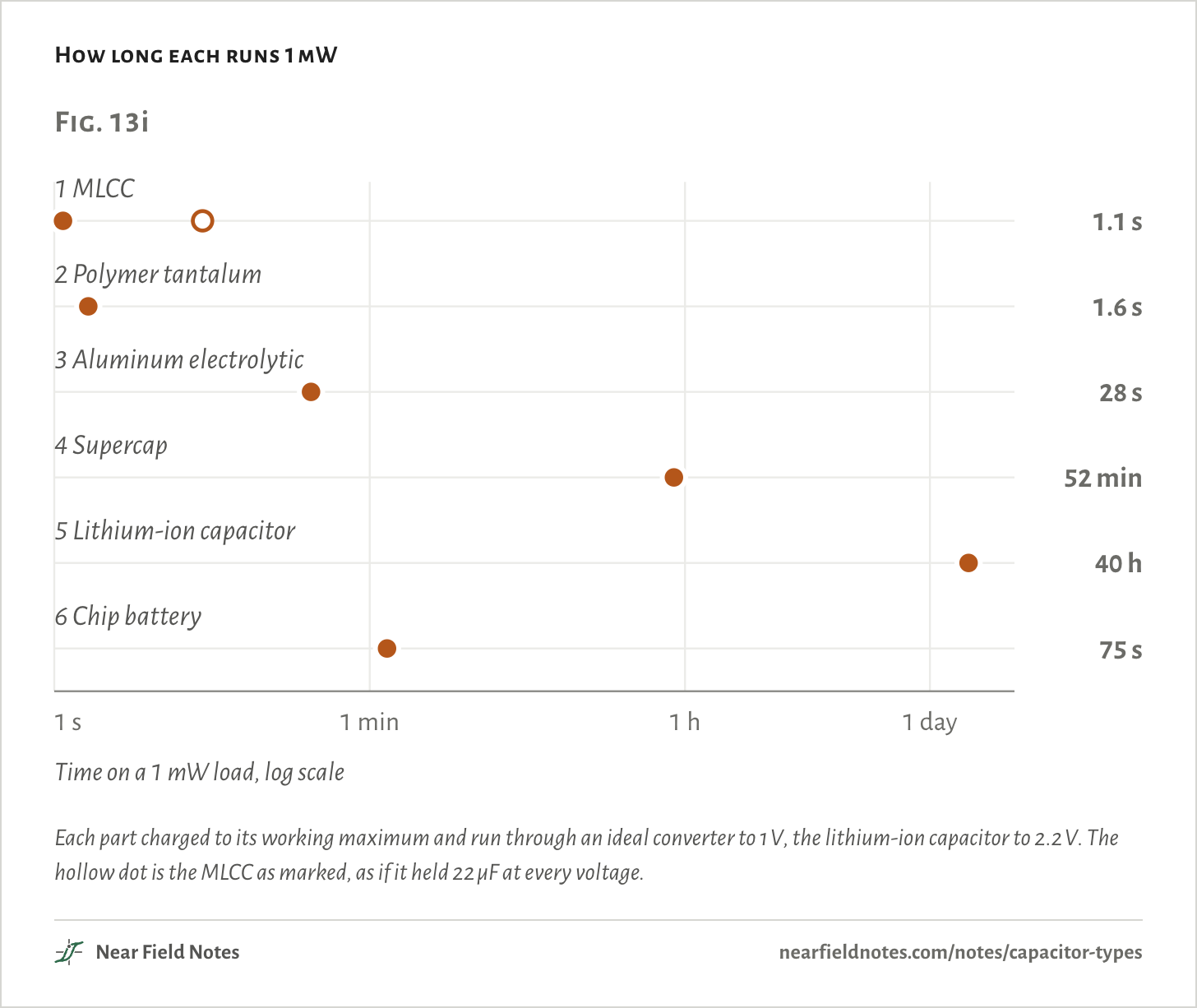
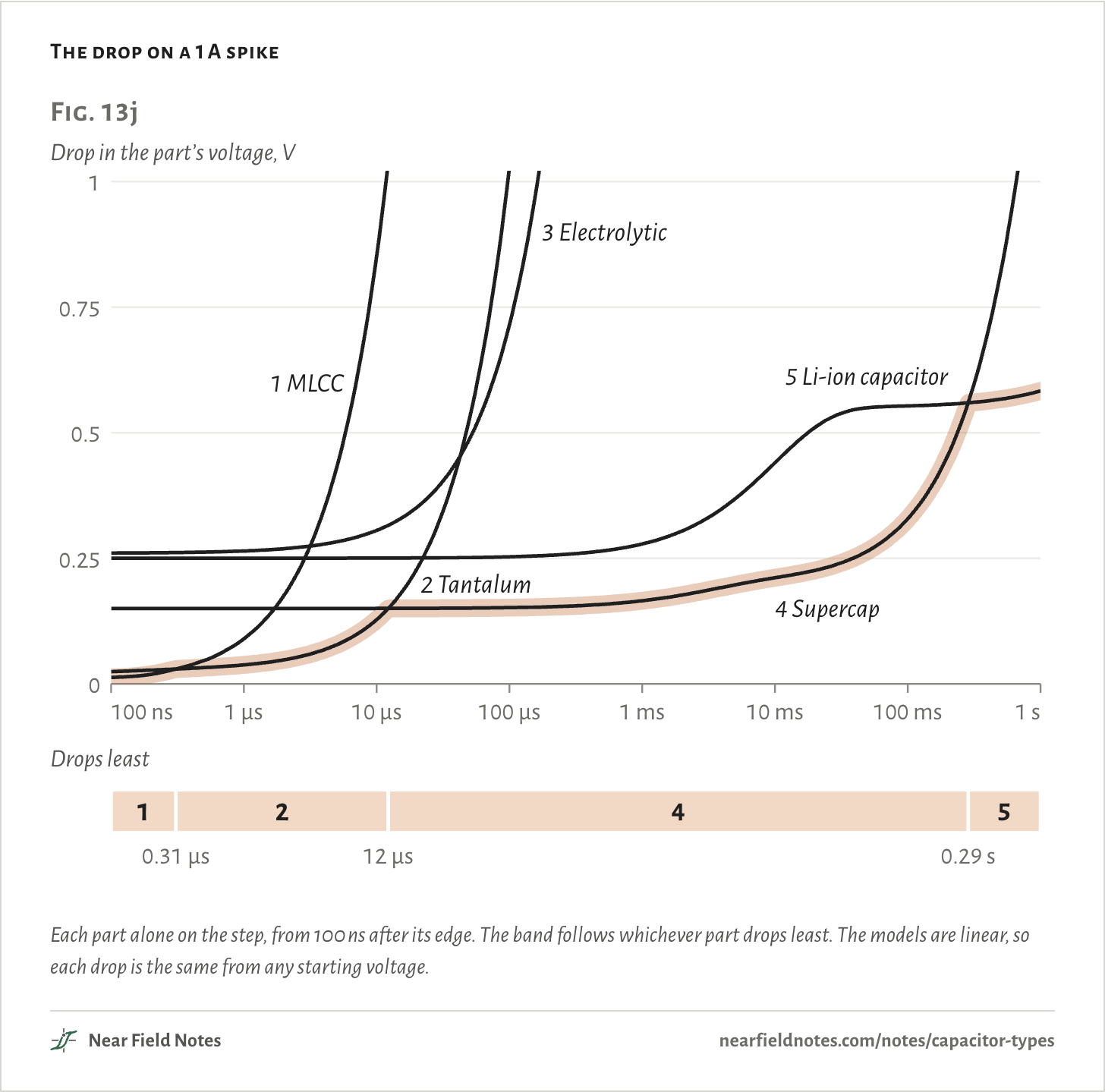
The one whose time scale matches the load’s. On the same 1 A spike, a ceramic MLCC drops least for the first 0.31 µs, a polymer tantalum until 12 µs, a supercap until 0.29 s, and a lithium-ion capacitor after that. On the same 1 mW load, six kinds last from 1.1 s to 40 h.

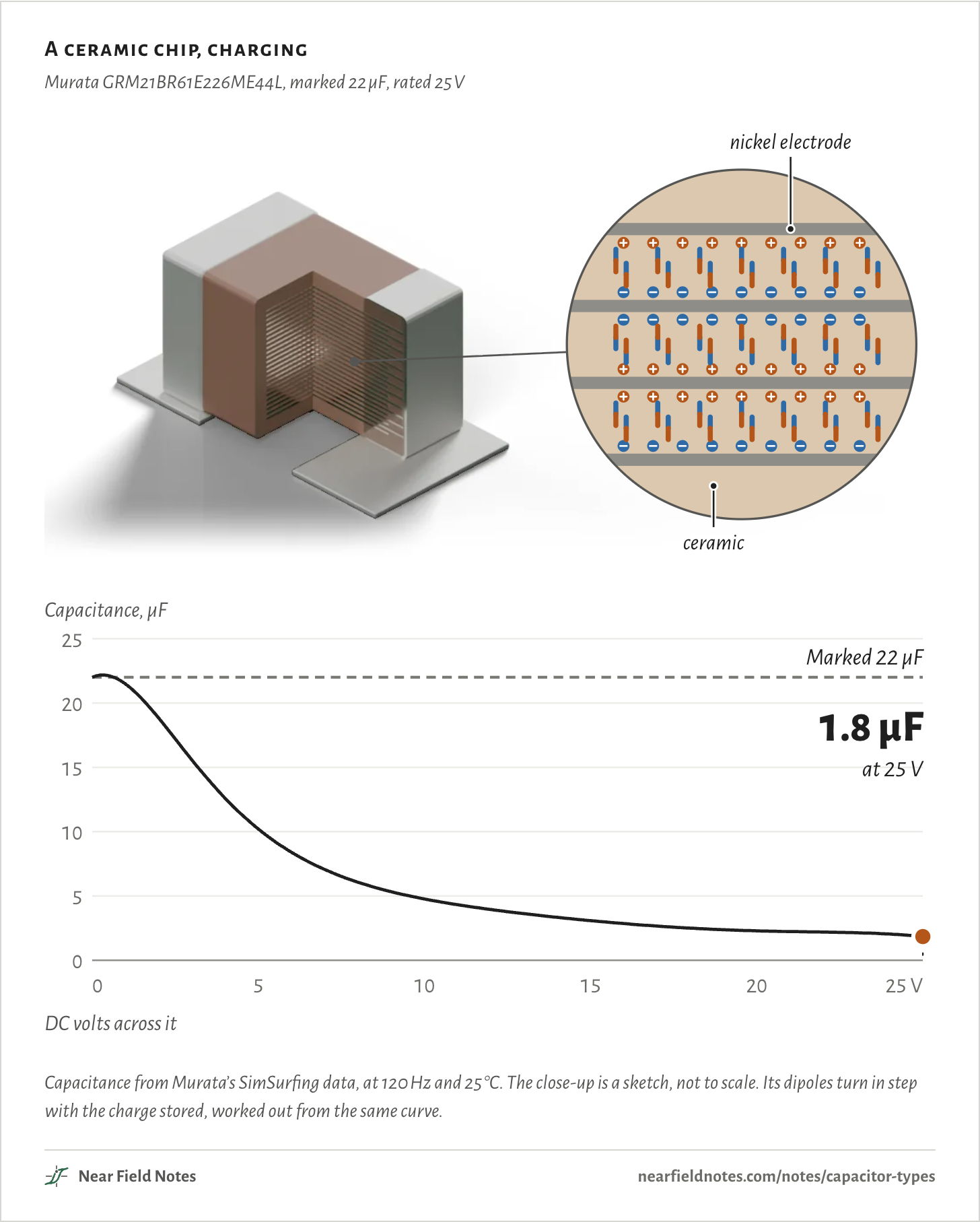
Each kind has a catch as well. The figure charges a 22 µF MLCC up to its rated 25 V, along Murata’s own curve. By 25 V it holds 1.8 µF.

In the close-up, the ceramic’s dipoles turn to line up as it charges. Once most have turned, each extra volt stores less.

A ceramic chip, charging

Murata GRM21BR61E226ME44L, marked 22 µF, rated 25 V

nickel electrodeceramicCapacitance, µF010200510152025 VDC volts across itMarked 22 µF1.8 µFat 25 Vnickel electrodeceramicCapacitance, µF05101520250510152025 VDC volts across itMarked 22 µF1.8 µFat 25 Vnickel electrodeceramicCapacitance, µF05101520250510152025 VDC volts across itMarked 22 µF1.8 µFat 25 V

Capacitance from Murata’s SimSurfing data, at 120 Hz and 25 °C. The close-up is a sketch, not to scale. Its dipoles turn in step with the charge stored, worked out from the same curve.

Six ways to store charge

Cut open, at true size

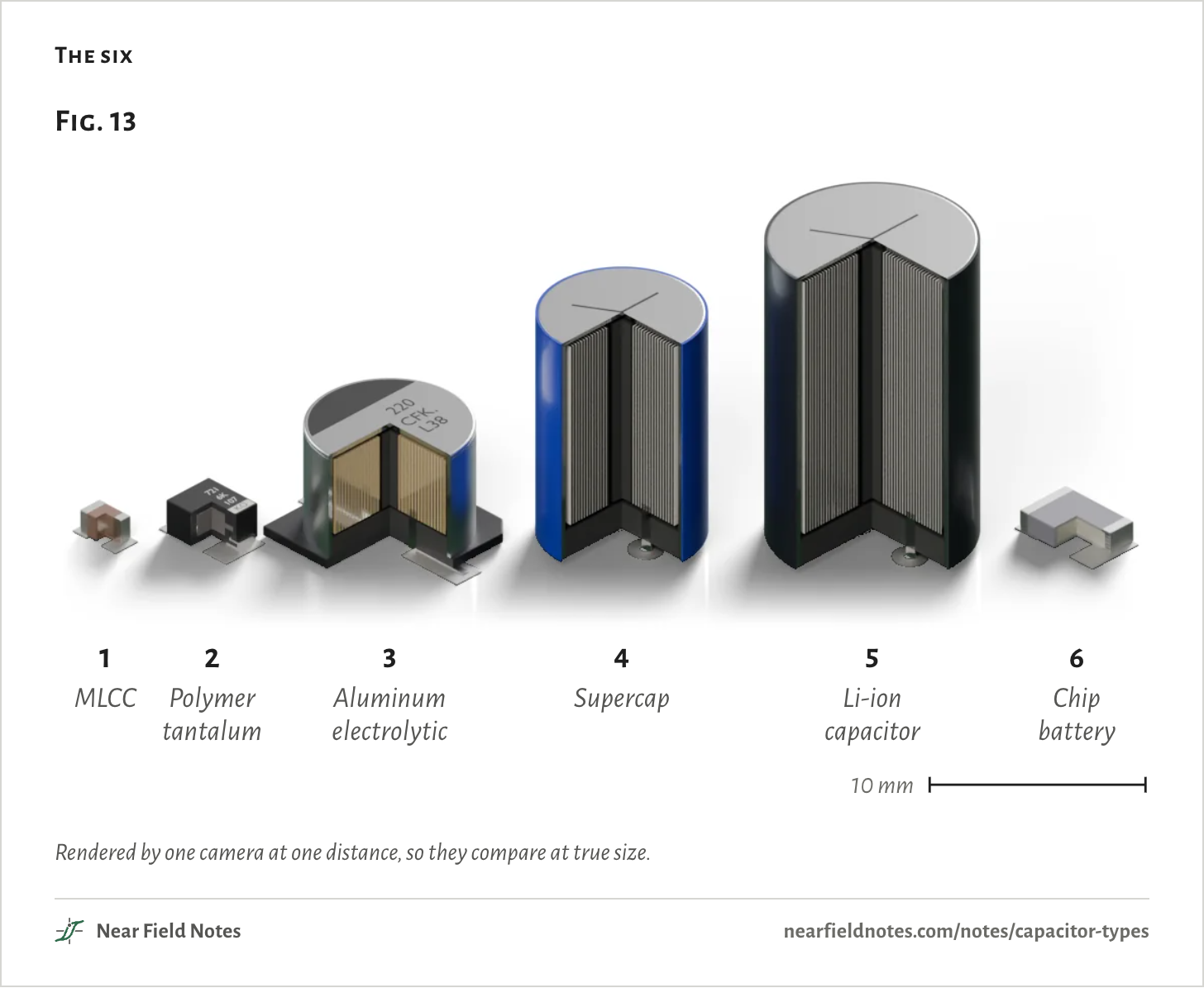
Six common parts store charge on a board. Three are capacitors, with a thin insulator between two conductors. They are the ceramic MLCC, the polymer tantalum and the aluminum electrolytic. The supercap packs ions against carbon. The lithium-ion capacitor is half supercap, half battery, and the chip battery is a battery built like an MLCC.

These are real parts of each. Their outsides follow the datasheets. Makers don’t publish the insides, so those are drawn from their construction drawings, with far fewer and thicker layers than the real parts have.

The six
Fig. 131234561 MLCC2 Polymer tantalum3 Aluminum electrolytic4 Supercap5 Lithium-ion capacitor6 Chip battery10 mmFig. 131234561 MLCC2 Polymer tantalum3 Aluminum electrolytic4 Supercap5 Lithium-ion capacitor6 Chip battery10 mmFig. 131MLCC2Polymertantalum3Aluminumelectrolytic4Supercap5Li-ioncapacitor6Chipbattery10 mm

Rendered by one camera at one distance, so they compare at true size.

The two tests

Energy, then speed

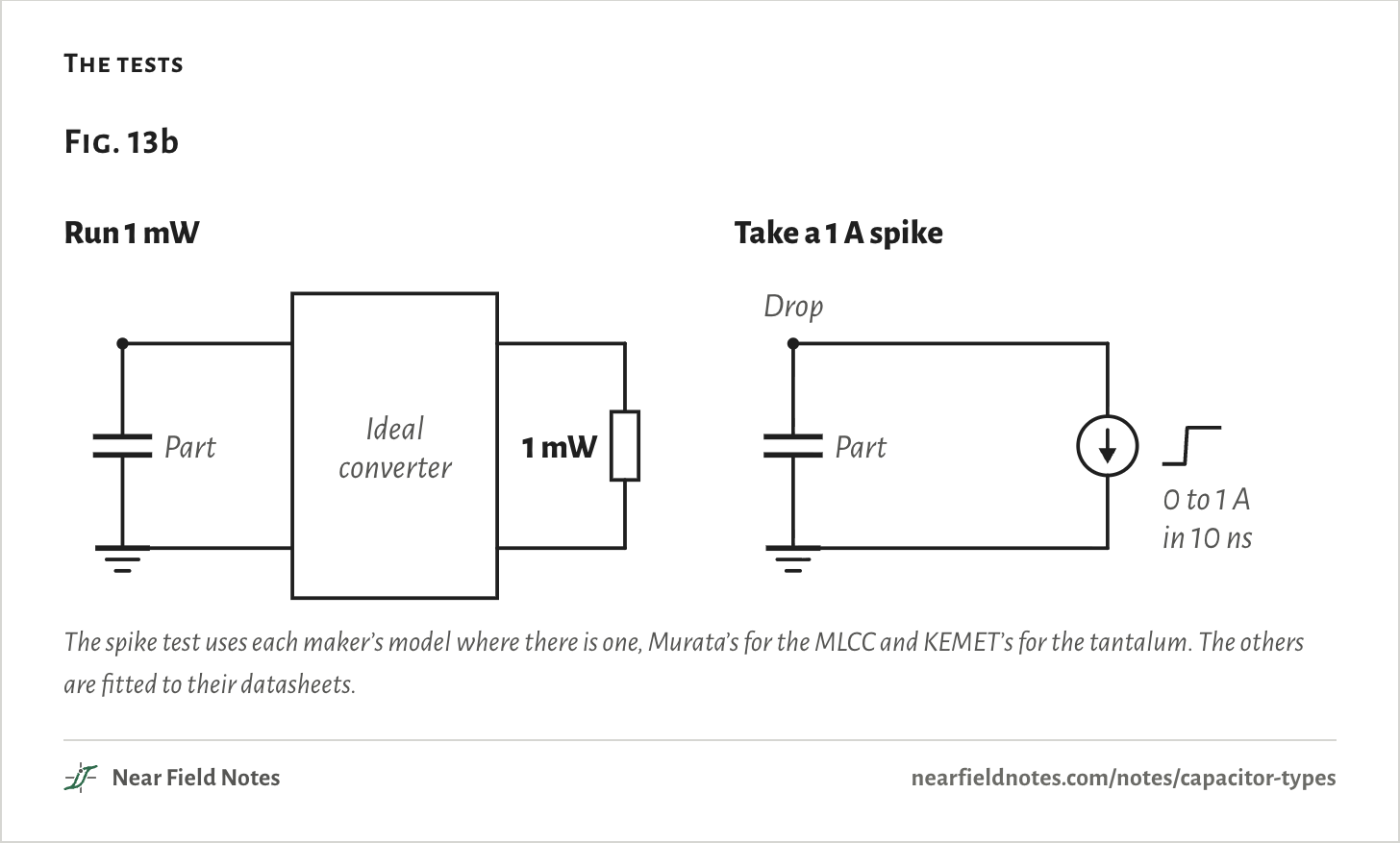
Each part takes the same two simulated tests. In the first, an ideal converter draws a steady 1 mW from it, from fully charged down to 1 V, or to 2.2 V for the lithium-ion capacitor, its floor. That asks how much energy it holds.

In the second, its load steps from nothing to 1 A in 10 ns, and its voltage is followed from 100 ns to 1 s after. That asks how fast it gives its charge up. The chip battery sits this one out. TDK rates it for 5 mA at most.

The tests
Fig. 13bRun 1 mWIdealconverter1 mWPartTake a 1 A spikeDrop0 to 1 Ain 10 nsPartFig. 13bRun 1 mWIdealconverter1 mWPartTake a 1 A spikeDrop0 to 1 Ain 10 nsPartFig. 13bRun 1 mWIdealconverter1 mWPartTake a 1 A spikeDrop0 to 1 Ain 10 nsPart

The spike test uses each maker’s model where there is one, Murata’s for the MLCC and KEMET’s for the tantalum. The others are fitted to their datasheets.

MLCC

Murata GRM21BR61E226ME44L

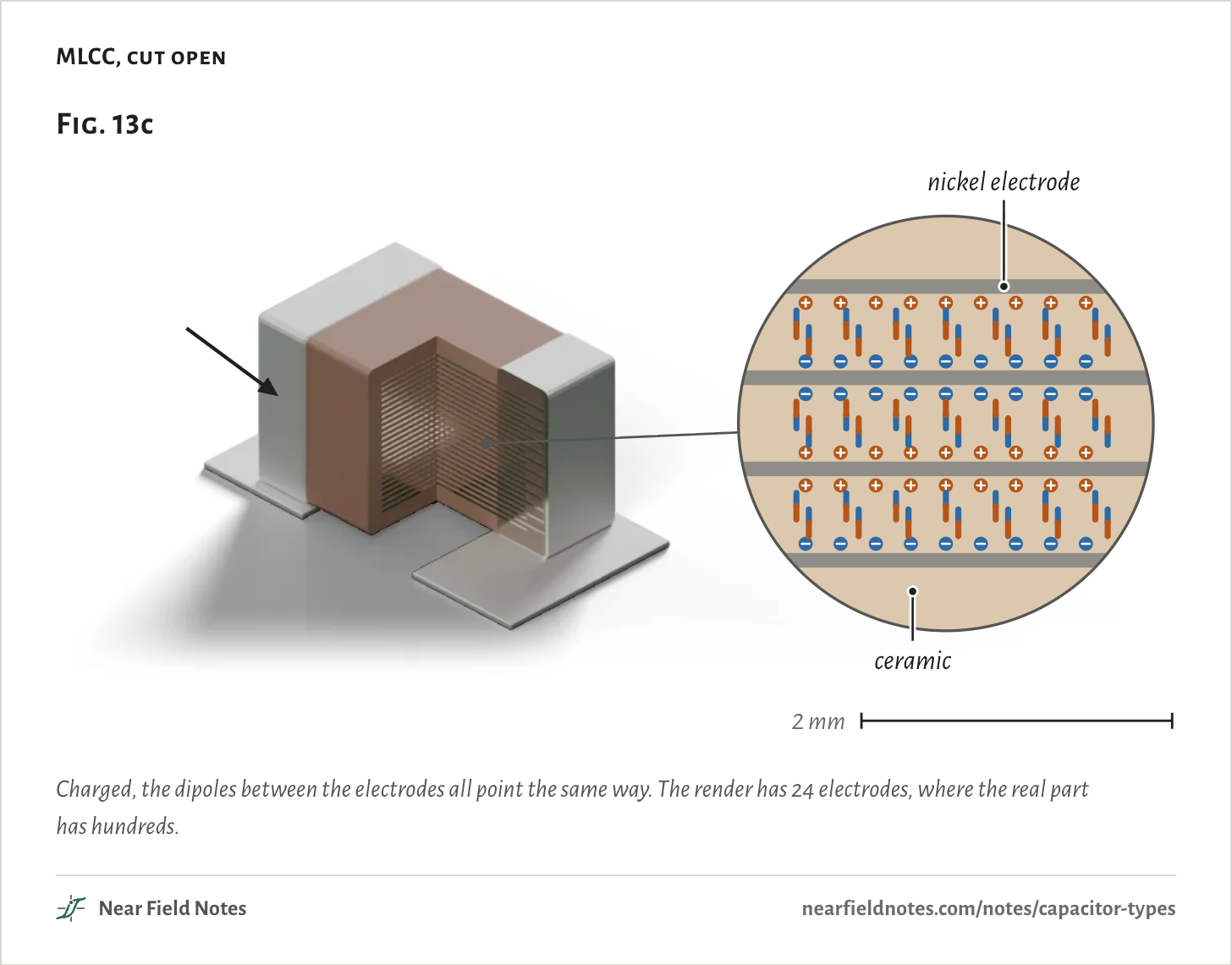
A multilayer ceramic capacitor stacks hundreds of thin nickel electrodes in ceramic, joined to each end in turn. Charge sits on the electrodes, and the ceramic between them stores more by turning its dipoles to line up with the field.

MLCC, cut open
Fig. 13cnickel electrodeceramic2 mmFig. 13cnickel electrodeceramic2 mmFig. 13cnickel electrodeceramic2 mm

Charged, the dipoles between the electrodes all point the same way. The render has 24 electrodes, where the real part has hundreds.

278

Polymer tantalum

KEMET T520B107M006ATE040

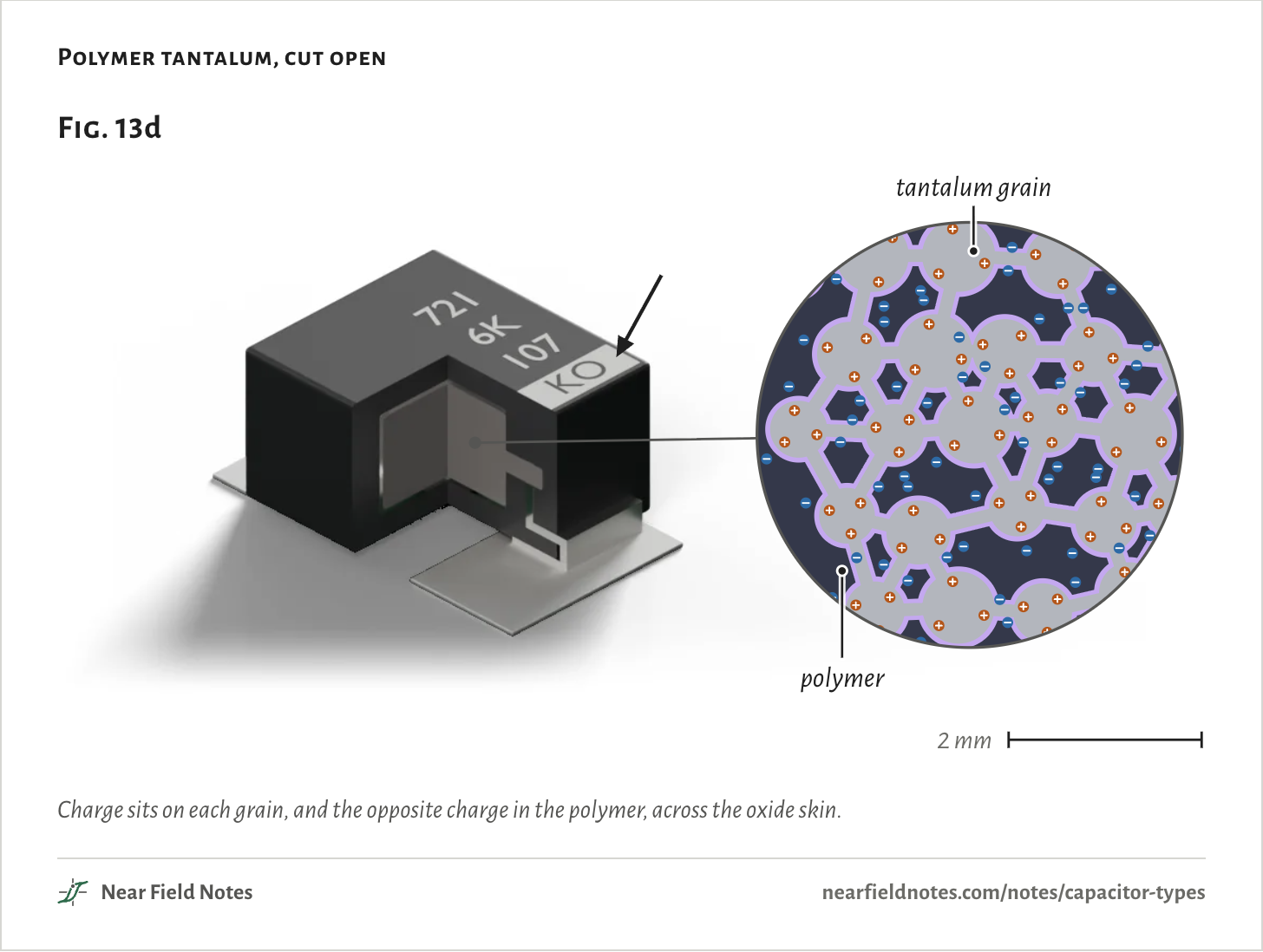
A polymer tantalum starts as a pellet of tantalum grains fused into a sponge. An oxide grown on every grain is its insulator, and a conducting polymer fills the pores as the other side. The sponge’s huge surface gives it its capacitance.

Polymer tantalum, cut open
Fig. 13dtantalum grainpolymer2 mmFig. 13dtantalum grainpolymer2 mmFig. 13dtantalum grainpolymer2 mm

Charge sits on each grain, and the opposite charge in the polymer, across the oxide skin.

280

Aluminum electrolytic

Panasonic EEE-FK1C221P

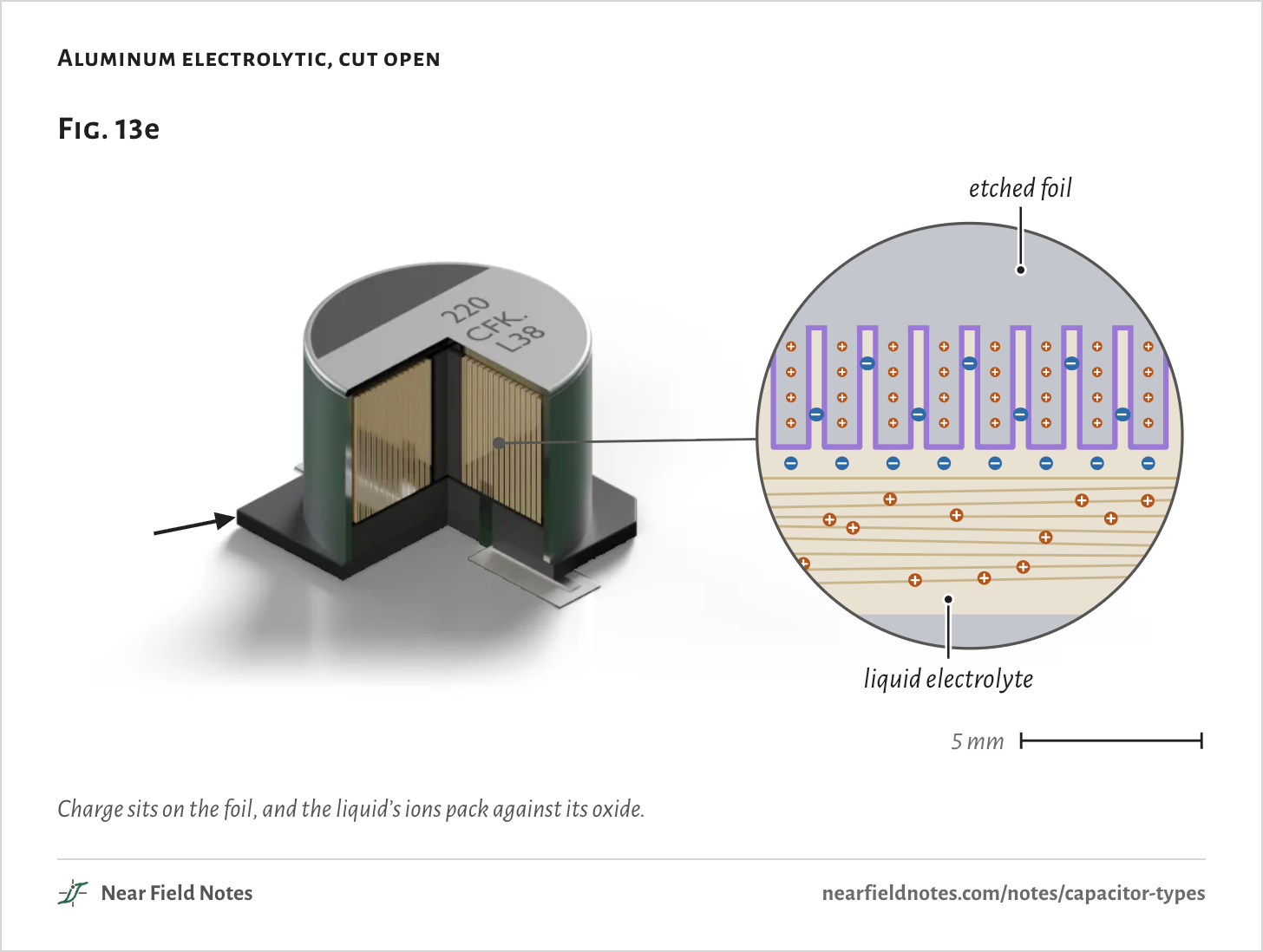
An aluminum electrolytic rolls up a strip of etched aluminum foil with paper soaked in a liquid. An oxide grown on the foil is its insulator, and the liquid reaches into every etched tunnel to carry charge right up to it.

Aluminum electrolytic, cut open
Fig. 13eetched foilliquid electrolyte5 mmFig. 13eetched foilliquid electrolyte5 mmFig. 13eetched foilliquid electrolyte5 mm

Charge sits on the foil, and the liquid’s ions pack against its oxide.

282

Supercap

KYOCERA AVX SCCR12B105SRB

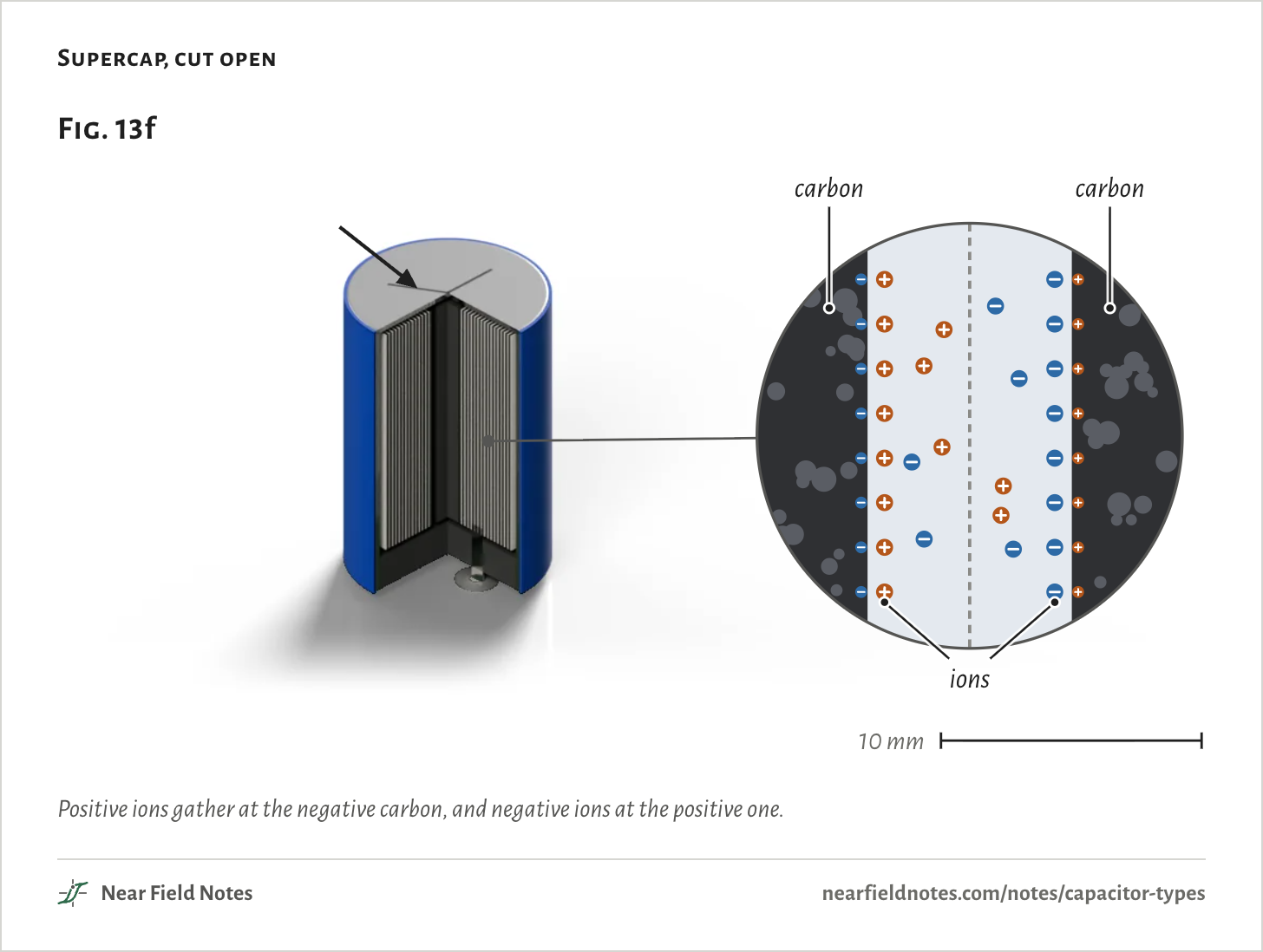
A supercap stores charge without an insulating layer. Two sheets of porous carbon sit in a liquid full of ions. Charged, the ions pack against the carbon’s surface, an area so large that a small can holds a whole farad.

Supercap, cut open
Fig. 13fcarboncarbonions10 mmFig. 13fcarboncarbonions10 mmFig. 13fcarboncarbonions10 mm

Positive ions gather at the negative carbon, and negative ions at the positive one.

284

Lithium-ion capacitor

Eaton HS1016-3R8306-R

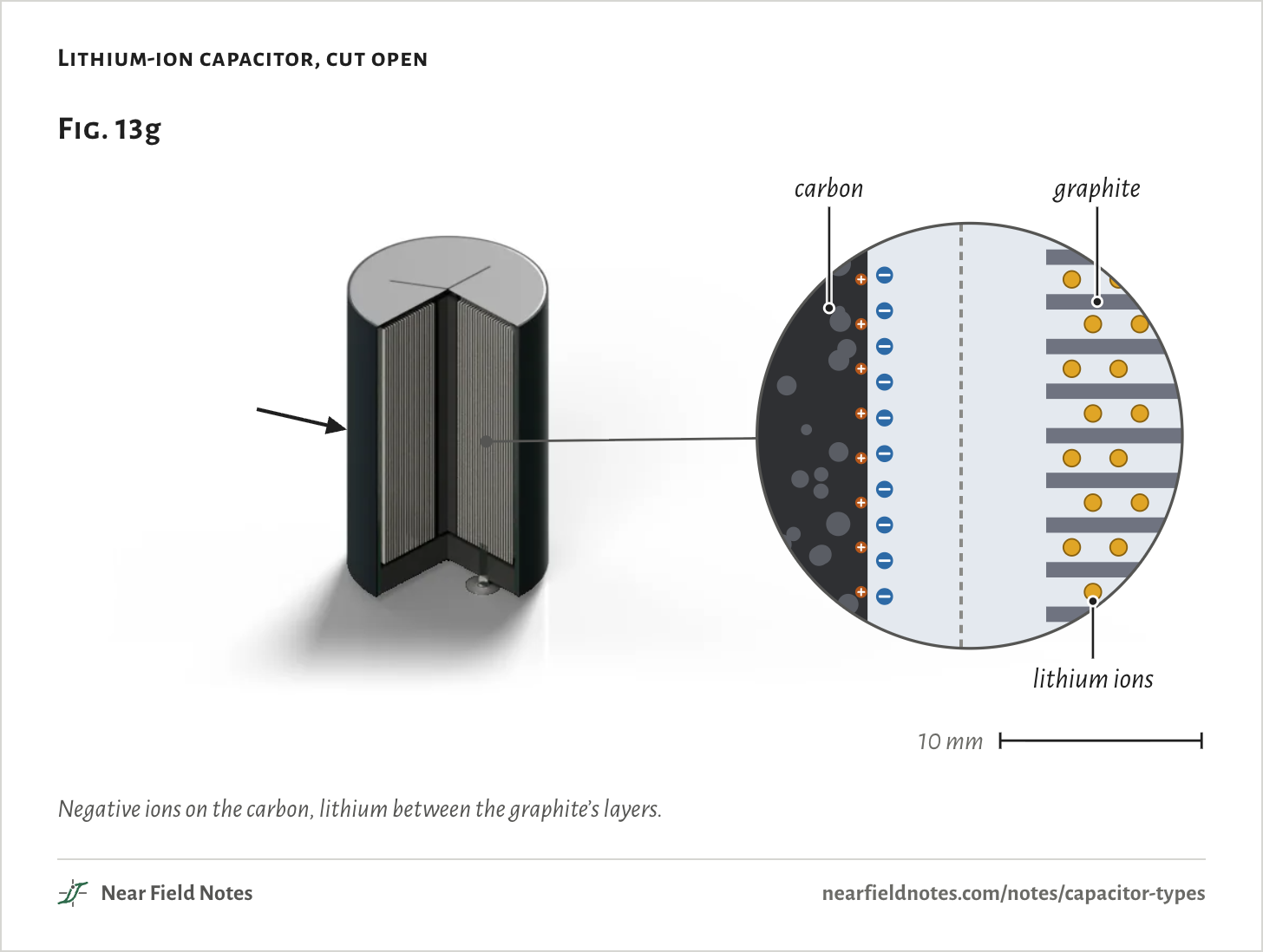
A lithium-ion capacitor is half supercap, half battery. Its positive side is carbon, holding ions on its surface like a supercap’s. Its negative side is graphite, with lithium slid in between its layers like a battery’s.

Lithium-ion capacitor, cut open
Fig. 13gcarbongraphitelithium ions10 mmFig. 13gcarbongraphitelithium ions10 mmFig. 13gcarbongraphitelithium ions10 mm

Negative ions on the carbon, lithium between the graphite’s layers.

286

Chip battery

TDK CeraCharge BCT1812M101AG

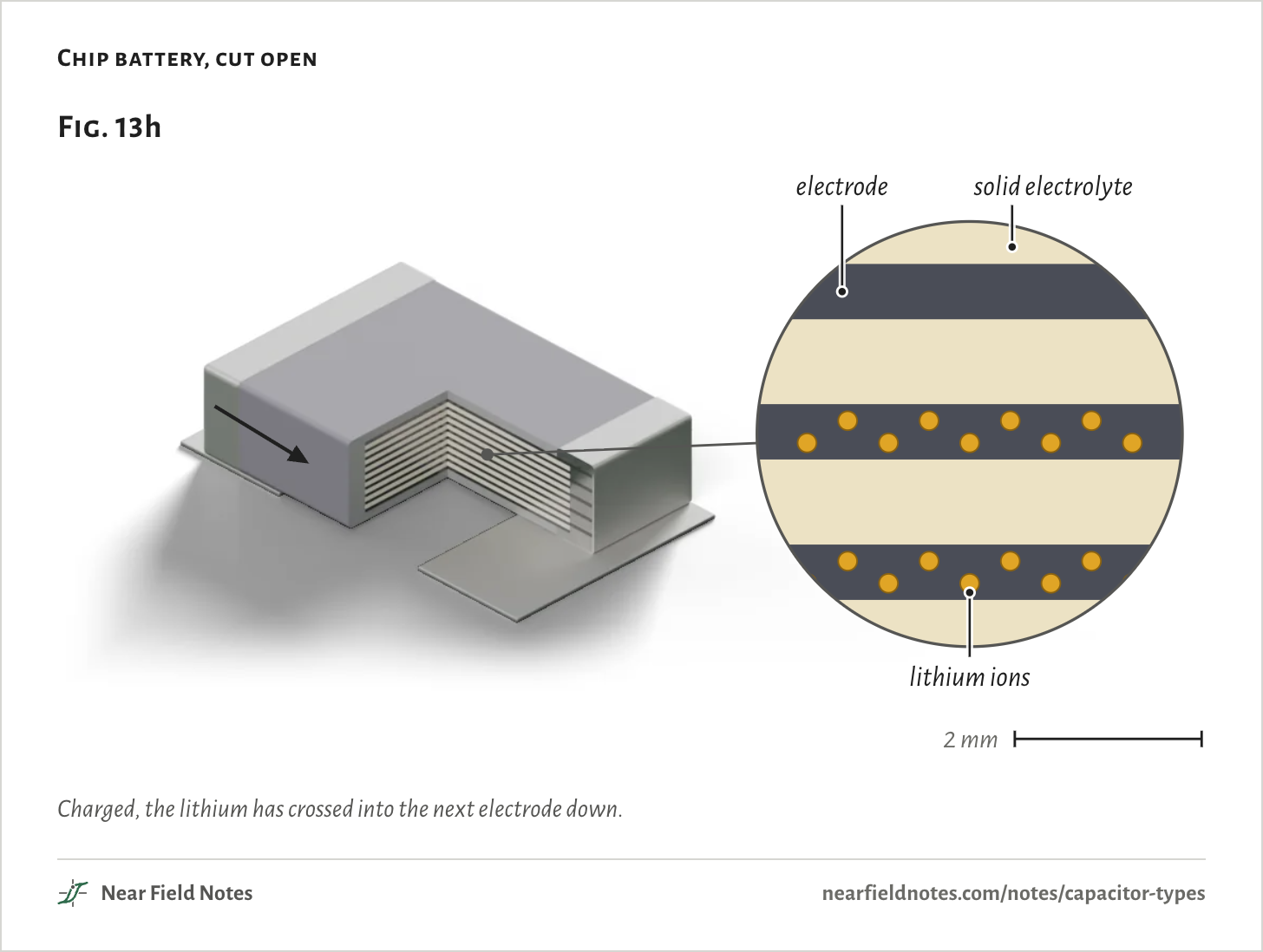
The chip battery is a rechargeable lithium battery built like an MLCC. Thin electrode layers alternate with a solid ceramic electrolyte, and lithium ions cross the ceramic from one electrode to the next as it charges.

Chip battery, cut open
Fig. 13helectrodesolid electrolytelithium ions2 mmFig. 13helectrodesolid electrolytelithium ions2 mmFig. 13helectrodesolid electrolytelithium ions2 mm

Charged, the lithium has crossed into the next electrode down.

288

Running 1 mW

The energy each holds

How long a capacitor runs a steady load comes from the energy it gives up between its starting voltage and its floor:

t=C(V02−Vf2)2P

=1.6 sfor the tantalum,40 hfor the lithium-ion capacitor

The voltage counts twice. Charged to 16 V, the electrolytic outlasts the tantalum 18 times over, with about twice its capacitance.

The MLCC breaks the formula. At its marked 22 µF it would last 6.9 s, but its capacitance falls as its voltage rises, and it lasts 1.1 s.

The supercap and the lithium-ion capacitor run for 52 min and 40 h. The chip battery holds more than any of the first three, but at this load its resistance cuts it off early.

How long each runs 1 mW
Fig. 13i1 s1 min1 h1 day1 MLCC1.1 s2 Polymer tantalum1.6 s3 Aluminum electrolytic28 s4 Supercap52 min5 Lithium-ion capacitor40 h6 Chip battery75 sTime on a 1 mW load, log scaleFig. 13i1 s1 min1 h1 day1 MLCC1.1 s2 Polymer tantalum1.6 s3 Aluminum electrolytic28 s4 Supercap52 min5 Lithium-ion capacitor40 h6 Chip battery75 sTime on a 1 mW load, log scaleFig. 13i1 s1 min1 h1 day1 MLCC1.1 s2 Polymer tantalum1.6 s3 Aluminum electrolytic28 s4 Supercap52 min5 Lithium-ion capacitor40 h6 Chip battery75 sTime on a 1 mW load, log scale

Each part charged to its working maximum and run through an ideal converter to 1 V, the lithium-ion capacitor to 2.2 V. The hollow dot is the MLCC as marked, as if it held 22 µF at every voltage.

A 1 A spike

How fast each gives charge up

On a sudden step, two things pull a part’s voltage down. Its resistance takes a share at once, and the charge it gives up takes more the longer the step goes on:

ΔV=IR+ItC

≈3 mV + 78 mV per µsfor the MLCC,150 mV + 1 mV per msfor the supercap

A small capacitor with almost no resistance drops least at first, then runs short of charge. A big one drops more at once, then barely moves.

The lowest drop passes from part to part. The MLCC holds it until 0.31 µs, the tantalum until 12 µs, the supercap until 0.29 s, and the lithium-ion capacitor after that. The electrolytic is never lowest. Its 0.26 Ω drops more at once than the supercap, and its charge runs out first.

The drop on a 1 A spike
Fig. 13jDrop in the part’s voltage, V00.250.50.751100 ns10 µs1 ms1 s12345Drops least12450.31 µs12 µs0.29 s1 MLCC2 Polymer tantalum3 Aluminum electrolytic4 Supercap5 Lithium-ion capacitorFig. 13jDrop in the part’s voltage, V00.250.50.751100 ns1 µs10 µs100 µs1 ms10 ms100 ms1 s1 MLCC2 Tantalum3 Electrolytic4 Supercap5 Li-ion capacitorDrops least12450.31 µs12 µs0.29 sFig. 13jDrop in the part’s voltage, V00.250.50.751100 ns1 µs10 µs100 µs1 ms10 ms100 ms1 s1 MLCC2 Tantalum3 Electrolytic4 Supercap5 Li-ion capacitorDrops least12450.31 µs12 µs0.29 s

Each part alone on the step, from 100 ns after its edge. The band follows whichever part drops least. The models are linear, so each drop is the same from any starting voltage.

Side by side

The six in numbers
The six
KindPartRatingSize, mmRuns 1 mWResistanceLeakagePrice
1 MLCCMurata GRM21BR61E226ME44L22 µF 25 V2.0 × 1.25 × 1.251.1 s2.5 mΩ typ11 µA max$0.36
2 Polymer tantalumKEMET T520B107M006ATE040100 µF 6.3 V3.5 × 2.8 × 1.91.6 s40 mΩ max63 µA max$1.07
3 Aluminum electrolyticPanasonic EEE-FK1C221P220 µF 16 VØ8 × 6.228 s0.26 Ω max35 µA max$0.88
4 SupercapKYOCERA AVX SCCR12B105SRB1 F 2.7 VØ8 × 1252 min0.2 Ω6 µA max$1.76
5 Lithium-ion capacitorEaton HS1016-3R8306-R30 F 3.8 VØ10 × 1640 h0.55 Ω max3 µA max$4.14
6 Chip batteryTDK CeraCharge BCT1812M101AG100 µAh 1.5 V4.4 × 3.0 × 1.175 sunder 200 Ω0.1 µA$10.88

Resistance and leakage as each maker gives them. The MLCC’s resistance is typical, the supercap’s is its DC value over 10 ms, and the MLCC’s leakage follows from its insulation resistance at 25 V. Prices for one part on 3 November 2026, from Digi-Key or Mouser.

Pick by how long the load lasts. An MLCC covers nanoseconds, a polymer tantalum microseconds, a supercap up to a fraction of a second, and a lithium-ion capacitor anything longer. The electrolytic’s place is smoothing at higher voltage, and the chip battery’s is a clock at microamps.

Conditions

Parts
Murata GRM21BR61E226ME44L, KEMET T520B107M006ATE040, Panasonic EEE-FK1C221P, KYOCERA AVX SCCR12B105SRB, Eaton HS1016-3R8306-R and TDK CeraCharge BCT1812M101AG
Run test
An ideal converter draws 1.000 mW at the part’s terminals, from its working maximum down to 1 V, or 2.2 V for the lithium-ion capacitor. Each part’s resistance is counted, and so is the leakage of the two that run for minutes or hours, at its datasheet maximum.
MLCC
Its capacitance at each voltage from Murata’s DC-bias curve, at 120 Hz and 0.5 V rms
Chip battery
TDK’s own discharge curves at 0.5 and 1 mA, between which 1 mW falls
Spike test
A 1 A step with a 10 ns edge into each part alone, in ngspice, followed from 100 ns to 1 s
Models
Murata’s SimSurfing netlist for the MLCC at 3.3 V, and KEMET’s K-SIM ladder for the tantalum. The electrolytic is a resistor, inductor and capacitor with its datasheet’s 0.26 Ω. The supercap and the lithium-ion capacitor are fitted to their datasheets’ resistances at 1 kHz and DC.
Renders
Blender, one camera. Outsides from the datasheets, insides estimated from the makers’ construction drawings.

Simulated only. Nothing on this page has been measured on a board yet.

Limits

  • The spike models are linear, so nothing runs out of charge partway. The MLCC is Murata’s netlist for 3.3 V, whose main capacitance is 12.9 µF, less than the 14.6 µF of its 120 Hz curve.
  • Inductance is left out after the edge. It matters only during the 10 ns edge, and there it depends on the layout.
  • The supercap’s and the lithium-ion capacitor’s slower time constants are estimates, fitted to the few resistances their datasheets give.
  • Each part is at its nominal capacitance. The lithium-ion capacitor’s 30 F is its minimum, since its tolerance is 0 to +50%.
  • The close-ups are sketches, and the renders draw far fewer and thicker layers than the real parts.

Files

  • sim/parts.pyThe six parts’ values and spice models
  • sim/tests.pyThe 1 mW run and the 1 A spike
  • render/scene.pyThe renders
  • refs/research.mdEvery datasheet figure and its source

Sources

Like this note?

Rev 1 ·
  1. Rev 1First published

Each fix gets a line here, with the reader's name if they want credit.

Did it answer your question?

Want more on this?

Report a problem

What should the next note be? Ask for one